LeetCode 806: Number of Lines To Write String (Greedy Width Accumulation)
LeetCode 806GreedySimulationToday we solve LeetCode 806 - Number of Lines To Write String.
Source: https://leetcode.com/problems/number-of-lines-to-write-string/
English
Problem Summary
You are given an array widths where widths[i] is the width of character 'a' + i, and a string s. Each line can hold at most 100 units. Write characters in order and wrap when needed. Return [lineCount, lastLineWidth].
Key Insight
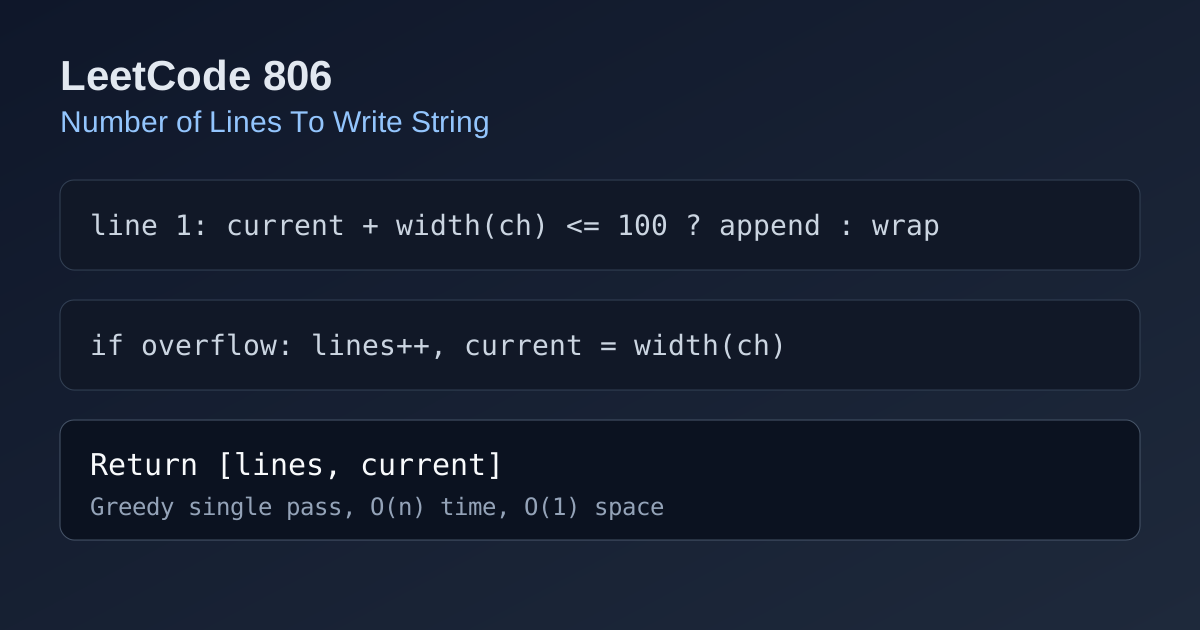
This is a direct greedy simulation. Track current line width. For each character width w:
- if current + w <= 100, stay on this line;
- otherwise start a new line and set current = w.
Algorithm
- Initialize lines = 1, current = 0.
- For each character in s, map to index c - 'a' and get width.
- Apply wrap rule above.
- Return [lines, current].
Complexity Analysis
Time: O(n), where n = s.length.
Space: O(1).
Common Pitfalls
- Starting with lines = 0 can break single-line cases.
- Off-by-one when converting char to index.
- Wrapping on == 100 is wrong; exactly 100 still fits the same line.
Reference Implementations (Java / Go / C++ / Python / JavaScript)
class Solution {
    public int[] numberOfLines(int[] widths, String s) {
        int lines = 1, current = 0;
        for (int i = 0; i < s.length(); i++) {
            int w = widths[s.charAt(i) - 'a'];
            if (current + w <= 100) current += w;
            else {
                lines++;
                current = w;
            }
        }
        return new int[]{lines, current};
    }
}
func numberOfLines(widths []int, s string) []int {
lines, current := 1, 0
for _, ch := range s {
w := widths[ch-'a']
if current+w <= 100 {
current += w
} else {
lines++
current = w
}
}
return []int{lines, current}
}class Solution {
public:
vector<int> numberOfLines(vector<int>& widths, string s) {
int lines = 1, current = 0;
for (char c : s) {
int w = widths[c - 'a'];
if (current + w <= 100) current += w;
else {
lines++;
current = w;
}
}
return {lines, current};
}
};class Solution:
def numberOfLines(self, widths: List[int], s: str) -> List[int]:
lines, current = 1, 0
for ch in s:
w = widths[ord(ch) - ord('a')]
if current + w <= 100:
current += w
else:
lines += 1
current = w
return [lines, current]var numberOfLines = function(widths, s) {
let lines = 1, current = 0;
for (const ch of s) {
const w = widths[ch.charCodeAt(0) - 97];
if (current + w <= 100) current += w;
else {
lines++;
current = w;
}
}
return [lines, current];
};中文
题目概述
给定数组 widths(表示每个小写字母的宽度)和字符串 s。每行最多容纳 100 宽度,按顺序书写字符,放不下就换行。返回 [行数, 最后一行宽度]。
核心思路
直接贪心模拟即可。维护当前行宽 current:
- 若 current + w <= 100,继续写在当前行;
- 否则换到新行,lines++ 且 current = w。
算法步骤
- 初始化 lines = 1、current = 0。
- 遍历字符串中每个字符,查询对应宽度。
- 按是否超过 100 执行累加或换行。
- 最后返回 [lines, current]。
复杂度分析
时间复杂度:O(n)。
空间复杂度:O(1)。
常见陷阱
- 把初始行数写成 0 会导致答案偏小。
- 字符到下标映射容易写错。
- current + w == 100 仍然能放在当前行,不应提前换行。
多语言参考实现(Java / Go / C++ / Python / JavaScript)
class Solution {
    public int[] numberOfLines(int[] widths, String s) {
        int lines = 1, current = 0;
        for (int i = 0; i < s.length(); i++) {
            int w = widths[s.charAt(i) - 'a'];
            if (current + w <= 100) current += w;
            else {
                lines++;
                current = w;
            }
        }
        return new int[]{lines, current};
    }
}
func numberOfLines(widths []int, s string) []int {
lines, current := 1, 0
for _, ch := range s {
w := widths[ch-'a']
if current+w <= 100 {
current += w
} else {
lines++
current = w
}
}
return []int{lines, current}
}class Solution {
public:
vector<int> numberOfLines(vector<int>& widths, string s) {
int lines = 1, current = 0;
for (char c : s) {
int w = widths[c - 'a'];
if (current + w <= 100) current += w;
else {
lines++;
current = w;
}
}
return {lines, current};
}
};class Solution:
def numberOfLines(self, widths: List[int], s: str) -> List[int]:
lines, current = 1, 0
for ch in s:
w = widths[ord(ch) - ord('a')]
if current + w <= 100:
current += w
else:
lines += 1
current = w
return [lines, current]var numberOfLines = function(widths, s) {
let lines = 1, current = 0;
for (const ch of s) {
const w = widths[ch.charCodeAt(0) - 97];
if (current + w <= 100) current += w;
else {
lines++;
current = w;
}
}
return [lines, current];
};
Comments