LeetCode 747: Largest Number At Least Twice of Others (Track Top-2 Maxima)
LeetCode 747ArrayGreedyToday we solve LeetCode 747 - Largest Number At Least Twice of Others.
Source: https://leetcode.com/problems/largest-number-at-least-twice-of-others/
English
Problem Summary
Given an integer array nums, return the index of the largest element if it is at least twice as large as every other number; otherwise return -1.
Key Insight
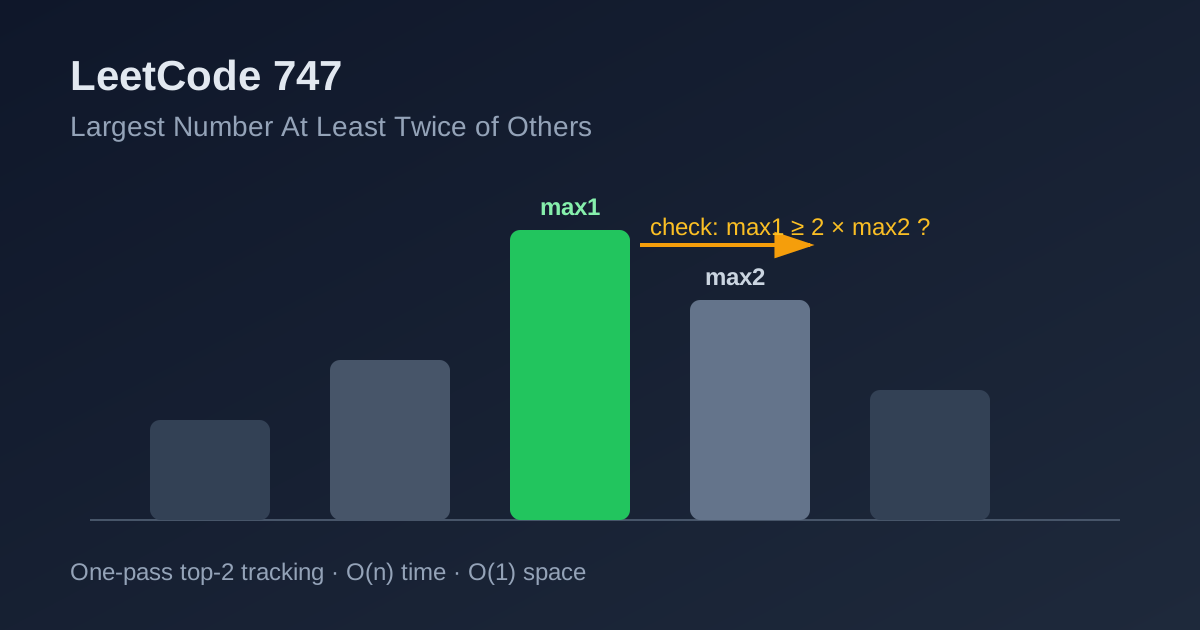
The condition only depends on the largest and the second largest values. If max1 >= 2 * max2, then max1 is at least twice every other element.
Algorithm
- One pass to track max1, max2, and idx1.
- Update both maxima when a new largest appears; otherwise maybe update second largest.
- After scan: return idx1 if max1 >= 2 * max2, else -1.
Complexity Analysis
Let n be array length.
Time: O(n).
Space: O(1).
Common Pitfalls
- Sorting first (works but unnecessary O(n log n)).
- Forgetting to keep index of the largest element.
- Not handling tiny arrays like size 1 (the only element is valid).
Reference Implementations (Java / Go / C++ / Python / JavaScript)
class Solution {
    public int dominantIndex(int[] nums) {
        int max1 = -1, max2 = -1, idx1 = -1;
        for (int i = 0; i < nums.length; i++) {
            int x = nums[i];
            if (x > max1) {
                max2 = max1;
                max1 = x;
                idx1 = i;
            } else if (x > max2) {
                max2 = x;
            }
        }
        return max1 >= 2 * max2 ? idx1 : -1;
    }
}
func dominantIndex(nums []int) int {
max1, max2, idx1 := -1, -1, -1
for i, x := range nums {
if x > max1 {
max2 = max1
max1 = x
idx1 = i
} else if x > max2 {
max2 = x
}
}
if max1 >= 2*max2 {
return idx1
}
return -1
}class Solution {
public:
int dominantIndex(vector<int>& nums) {
int max1 = -1, max2 = -1, idx1 = -1;
for (int i = 0; i < (int)nums.size(); i++) {
int x = nums[i];
if (x > max1) {
max2 = max1;
max1 = x;
idx1 = i;
} else if (x > max2) {
max2 = x;
}
}
return (max1 >= 2 * max2) ? idx1 : -1;
}
};class Solution:
def dominantIndex(self, nums: List[int]) -> int:
max1, max2, idx1 = -1, -1, -1
for i, x in enumerate(nums):
if x > max1:
max2 = max1
max1 = x
idx1 = i
elif x > max2:
max2 = x
return idx1 if max1 >= 2 * max2 else -1var dominantIndex = function(nums) {
let max1 = -1, max2 = -1, idx1 = -1;
for (let i = 0; i < nums.length; i++) {
const x = nums[i];
if (x > max1) {
max2 = max1;
max1 = x;
idx1 = i;
} else if (x > max2) {
max2 = x;
}
}
return max1 >= 2 * max2 ? idx1 : -1;
};中文
题目概述
给定整数数组 nums。如果最大元素至少是其余每个元素的两倍,返回该最大元素下标;否则返回 -1。
核心思路
只需要比较“第一大”和“第二大”。若 max1 >= 2 * max2,那就说明第一大至少是其他所有元素的两倍。
算法步骤
- 一次遍历维护 max1、max2 与 idx1。
- 遇到新最大值时,原最大值降为第二大。
- 否则只尝试更新第二大。
- 最后检查 max1 >= 2 * max2,成立返回 idx1,否则返回 -1。
复杂度分析
设数组长度为 n。
时间复杂度:O(n)。
空间复杂度:O(1)。
常见陷阱
- 先排序也能做,但会退化到 O(n log n)。
- 忘记记录最大值对应下标。
- 忽略长度为 1 的情况(唯一元素必然满足条件)。
多语言参考实现(Java / Go / C++ / Python / JavaScript)
class Solution {
    public int dominantIndex(int[] nums) {
        int max1 = -1, max2 = -1, idx1 = -1;
        for (int i = 0; i < nums.length; i++) {
            int x = nums[i];
            if (x > max1) {
                max2 = max1;
                max1 = x;
                idx1 = i;
            } else if (x > max2) {
                max2 = x;
            }
        }
        return max1 >= 2 * max2 ? idx1 : -1;
    }
}
func dominantIndex(nums []int) int {
max1, max2, idx1 := -1, -1, -1
for i, x := range nums {
if x > max1 {
max2 = max1
max1 = x
idx1 = i
} else if x > max2 {
max2 = x
}
}
if max1 >= 2*max2 {
return idx1
}
return -1
}class Solution {
public:
int dominantIndex(vector<int>& nums) {
int max1 = -1, max2 = -1, idx1 = -1;
for (int i = 0; i < (int)nums.size(); i++) {
int x = nums[i];
if (x > max1) {
max2 = max1;
max1 = x;
idx1 = i;
} else if (x > max2) {
max2 = x;
}
}
return (max1 >= 2 * max2) ? idx1 : -1;
}
};class Solution:
def dominantIndex(self, nums: List[int]) -> int:
max1, max2, idx1 = -1, -1, -1
for i, x in enumerate(nums):
if x > max1:
max2 = max1
max1 = x
idx1 = i
elif x > max2:
max2 = x
return idx1 if max1 >= 2 * max2 else -1var dominantIndex = function(nums) {
let max1 = -1, max2 = -1, idx1 = -1;
for (let i = 0; i < nums.length; i++) {
const x = nums[i];
if (x > max1) {
max2 = max1;
max1 = x;
idx1 = i;
} else if (x > max2) {
max2 = x;
}
}
return max1 >= 2 * max2 ? idx1 : -1;
};
Comments