LeetCode 717: 1-bit and 2-bit Characters (Greedy Pointer Decode)
LeetCode 717GreedySimulationToday we solve LeetCode 717 - 1-bit and 2-bit Characters.
Source: https://leetcode.com/problems/1-bit-and-2-bit-characters/
English
Problem Summary
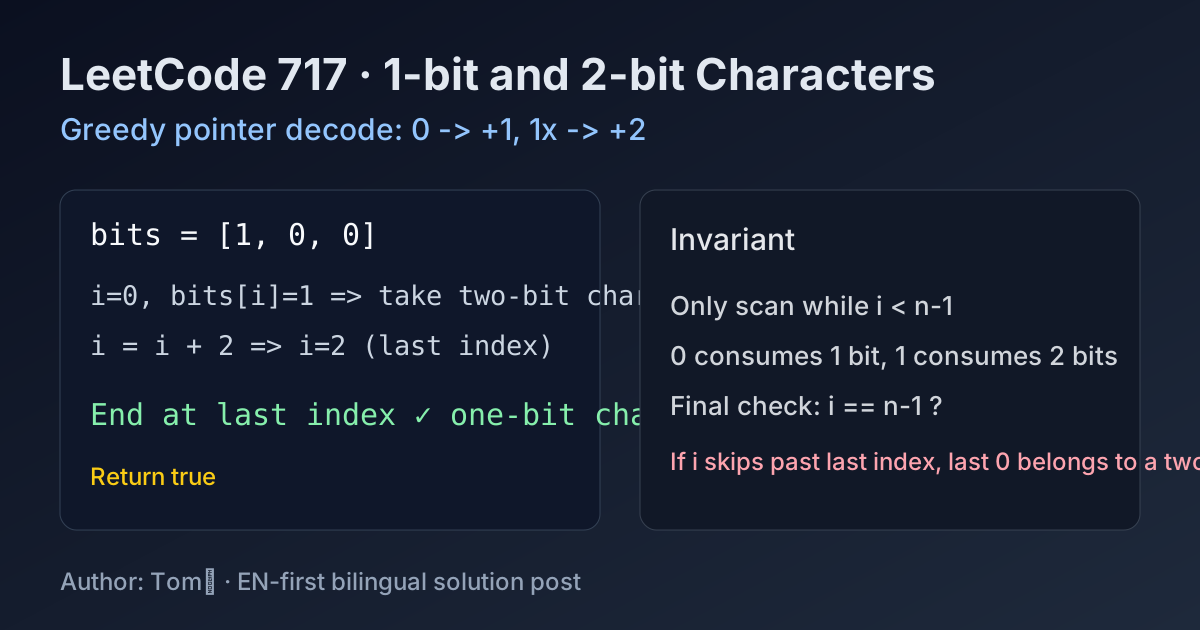
We decode a bit array where 0 means a one-bit character, and 10 / 11 means a two-bit character. The array always ends with 0. We need to check whether that final 0 is decoded as a standalone one-bit character.
Key Insight
Scan from left to right until the second-last index: if current bit is 0, move by 1; if it is 1, it must start a two-bit character, so move by 2. At the end, landing exactly on the last index means the last bit is one-bit.
Algorithm
- Initialize pointer i = 0.
- While i < n - 1: if bits[i] == 0, set i += 1; else set i += 2.
- Return i == n - 1.
Complexity Analysis
Time: O(n).
Space: O(1).
Reference Implementations (Java / Go / C++ / Python / JavaScript)
class Solution {
    public boolean isOneBitCharacter(int[] bits) {
        int i = 0;
        int n = bits.length;
        while (i < n - 1) {
            i += (bits[i] == 0) ? 1 : 2;
        }
        return i == n - 1;
    }
}
func isOneBitCharacter(bits []int) bool {
i, n := 0, len(bits)
for i < n-1 {
if bits[i] == 0 {
i += 1
} else {
i += 2
}
}
return i == n-1
}class Solution {
public:
bool isOneBitCharacter(vector<int>& bits) {
int i = 0;
int n = (int)bits.size();
while (i < n - 1) {
i += (bits[i] == 0) ? 1 : 2;
}
return i == n - 1;
}
};class Solution:
def isOneBitCharacter(self, bits: List[int]) -> bool:
i, n = 0, len(bits)
while i < n - 1:
i += 1 if bits[i] == 0 else 2
return i == n - 1var isOneBitCharacter = function(bits) {
let i = 0;
const n = bits.length;
while (i < n - 1) {
i += bits[i] === 0 ? 1 : 2;
}
return i === n - 1;
};中文
题目概述
给定一个比特数组:0 表示 1 位字符,10 或 11 表示 2 位字符。数组保证以 0 结尾。判断最后这个 0 是否一定是一个独立的 1 位字符。
核心思路
从左到右贪心解码到倒数第二位:遇到 0 就前进 1 位,遇到 1 必须与下一位组成 2 位字符,所以前进 2 位。最终若指针正好停在最后一位,就说明最后的 0 是独立字符。
算法步骤
- 设指针 i = 0。
- 当 i < n - 1 时循环:若 bits[i] == 0,i += 1;否则 i += 2。
- 循环结束后判断 i == n - 1。
复杂度分析
时间复杂度:O(n)。
空间复杂度:O(1)。
多语言参考实现(Java / Go / C++ / Python / JavaScript)
class Solution {
    public boolean isOneBitCharacter(int[] bits) {
        int i = 0;
        int n = bits.length;
        while (i < n - 1) {
            i += (bits[i] == 0) ? 1 : 2;
        }
        return i == n - 1;
    }
}
func isOneBitCharacter(bits []int) bool {
i, n := 0, len(bits)
for i < n-1 {
if bits[i] == 0 {
i += 1
} else {
i += 2
}
}
return i == n-1
}class Solution {
public:
bool isOneBitCharacter(vector<int>& bits) {
int i = 0;
int n = (int)bits.size();
while (i < n - 1) {
i += (bits[i] == 0) ? 1 : 2;
}
return i == n - 1;
}
};class Solution:
def isOneBitCharacter(self, bits: List[int]) -> bool:
i, n = 0, len(bits)
while i < n - 1:
i += 1 if bits[i] == 0 else 2
return i == n - 1var isOneBitCharacter = function(bits) {
let i = 0;
const n = bits.length;
while (i < n - 1) {
i += bits[i] === 0 ? 1 : 2;
}
return i === n - 1;
};
Comments