LeetCode 703: Kth Largest Element in a Stream (Min-Heap of Size k)
LeetCode 703HeapPriority QueueToday we solve LeetCode 703 - Kth Largest Element in a Stream.
Source: https://leetcode.com/problems/kth-largest-element-in-a-stream/
English
Problem Summary
Design a class KthLargest that receives an integer k and an initial array nums. After each add(val) call, return the current kth largest element among all values seen so far.
Key Insight
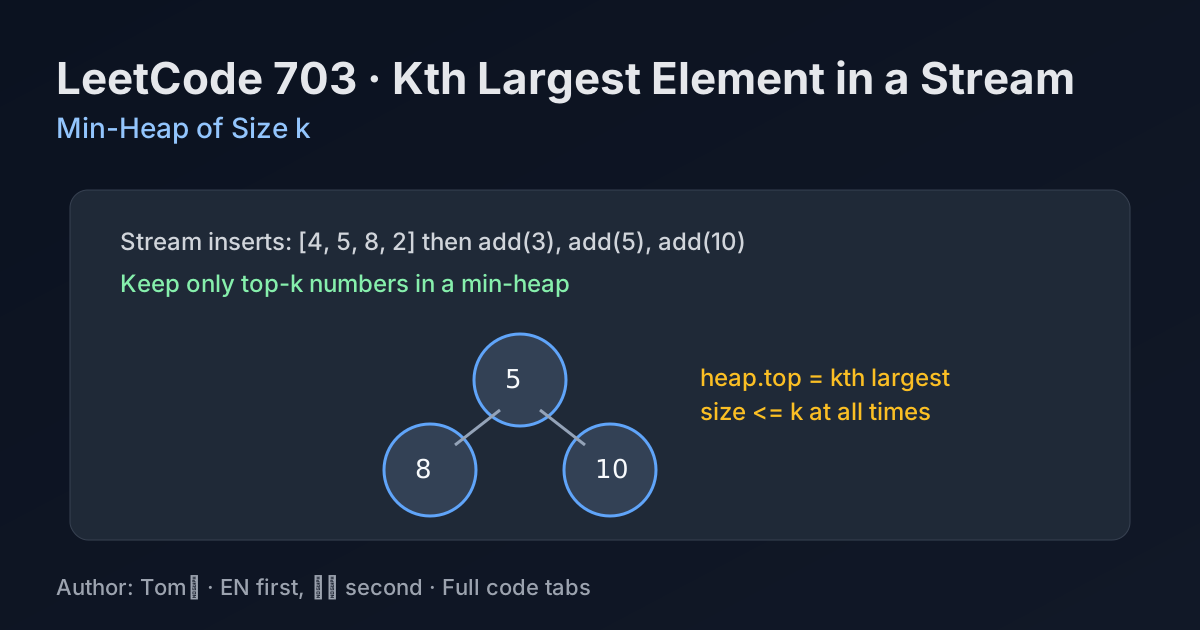
Keep only the k largest numbers using a min-heap of size k. The heap top is the smallest inside these k kept elements, which is exactly the kth largest globally.
Algorithm
- Initialize a min-heap.
- Push each initial number.
- If heap size exceeds k, pop the top.
- For each add(val), push val, pop if size > k, then return heap top.
Complexity Analysis
Let heap size be at most k.
Each insertion/removal costs O(log k).
So each add is O(log k), and extra space is O(k).
Common Pitfalls
- Using max-heap and keeping all numbers, causing unnecessary O(n) memory.
- Forgetting to trim heap when size exceeds k.
- Returning newly added value directly instead of heap top.
Reference Implementations (Java / Go / C++ / Python / JavaScript)
class KthLargest {
    private final int k;
    private final PriorityQueue<Integer> minHeap;

    public KthLargest(int k, int[] nums) {
        this.k = k;
        this.minHeap = new PriorityQueue<>();
        for (int num : nums) {
            add(num);
        }
    }

    public int add(int val) {
        minHeap.offer(val);
        if (minHeap.size() > k) {
            minHeap.poll();
        }
        return minHeap.peek();
    }
}
type IntHeap []int
func (h IntHeap) Len() int { return len(h) }
func (h IntHeap) Less(i, j int) bool { return h[i] < h[j] }
func (h IntHeap) Swap(i, j int) { h[i], h[j] = h[j], h[i] }
func (h *IntHeap) Push(x interface{}) { *h = append(*h, x.(int)) }
func (h *IntHeap) Pop() interface{} {
old := *h
n := len(old)
x := old[n-1]
*h = old[:n-1]
return x
}
type KthLargest struct {
k int
heap IntHeap
}
func Constructor(k int, nums []int) KthLargest {
kl := KthLargest{k: k, heap: IntHeap{}}
heap.Init(&kl.heap)
for _, num := range nums {
kl.Add(num)
}
return kl
}
func (this *KthLargest) Add(val int) int {
heap.Push(&this.heap, val)
if this.heap.Len() > this.k {
heap.Pop(&this.heap)
}
return this.heap[0]
}class KthLargest {
private:
int k;
priority_queue<int, vector<int>, greater<int>> minHeap;
public:
KthLargest(int k, vector<int>& nums) : k(k) {
for (int x : nums) add(x);
}
int add(int val) {
minHeap.push(val);
if ((int)minHeap.size() > k) {
minHeap.pop();
}
return minHeap.top();
}
};import heapq
class KthLargest:
def __init__(self, k: int, nums: List[int]):
self.k = k
self.heap = []
for x in nums:
self.add(x)
def add(self, val: int) -> int:
heapq.heappush(self.heap, val)
if len(self.heap) > self.k:
heapq.heappop(self.heap)
return self.heap[0]class MinHeap {
constructor() { this.data = []; }
size() { return this.data.length; }
peek() { return this.data[0]; }
push(x) {
const a = this.data;
a.push(x);
let i = a.length - 1;
while (i > 0) {
const p = (i - 1) >> 1;
if (a[p] <= a[i]) break;
[a[p], a[i]] = [a[i], a[p]];
i = p;
}
}
pop() {
const a = this.data;
if (!a.length) return null;
const top = a[0];
const last = a.pop();
if (a.length) {
a[0] = last;
let i = 0;
while (true) {
let l = i * 2 + 1, r = i * 2 + 2, m = i;
if (l < a.length && a[l] < a[m]) m = l;
if (r < a.length && a[r] < a[m]) m = r;
if (m === i) break;
[a[i], a[m]] = [a[m], a[i]];
i = m;
}
}
return top;
}
}
var KthLargest = function(k, nums) {
this.k = k;
this.heap = new MinHeap();
for (const x of nums) this.add(x);
};
KthLargest.prototype.add = function(val) {
this.heap.push(val);
if (this.heap.size() > this.k) this.heap.pop();
return this.heap.peek();
};中文
题目概述
设计一个 KthLargest 类:给定 k 和初始数组 nums,每次调用 add(val) 后返回当前数据流中的第 k 大元素。
核心思路
用一个大小最多为 k 的小顶堆维护“当前最大的 k 个数”。堆顶是这 k 个数里最小的那个,也就是全局第 k 大。
算法步骤
- 初始化小顶堆。
- 依次加入初始数组元素。
- 若堆大小超过 k,弹出堆顶。
- 每次 add(val):先入堆,再按需弹出,最后返回堆顶。
复杂度分析
堆大小不超过 k。
每次入堆/出堆复杂度是 O(log k)。
因此每次 add 为 O(log k),空间复杂度 O(k)。
常见陷阱
- 维护了全部元素,导致空间不必要膨胀。
- 忘记在堆大小超过 k 时及时弹出。
- 错把新插入值当答案,而不是返回堆顶。
多语言参考实现(Java / Go / C++ / Python / JavaScript)
class KthLargest {
    private final int k;
    private final PriorityQueue<Integer> minHeap;

    public KthLargest(int k, int[] nums) {
        this.k = k;
        this.minHeap = new PriorityQueue<>();
        for (int num : nums) {
            add(num);
        }
    }

    public int add(int val) {
        minHeap.offer(val);
        if (minHeap.size() > k) {
            minHeap.poll();
        }
        return minHeap.peek();
    }
}
type IntHeap []int
func (h IntHeap) Len() int { return len(h) }
func (h IntHeap) Less(i, j int) bool { return h[i] < h[j] }
func (h IntHeap) Swap(i, j int) { h[i], h[j] = h[j], h[i] }
func (h *IntHeap) Push(x interface{}) { *h = append(*h, x.(int)) }
func (h *IntHeap) Pop() interface{} {
old := *h
n := len(old)
x := old[n-1]
*h = old[:n-1]
return x
}
type KthLargest struct {
k int
heap IntHeap
}
func Constructor(k int, nums []int) KthLargest {
kl := KthLargest{k: k, heap: IntHeap{}}
heap.Init(&kl.heap)
for _, num := range nums {
kl.Add(num)
}
return kl
}
func (this *KthLargest) Add(val int) int {
heap.Push(&this.heap, val)
if this.heap.Len() > this.k {
heap.Pop(&this.heap)
}
return this.heap[0]
}class KthLargest {
private:
int k;
priority_queue<int, vector<int>, greater<int>> minHeap;
public:
KthLargest(int k, vector<int>& nums) : k(k) {
for (int x : nums) add(x);
}
int add(int val) {
minHeap.push(val);
if ((int)minHeap.size() > k) {
minHeap.pop();
}
return minHeap.top();
}
};import heapq
class KthLargest:
def __init__(self, k: int, nums: List[int]):
self.k = k
self.heap = []
for x in nums:
self.add(x)
def add(self, val: int) -> int:
heapq.heappush(self.heap, val)
if len(self.heap) > self.k:
heapq.heappop(self.heap)
return self.heap[0]class MinHeap {
constructor() { this.data = []; }
size() { return this.data.length; }
peek() { return this.data[0]; }
push(x) {
const a = this.data;
a.push(x);
let i = a.length - 1;
while (i > 0) {
const p = (i - 1) >> 1;
if (a[p] <= a[i]) break;
[a[p], a[i]] = [a[i], a[p]];
i = p;
}
}
pop() {
const a = this.data;
if (!a.length) return null;
const top = a[0];
const last = a.pop();
if (a.length) {
a[0] = last;
let i = 0;
while (true) {
let l = i * 2 + 1, r = i * 2 + 2, m = i;
if (l < a.length && a[l] < a[m]) m = l;
if (r < a.length && a[r] < a[m]) m = r;
if (m === i) break;
[a[i], a[m]] = [a[m], a[i]];
i = m;
}
}
return top;
}
}
var KthLargest = function(k, nums) {
this.k = k;
this.heap = new MinHeap();
for (const x of nums) this.add(x);
};
KthLargest.prototype.add = function(val) {
this.heap.push(val);
if (this.heap.size() > this.k) this.heap.pop();
return this.heap.peek();
};
Comments