LeetCode 697: Degree of an Array (First/Last Index + Frequency)
LeetCode 697ArrayHash TableToday we solve LeetCode 697 - Degree of an Array.
Source: https://leetcode.com/problems/degree-of-an-array/
English
Problem Summary
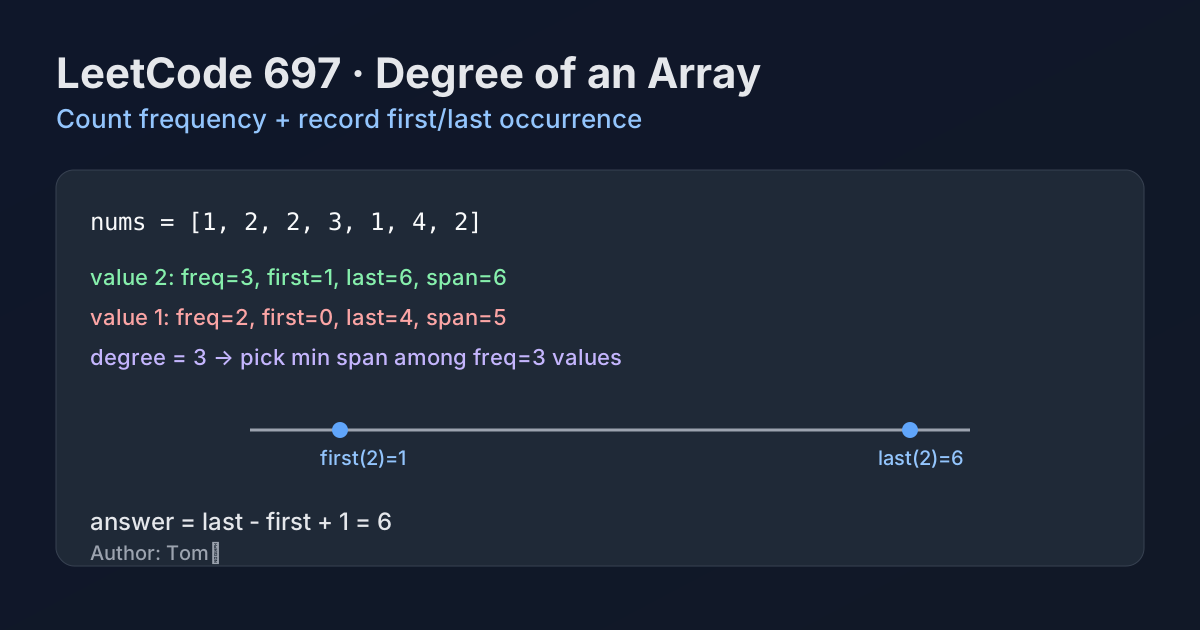
The degree of an array is the maximum frequency of any value. We need the minimum length of a contiguous subarray that has the same degree as the whole array.
Key Insight
For each number x, if we know:
- its total frequency cnt[x]
- its first position first[x]
- its last position last[x]
then the shortest subarray achieving x's degree is exactly last[x] - first[x] + 1.
Algorithm
- Scan once, update cnt, first, and last.
- Find global degree D = max(cnt[x]).
- Among all values with cnt[x] == D, minimize last[x] - first[x] + 1.
Complexity Analysis
Time: O(n).
Space: O(n) in worst case (all values distinct).
Reference Implementations (Java / Go / C++ / Python / JavaScript)
class Solution {
    public int findShortestSubArray(int[] nums) {
        Map<Integer, Integer> cnt = new HashMap<>();
        Map<Integer, Integer> first = new HashMap<>();
        Map<Integer, Integer> last = new HashMap<>();

        for (int i = 0; i < nums.length; i++) {
            int x = nums[i];
            cnt.put(x, cnt.getOrDefault(x, 0) + 1);
            first.putIfAbsent(x, i);
            last.put(x, i);
        }

        int degree = 0;
        for (int c : cnt.values()) {
            degree = Math.max(degree, c);
        }

        int ans = nums.length;
        for (int x : cnt.keySet()) {
            if (cnt.get(x) == degree) {
                ans = Math.min(ans, last.get(x) - first.get(x) + 1);
            }
        }
        return ans;
    }
}
func findShortestSubArray(nums []int) int {
cnt := map[int]int{}
first := map[int]int{}
last := map[int]int{}
for i, x := range nums {
cnt[x]++
if _, ok := first[x]; !ok {
first[x] = i
}
last[x] = i
}
degree := 0
for _, c := range cnt {
if c > degree {
degree = c
}
}
ans := len(nums)
for x, c := range cnt {
if c == degree {
if length := last[x] - first[x] + 1; length < ans {
ans = length
}
}
}
return ans
}class Solution {
public:
int findShortestSubArray(vector<int>& nums) {
unordered_map<int, int> cnt, first, last;
for (int i = 0; i < (int)nums.size(); ++i) {
int x = nums[i];
cnt[x]++;
if (!first.count(x)) first[x] = i;
last[x] = i;
}
int degree = 0;
for (auto& [x, c] : cnt) {
degree = max(degree, c);
}
int ans = nums.size();
for (auto& [x, c] : cnt) {
if (c == degree) {
ans = min(ans, last[x] - first[x] + 1);
}
}
return ans;
}
};class Solution:
def findShortestSubArray(self, nums: List[int]) -> int:
cnt = {}
first = {}
last = {}
for i, x in enumerate(nums):
cnt[x] = cnt.get(x, 0) + 1
if x not in first:
first[x] = i
last[x] = i
degree = max(cnt.values())
ans = len(nums)
for x, c in cnt.items():
if c == degree:
ans = min(ans, last[x] - first[x] + 1)
return ansvar findShortestSubArray = function(nums) {
const cnt = new Map();
const first = new Map();
const last = new Map();
for (let i = 0; i < nums.length; i++) {
const x = nums[i];
cnt.set(x, (cnt.get(x) || 0) + 1);
if (!first.has(x)) first.set(x, i);
last.set(x, i);
}
let degree = 0;
for (const c of cnt.values()) degree = Math.max(degree, c);
let ans = nums.length;
for (const [x, c] of cnt.entries()) {
if (c === degree) {
ans = Math.min(ans, last.get(x) - first.get(x) + 1);
}
}
return ans;
};中文
题目概述
数组的“度”是某个数字出现次数的最大值。要求找到一个最短连续子数组,使它的度与原数组相同。
核心思路
对每个数字 x 同时记录三件事:
- 出现次数 cnt[x]
- 首次出现位置 first[x]
- 最后出现位置 last[x]
若 x 达到全局度数,则它对应的最短区间长度就是 last[x] - first[x] + 1。
算法步骤
- 一次遍历建立 cnt/first/last。
- 计算原数组度数 D。
- 在所有 cnt[x] == D 的数字中,取最小区间长度。
复杂度分析
时间复杂度:O(n)。
空间复杂度:O(n)(最坏情况下所有元素都不同)。
多语言参考实现(Java / Go / C++ / Python / JavaScript)
class Solution {
    public int findShortestSubArray(int[] nums) {
        Map<Integer, Integer> cnt = new HashMap<>();
        Map<Integer, Integer> first = new HashMap<>();
        Map<Integer, Integer> last = new HashMap<>();

        for (int i = 0; i < nums.length; i++) {
            int x = nums[i];
            cnt.put(x, cnt.getOrDefault(x, 0) + 1);
            first.putIfAbsent(x, i);
            last.put(x, i);
        }

        int degree = 0;
        for (int c : cnt.values()) {
            degree = Math.max(degree, c);
        }

        int ans = nums.length;
        for (int x : cnt.keySet()) {
            if (cnt.get(x) == degree) {
                ans = Math.min(ans, last.get(x) - first.get(x) + 1);
            }
        }
        return ans;
    }
}
func findShortestSubArray(nums []int) int {
cnt := map[int]int{}
first := map[int]int{}
last := map[int]int{}
for i, x := range nums {
cnt[x]++
if _, ok := first[x]; !ok {
first[x] = i
}
last[x] = i
}
degree := 0
for _, c := range cnt {
if c > degree {
degree = c
}
}
ans := len(nums)
for x, c := range cnt {
if c == degree {
if length := last[x] - first[x] + 1; length < ans {
ans = length
}
}
}
return ans
}class Solution {
public:
int findShortestSubArray(vector<int>& nums) {
unordered_map<int, int> cnt, first, last;
for (int i = 0; i < (int)nums.size(); ++i) {
int x = nums[i];
cnt[x]++;
if (!first.count(x)) first[x] = i;
last[x] = i;
}
int degree = 0;
for (auto& [x, c] : cnt) {
degree = max(degree, c);
}
int ans = nums.size();
for (auto& [x, c] : cnt) {
if (c == degree) {
ans = min(ans, last[x] - first[x] + 1);
}
}
return ans;
}
};class Solution:
def findShortestSubArray(self, nums: List[int]) -> int:
cnt = {}
first = {}
last = {}
for i, x in enumerate(nums):
cnt[x] = cnt.get(x, 0) + 1
if x not in first:
first[x] = i
last[x] = i
degree = max(cnt.values())
ans = len(nums)
for x, c in cnt.items():
if c == degree:
ans = min(ans, last[x] - first[x] + 1)
return ansvar findShortestSubArray = function(nums) {
const cnt = new Map();
const first = new Map();
const last = new Map();
for (let i = 0; i < nums.length; i++) {
const x = nums[i];
cnt.set(x, (cnt.get(x) || 0) + 1);
if (!first.has(x)) first.set(x, i);
last.set(x, i);
}
let degree = 0;
for (const c of cnt.values()) degree = Math.max(degree, c);
let ans = nums.length;
for (const [x, c] of cnt.entries()) {
if (c === degree) {
ans = Math.min(ans, last.get(x) - first.get(x) + 1);
}
}
return ans;
};
Comments