LeetCode 559: Maximum Depth of N-ary Tree (DFS / BFS Level Counting)
LeetCode 559TreeDFSBFSToday we solve LeetCode 559 - Maximum Depth of N-ary Tree.
Source: https://leetcode.com/problems/maximum-depth-of-n-ary-tree/
English
Problem Summary
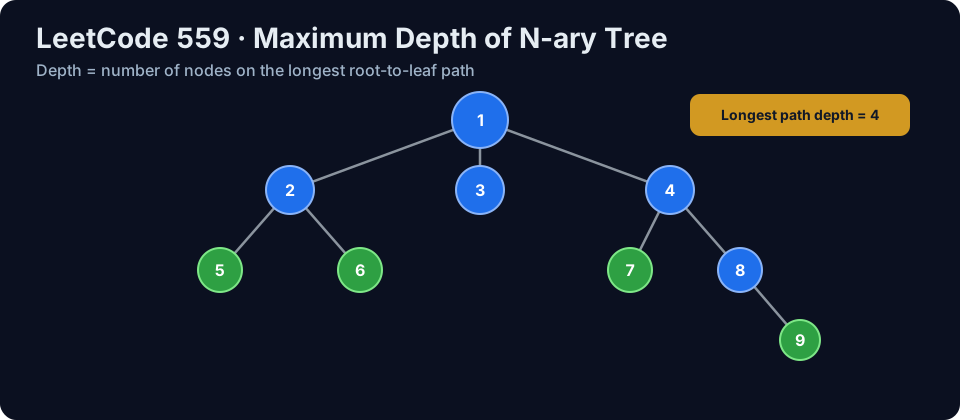
Given the root of an N-ary tree, return its maximum depth. The maximum depth is the number of nodes along the longest path from root to any leaf.
Key Insight
Depth is naturally a recursive quantity: depth(node) = 1 + max(depth(child)). For an empty node, depth is 0. This leads directly to DFS recursion. BFS level traversal gives the same answer by counting layers.
Algorithm (DFS)
- If root == null, return 0.
- Initialize best = 0.
- For each child, compute child depth and update best.
- Return best + 1 for current node.
Complexity Analysis
Let n be number of nodes.
Time: O(n) (each node visited once).
Space: O(h) recursion stack, where h is tree height (worst O(n)).
Reference Implementations (Java / Go / C++ / Python / JavaScript)
/*
// Definition for a Node.
class Node {
    public int val;
    public List<Node> children;
}
*/
class Solution {
    public int maxDepth(Node root) {
        if (root == null) return 0;
        int best = 0;
        for (Node child : root.children) {
            best = Math.max(best, maxDepth(child));
        }
        return best + 1;
    }
}
/*
// Definition for a Node.
type Node struct {
Val int
Children []*Node
}
*/
func maxDepth(root *Node) int {
if root == nil {
return 0
}
best := 0
for _, child := range root.Children {
d := maxDepth(child)
if d > best {
best = d
}
}
return best + 1
}/*
// Definition for a Node.
class Node {
public:
int val;
vector<Node*> children;
};
*/
class Solution {
public:
int maxDepth(Node* root) {
if (!root) return 0;
int best = 0;
for (Node* child : root->children) {
best = max(best, maxDepth(child));
}
return best + 1;
}
};"""
# Definition for a Node.
class Node:
def __init__(self, val=None, children=None):
self.val = val
self.children = children if children is not None else []
"""
class Solution:
def maxDepth(self, root: 'Node') -> int:
if not root:
return 0
best = 0
for child in root.children:
best = max(best, self.maxDepth(child))
return best + 1/**
* // Definition for a Node.
* function Node(val, children) {
* this.val = val;
* this.children = children;
* }
*/
var maxDepth = function(root) {
if (root === null) return 0;
let best = 0;
for (const child of root.children) {
best = Math.max(best, maxDepth(child));
}
return best + 1;
};中文
题目概述
给定一棵 N 叉树的根节点 root,返回其最大深度。最大深度定义为:从根到最远叶子节点路径上的节点总数。
核心思路
深度本质是递归定义:depth(node) = 1 + max(depth(child))。空节点深度为 0。因此 DFS 递归非常直接;也可以用 BFS 按层遍历并统计层数。
算法步骤(DFS)
- 若 root == null,返回 0。
- 设 best = 0 记录所有子树中的最大深度。
- 遍历每个子节点,递归求深度并更新 best。
- 返回 best + 1(加上当前节点这一层)。
复杂度分析
设节点数为 n。
时间复杂度:O(n)(每个节点访问一次)。
空间复杂度:O(h)(递归栈高度,h 为树高,最坏可到 O(n))。
多语言参考实现(Java / Go / C++ / Python / JavaScript)
/*
// Definition for a Node.
class Node {
    public int val;
    public List<Node> children;
}
*/
class Solution {
    public int maxDepth(Node root) {
        if (root == null) return 0;
        int best = 0;
        for (Node child : root.children) {
            best = Math.max(best, maxDepth(child));
        }
        return best + 1;
    }
}
/*
// Definition for a Node.
type Node struct {
Val int
Children []*Node
}
*/
func maxDepth(root *Node) int {
if root == nil {
return 0
}
best := 0
for _, child := range root.Children {
d := maxDepth(child)
if d > best {
best = d
}
}
return best + 1
}/*
// Definition for a Node.
class Node {
public:
int val;
vector<Node*> children;
};
*/
class Solution {
public:
int maxDepth(Node* root) {
if (!root) return 0;
int best = 0;
for (Node* child : root->children) {
best = max(best, maxDepth(child));
}
return best + 1;
}
};"""
# Definition for a Node.
class Node:
def __init__(self, val=None, children=None):
self.val = val
self.children = children if children is not None else []
"""
class Solution:
def maxDepth(self, root: 'Node') -> int:
if not root:
return 0
best = 0
for child in root.children:
best = max(best, self.maxDepth(child))
return best + 1/**
* // Definition for a Node.
* function Node(val, children) {
* this.val = val;
* this.children = children;
* }
*/
var maxDepth = function(root) {
if (root === null) return 0;
let best = 0;
for (const child of root.children) {
best = Math.max(best, maxDepth(child));
}
return best + 1;
};
Comments