LeetCode 507: Perfect Number (Divisor Pair Enumeration up to √n)
LeetCode 507MathNumber TheoryToday we solve LeetCode 507 - Perfect Number.
Source: https://leetcode.com/problems/perfect-number/
English
Problem Summary
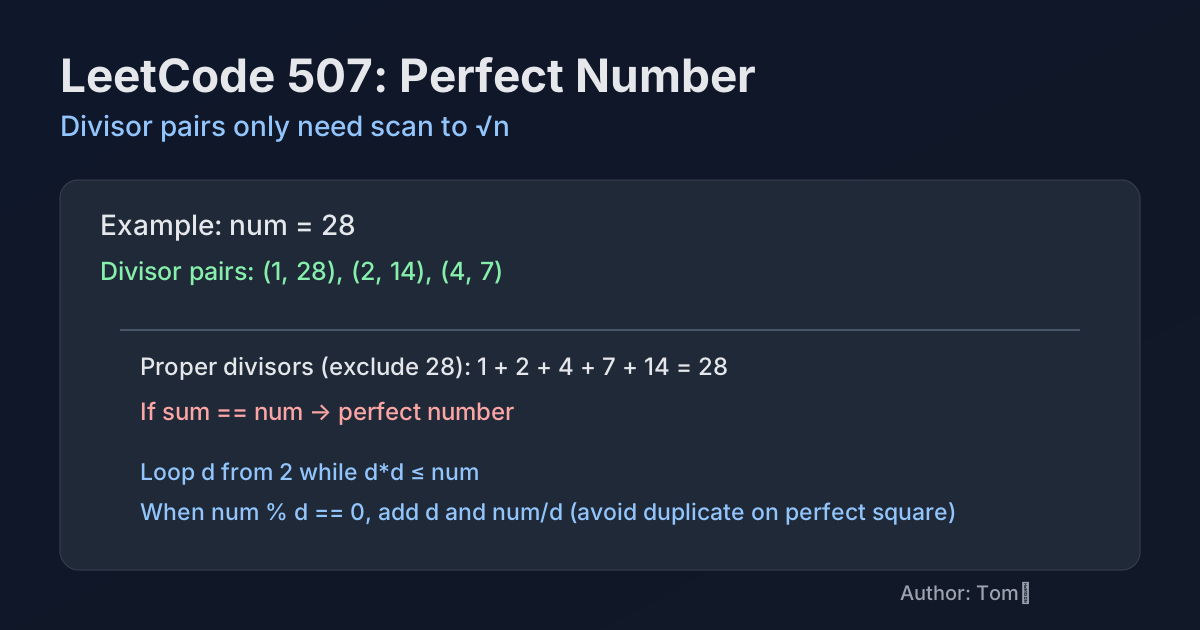
A perfect number equals the sum of its positive divisors excluding itself. Given an integer num, return true if it is perfect, otherwise false.
Key Insight
Divisors come in pairs. If d divides num, then num / d is also a divisor. So we only need to iterate d from 2 to √num, and add both divisors when a division is exact.
Algorithm
- If num <= 1, return false.
- Initialize sum = 1 (because 1 is a proper divisor for all num > 1).
- For each d from 2 while d * d <= num:
• if num % d == 0, add d and num / d.
• if d == num / d (perfect square), add it only once.
- Return whether sum == num.
Complexity Analysis
Time: O(√n).
Space: O(1).
Common Pitfalls
- Forgetting num = 1 should be false.
- Double-counting divisor when d * d == num.
- Starting sum at 0 and missing divisor 1.
Reference Implementations (Java / Go / C++ / Python / JavaScript)
class Solution {
    public boolean checkPerfectNumber(int num) {
        if (num <= 1) return false;

        int sum = 1;
        for (int d = 2; d * d <= num; d++) {
            if (num % d == 0) {
                sum += d;
                int other = num / d;
                if (other != d) {
                    sum += other;
                }
            }
        }
        return sum == num;
    }
}
func checkPerfectNumber(num int) bool {
if num <= 1 {
return false
}
sum := 1
for d := 2; d*d <= num; d++ {
if num%d == 0 {
sum += d
other := num / d
if other != d {
sum += other
}
}
}
return sum == num
}class Solution {
public:
bool checkPerfectNumber(int num) {
if (num <= 1) return false;
int sum = 1;
for (int d = 2; d * d <= num; ++d) {
if (num % d == 0) {
sum += d;
int other = num / d;
if (other != d) {
sum += other;
}
}
}
return sum == num;
}
};class Solution:
def checkPerfectNumber(self, num: int) -> bool:
if num <= 1:
return False
total = 1
d = 2
while d * d <= num:
if num % d == 0:
total += d
other = num // d
if other != d:
total += other
d += 1
return total == numvar checkPerfectNumber = function(num) {
if (num <= 1) return false;
let sum = 1;
for (let d = 2; d * d <= num; d++) {
if (num % d === 0) {
sum += d;
const other = Math.floor(num / d);
if (other !== d) {
sum += other;
}
}
}
return sum === num;
};中文
题目概述
如果一个正整数等于其所有真因子(不包含自身)的和,则称为完美数。给定整数 num,判断它是否为完美数。
核心思路
因子是成对出现的:若 d 是因子,则 num/d 也是因子。因此只需枚举到 √num,每次命中整除时同时累加这对因子。
算法步骤
- 若 num <= 1,直接返回 false。
- 先令 sum = 1(对 num > 1,1 一定是真因子)。
- 枚举 d = 2..√num:若 num % d == 0,加入 d 与 num/d。
- 若是完全平方(d == num/d),只加一次避免重复。
- 最后判断 sum == num。
复杂度分析
时间复杂度:O(√n)。
空间复杂度:O(1)。
常见陷阱
- 把 1 误判为完美数。
- 在平方根点把同一个因子加了两次。
- 忘记把 1 计入真因子和。
多语言参考实现(Java / Go / C++ / Python / JavaScript)
class Solution {
    public boolean checkPerfectNumber(int num) {
        if (num <= 1) return false;

        int sum = 1;
        for (int d = 2; d * d <= num; d++) {
            if (num % d == 0) {
                sum += d;
                int other = num / d;
                if (other != d) {
                    sum += other;
                }
            }
        }
        return sum == num;
    }
}
func checkPerfectNumber(num int) bool {
if num <= 1 {
return false
}
sum := 1
for d := 2; d*d <= num; d++ {
if num%d == 0 {
sum += d
other := num / d
if other != d {
sum += other
}
}
}
return sum == num
}class Solution {
public:
bool checkPerfectNumber(int num) {
if (num <= 1) return false;
int sum = 1;
for (int d = 2; d * d <= num; ++d) {
if (num % d == 0) {
sum += d;
int other = num / d;
if (other != d) {
sum += other;
}
}
}
return sum == num;
}
};class Solution:
def checkPerfectNumber(self, num: int) -> bool:
if num <= 1:
return False
total = 1
d = 2
while d * d <= num:
if num % d == 0:
total += d
other = num // d
if other != d:
total += other
d += 1
return total == numvar checkPerfectNumber = function(num) {
if (num <= 1) return false;
let sum = 1;
for (let d = 2; d * d <= num; d++) {
if (num % d === 0) {
sum += d;
const other = Math.floor(num / d);
if (other !== d) {
sum += other;
}
}
}
return sum === num;
};
Comments