LeetCode 475: Heaters (Sort + Nearest Heater Binary Search)
LeetCode 475Binary SearchSortingToday we solve LeetCode 475 - Heaters.
Source: https://leetcode.com/problems/heaters/
English
Problem Summary
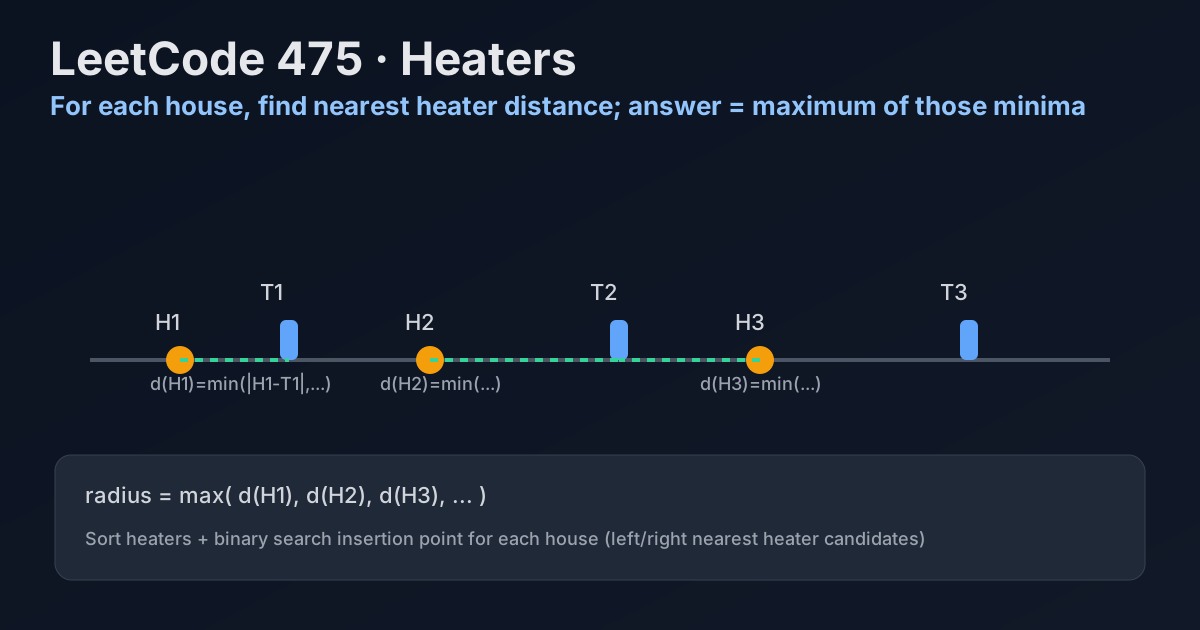
Given positions of houses and heaters on a line, we need the minimum heating radius r such that every house is within distance r of at least one heater.
Key Insight
The required radius is the maximum over all houses of their distance to the nearest heater. So for each house, we only need nearest-heater distance; final answer is the maximum of those distances.
Algorithm
- Sort heaters.
- For each house, binary search insertion index in heaters.
- Candidate nearest distances come from heater on left and heater on right (if they exist).
- Take the smaller one as this house's required radius.
- Track global maximum across all houses and return it.
Complexity Analysis
Let n be number of houses, m be number of heaters.
Time: O(m log m + n log m).
Space: O(1) extra (ignoring sort implementation details).
Common Pitfalls
- Using nearest house instead of nearest heater (wrong target).
- Forgetting boundary cases when binary search lands at 0 or m.
- Taking minimum across houses; we actually need maximum required local radius.
Reference Implementations (Java / Go / C++ / Python / JavaScript)
import java.util.Arrays;

class Solution {
    public int findRadius(int[] houses, int[] heaters) {
        Arrays.sort(heaters);
        int ans = 0;
        for (int h : houses) {
            int idx = Arrays.binarySearch(heaters, h);
            if (idx < 0) idx = -idx - 1;

            int leftDist = Integer.MAX_VALUE;
            if (idx - 1 >= 0) {
                leftDist = h - heaters[idx - 1];
            }

            int rightDist = Integer.MAX_VALUE;
            if (idx < heaters.length) {
                rightDist = heaters[idx] - h;
            }

            int nearest = Math.min(leftDist, rightDist);
            ans = Math.max(ans, nearest);
        }
        return ans;
    }
}
import "sort"
func findRadius(houses []int, heaters []int) int {
sort.Ints(heaters)
ans := 0
for _, h := range houses {
idx := sort.SearchInts(heaters, h)
leftDist := int(^uint(0) >> 1) // MaxInt
if idx-1 >= 0 {
leftDist = h - heaters[idx-1]
}
rightDist := int(^uint(0) >> 1)
if idx < len(heaters) {
rightDist = heaters[idx] - h
}
nearest := leftDist
if rightDist < nearest {
nearest = rightDist
}
if nearest > ans {
ans = nearest
}
}
return ans
}#include <bits/stdc++.h>
using namespace std;
class Solution {
public:
int findRadius(vector<int>& houses, vector<int>& heaters) {
sort(heaters.begin(), heaters.end());
int ans = 0;
for (int h : houses) {
auto it = lower_bound(heaters.begin(), heaters.end(), h);
int leftDist = INT_MAX;
if (it != heaters.begin()) {
leftDist = h - *prev(it);
}
int rightDist = INT_MAX;
if (it != heaters.end()) {
rightDist = *it - h;
}
int nearest = min(leftDist, rightDist);
ans = max(ans, nearest);
}
return ans;
}
};from bisect import bisect_left
from typing import List
class Solution:
def findRadius(self, houses: List[int], heaters: List[int]) -> int:
heaters.sort()
ans = 0
for h in houses:
idx = bisect_left(heaters, h)
left_dist = float('inf')
if idx - 1 >= 0:
left_dist = h - heaters[idx - 1]
right_dist = float('inf')
if idx < len(heaters):
right_dist = heaters[idx] - h
nearest = min(left_dist, right_dist)
ans = max(ans, nearest)
return ansvar findRadius = function(houses, heaters) {
heaters.sort((a, b) => a - b);
const lowerBound = (arr, target) => {
let l = 0, r = arr.length;
while (l < r) {
const mid = l + ((r - l) >> 1);
if (arr[mid] < target) l = mid + 1;
else r = mid;
}
return l;
};
let ans = 0;
for (const h of houses) {
const idx = lowerBound(heaters, h);
let leftDist = Number.POSITIVE_INFINITY;
if (idx - 1 >= 0) {
leftDist = h - heaters[idx - 1];
}
let rightDist = Number.POSITIVE_INFINITY;
if (idx < heaters.length) {
rightDist = heaters[idx] - h;
}
const nearest = Math.min(leftDist, rightDist);
ans = Math.max(ans, nearest);
}
return ans;
};中文
题目概述
给定一条数轴上的房屋位置数组和供暖器位置数组,要求找到最小半径 r,使得每个房屋都至少被某个供暖器覆盖(距离不超过 r)。
核心思路
答案等于“每个房屋到最近供暖器距离”的最大值。也就是说,先求每个房屋的局部最小需求半径,再在所有房屋中取最大值。
算法步骤
- 先对 heaters 排序。
- 对每个房屋位置 house,用二分查找插入点。
- 最近供暖器只可能是插入点左侧和右侧的供暖器。
- 取左右距离较小值作为当前房屋需求半径。
- 遍历时维护全局最大值并返回。
复杂度分析
设房屋数为 n,供暖器数为 m。
时间复杂度:O(m log m + n log m)。
额外空间复杂度:O(1)(不计排序实现开销)。
常见陷阱
- 误把“最近房屋”当成目标,正确是“最近供暖器”。
- 忽略边界:插入点在最左或最右时只能取一侧距离。
- 错误地对所有房屋取最小值;正确是取局部需求的最大值。
多语言参考实现(Java / Go / C++ / Python / JavaScript)
import java.util.Arrays;

class Solution {
    public int findRadius(int[] houses, int[] heaters) {
        Arrays.sort(heaters);
        int ans = 0;
        for (int h : houses) {
            int idx = Arrays.binarySearch(heaters, h);
            if (idx < 0) idx = -idx - 1;

            int leftDist = Integer.MAX_VALUE;
            if (idx - 1 >= 0) {
                leftDist = h - heaters[idx - 1];
            }

            int rightDist = Integer.MAX_VALUE;
            if (idx < heaters.length) {
                rightDist = heaters[idx] - h;
            }

            int nearest = Math.min(leftDist, rightDist);
            ans = Math.max(ans, nearest);
        }
        return ans;
    }
}
import "sort"
func findRadius(houses []int, heaters []int) int {
sort.Ints(heaters)
ans := 0
for _, h := range houses {
idx := sort.SearchInts(heaters, h)
leftDist := int(^uint(0) >> 1) // MaxInt
if idx-1 >= 0 {
leftDist = h - heaters[idx-1]
}
rightDist := int(^uint(0) >> 1)
if idx < len(heaters) {
rightDist = heaters[idx] - h
}
nearest := leftDist
if rightDist < nearest {
nearest = rightDist
}
if nearest > ans {
ans = nearest
}
}
return ans
}#include <bits/stdc++.h>
using namespace std;
class Solution {
public:
int findRadius(vector<int>& houses, vector<int>& heaters) {
sort(heaters.begin(), heaters.end());
int ans = 0;
for (int h : houses) {
auto it = lower_bound(heaters.begin(), heaters.end(), h);
int leftDist = INT_MAX;
if (it != heaters.begin()) {
leftDist = h - *prev(it);
}
int rightDist = INT_MAX;
if (it != heaters.end()) {
rightDist = *it - h;
}
int nearest = min(leftDist, rightDist);
ans = max(ans, nearest);
}
return ans;
}
};from bisect import bisect_left
from typing import List
class Solution:
def findRadius(self, houses: List[int], heaters: List[int]) -> int:
heaters.sort()
ans = 0
for h in houses:
idx = bisect_left(heaters, h)
left_dist = float('inf')
if idx - 1 >= 0:
left_dist = h - heaters[idx - 1]
right_dist = float('inf')
if idx < len(heaters):
right_dist = heaters[idx] - h
nearest = min(left_dist, right_dist)
ans = max(ans, nearest)
return ansvar findRadius = function(houses, heaters) {
heaters.sort((a, b) => a - b);
const lowerBound = (arr, target) => {
let l = 0, r = arr.length;
while (l < r) {
const mid = l + ((r - l) >> 1);
if (arr[mid] < target) l = mid + 1;
else r = mid;
}
return l;
};
let ans = 0;
for (const h of houses) {
const idx = lowerBound(heaters, h);
let leftDist = Number.POSITIVE_INFINITY;
if (idx - 1 >= 0) {
leftDist = h - heaters[idx - 1];
}
let rightDist = Number.POSITIVE_INFINITY;
if (idx < heaters.length) {
rightDist = heaters[idx] - h;
}
const nearest = Math.min(leftDist, rightDist);
ans = Math.max(ans, nearest);
}
return ans;
};
Comments