LeetCode 461: Hamming Distance (XOR + Set Bit Counting)
LeetCode 461Bit ManipulationXORBit CountToday we solve LeetCode 461 - Hamming Distance.
Source: https://leetcode.com/problems/hamming-distance/
English
Problem Summary
Given two integers x and y, return how many bit positions are different between them.
Key Insight
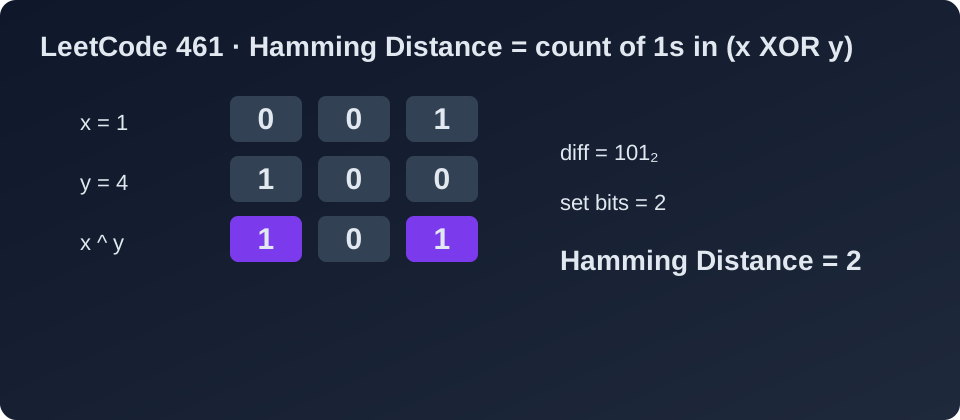
x ^ y keeps exactly the differing bit positions as 1. So the answer is just the number of set bits in x ^ y.
Algorithm
1) Compute diff = x ^ y.
2) Count how many 1s are in diff.
3) Return that count.
Complexity Analysis
Time: O(k), where k is the number of bits (at most 31 for this problem range).
Space: O(1).
Common Pitfalls
- Comparing decimal digits instead of binary bits.
- Forgetting XOR and trying manual per-bit alignment with strings.
- Using signed-shift loops carelessly in languages where right shift keeps sign bits.
Reference Implementations (Java / Go / C++ / Python / JavaScript)
class Solution {
    public int hammingDistance(int x, int y) {
        int diff = x ^ y;
        int count = 0;
        while (diff != 0) {
            count += (diff & 1);
            diff >>>= 1;
        }
        return count;
    }
}
func hammingDistance(x int, y int) int {
diff := x ^ y
count := 0
for diff != 0 {
count += diff & 1
diff >>= 1
}
return count
}class Solution {
public:
int hammingDistance(int x, int y) {
int diff = x ^ y;
int count = 0;
while (diff != 0) {
count += (diff & 1);
diff >>= 1;
}
return count;
}
};class Solution:
def hammingDistance(self, x: int, y: int) -> int:
diff = x ^ y
count = 0
while diff:
count += diff & 1
diff >>= 1
return countvar hammingDistance = function(x, y) {
let diff = x ^ y;
let count = 0;
while (diff !== 0) {
count += (diff & 1);
diff >>>= 1;
}
return count;
};中文
题目概述
给定两个整数 x 和 y,返回它们在二进制表示中不同位的个数。
核心思路
对两个数做异或:x ^ y。凡是不同的位会变成 1,所以答案就是这个结果里 1 的数量。
算法步骤
1)计算 diff = x ^ y。
2)循环统计 diff 的最低位是否为 1。
3)右移直到 diff 为 0,返回计数。
复杂度分析
时间复杂度:O(k),k 为位数(本题范围内最多 31 位)。
空间复杂度:O(1)。
常见陷阱
- 把题目误解成十进制位比较。
- 不用 XOR,改用字符串对齐导致实现冗长。
- 在不同语言中混用有符号右移和无符号右移,导致边界行为不一致。
多语言参考实现(Java / Go / C++ / Python / JavaScript)
class Solution {
    public int hammingDistance(int x, int y) {
        int diff = x ^ y;
        int count = 0;
        while (diff != 0) {
            count += (diff & 1);
            diff >>>= 1;
        }
        return count;
    }
}
func hammingDistance(x int, y int) int {
diff := x ^ y
count := 0
for diff != 0 {
count += diff & 1
diff >>= 1
}
return count
}class Solution {
public:
int hammingDistance(int x, int y) {
int diff = x ^ y;
int count = 0;
while (diff != 0) {
count += (diff & 1);
diff >>= 1;
}
return count;
}
};class Solution:
def hammingDistance(self, x: int, y: int) -> int:
diff = x ^ y
count = 0
while diff:
count += diff & 1
diff >>= 1
return countvar hammingDistance = function(x, y) {
let diff = x ^ y;
let count = 0;
while (diff !== 0) {
count += (diff & 1);
diff >>>= 1;
}
return count;
};
Comments