LeetCode 3461: Check If Digits Are Equal in String After Operations I (Triangle Reduction Simulation)
LeetCode 3461StringSimulationToday we solve LeetCode 3461 - Check If Digits Are Equal in String After Operations I.
Source: https://leetcode.com/problems/check-if-digits-are-equal-in-string-after-operations-i/
English
Problem Summary
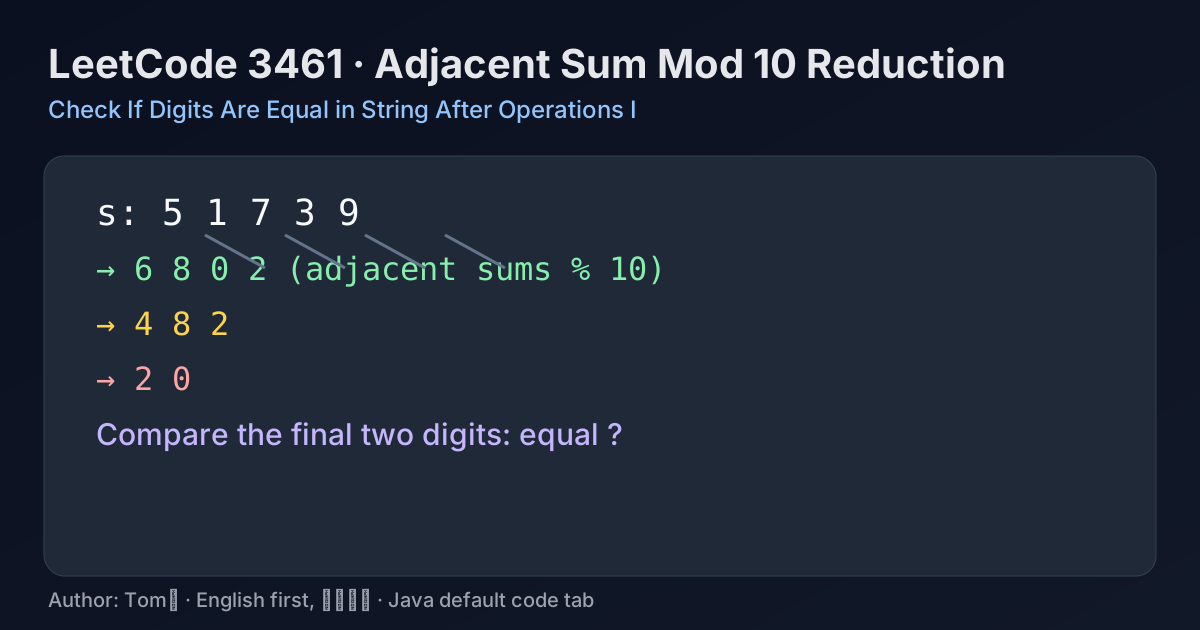
Given a digit string s, repeatedly replace it with the sequence formed by adjacent sums modulo 10: next[i] = (s[i] + s[i+1]) % 10. Continue until only two digits remain, and return whether they are equal.
Key Insight
This is a deterministic triangle-style reduction. Every round shortens the string by one, so simulation is straightforward and safe under the constraints.
Algorithm
- Convert characters to integer digits array.
- While length > 2, build a new array of length n-1 using adjacent modulo-10 sums.
- Replace current array with the new one.
- At length 2, return whether the two digits are equal.
Complexity Analysis
For length n, total operations are (n-1) + (n-2) + ... + 1 = O(n^2).
Time: O(n^2).
Space: O(n) for the current/next arrays.
Common Pitfalls
- Forgetting modulo 10 on each adjacent sum.
- Mutating in place incorrectly and corrupting values needed by the same round.
- Stopping at length 1 instead of length 2.
Reference Implementations (Java / Go / C++ / Python / JavaScript)
class Solution {
    public boolean hasSameDigits(String s) {
        int n = s.length();
        int[] cur = new int[n];
        for (int i = 0; i < n; i++) {
            cur[i] = s.charAt(i) - '0';
        }

        while (n > 2) {
            int[] next = new int[n - 1];
            for (int i = 0; i < n - 1; i++) {
                next[i] = (cur[i] + cur[i + 1]) % 10;
            }
            cur = next;
            n--;
        }
        return cur[0] == cur[1];
    }
}
func hasSameDigits(s string) bool {
n := len(s)
cur := make([]int, n)
for i := 0; i < n; i++ {
cur[i] = int(s[i] - '0')
}
for n > 2 {
next := make([]int, n-1)
for i := 0; i < n-1; i++ {
next[i] = (cur[i] + cur[i+1]) % 10
}
cur = next
n--
}
return cur[0] == cur[1]
}class Solution {
public:
bool hasSameDigits(string s) {
int n = s.size();
vector<int> cur(n);
for (int i = 0; i < n; i++) {
cur[i] = s[i] - '0';
}
while (n > 2) {
vector<int> next(n - 1);
for (int i = 0; i < n - 1; i++) {
next[i] = (cur[i] + cur[i + 1]) % 10;
}
cur = move(next);
n--;
}
return cur[0] == cur[1];
}
};class Solution:
def hasSameDigits(self, s: str) -> bool:
cur = [ord(ch) - ord('0') for ch in s]
while len(cur) > 2:
cur = [(cur[i] + cur[i + 1]) % 10 for i in range(len(cur) - 1)]
return cur[0] == cur[1]var hasSameDigits = function(s) {
let cur = Array.from(s, ch => ch.charCodeAt(0) - 48);
while (cur.length > 2) {
const next = new Array(cur.length - 1);
for (let i = 0; i < cur.length - 1; i++) {
next[i] = (cur[i] + cur[i + 1]) % 10;
}
cur = next;
}
return cur[0] === cur[1];
};中文
题目概述
给你一个数字字符串 s。重复执行操作:把每一对相邻数字相加后对 10 取模,形成新字符串,直到只剩两个数字。判断这两个数字是否相等。
核心思路
这是一个固定过程的“数字三角形”收缩。每轮长度减少 1,直接模拟即可,逻辑清晰且在题目约束内足够高效。
算法步骤
- 先把字符串转成整型数组。
- 当数组长度大于 2 时,构造长度为 n-1 的新数组。
- 新数组第 i 位为 (cur[i] + cur[i+1]) % 10。
- 替换当前数组,继续下一轮。
- 最终比较剩余两个数字是否相等。
复杂度分析
长度为 n 时,总计算量为 (n-1)+(n-2)+...+1。
时间复杂度:O(n^2)。
空间复杂度:O(n)。
常见陷阱
- 忘记每步都要对 10 取模。
- 原地覆盖导致本轮后续计算读到被污染的数据。
- 终止条件写错(应该停在长度为 2)。
多语言参考实现(Java / Go / C++ / Python / JavaScript)
class Solution {
    public boolean hasSameDigits(String s) {
        int n = s.length();
        int[] cur = new int[n];
        for (int i = 0; i < n; i++) {
            cur[i] = s.charAt(i) - '0';
        }

        while (n > 2) {
            int[] next = new int[n - 1];
            for (int i = 0; i < n - 1; i++) {
                next[i] = (cur[i] + cur[i + 1]) % 10;
            }
            cur = next;
            n--;
        }
        return cur[0] == cur[1];
    }
}
func hasSameDigits(s string) bool {
n := len(s)
cur := make([]int, n)
for i := 0; i < n; i++ {
cur[i] = int(s[i] - '0')
}
for n > 2 {
next := make([]int, n-1)
for i := 0; i < n-1; i++ {
next[i] = (cur[i] + cur[i+1]) % 10
}
cur = next
n--
}
return cur[0] == cur[1]
}class Solution {
public:
bool hasSameDigits(string s) {
int n = s.size();
vector<int> cur(n);
for (int i = 0; i < n; i++) {
cur[i] = s[i] - '0';
}
while (n > 2) {
vector<int> next(n - 1);
for (int i = 0; i < n - 1; i++) {
next[i] = (cur[i] + cur[i + 1]) % 10;
}
cur = move(next);
n--;
}
return cur[0] == cur[1];
}
};class Solution:
def hasSameDigits(self, s: str) -> bool:
cur = [ord(ch) - ord('0') for ch in s]
while len(cur) > 2:
cur = [(cur[i] + cur[i + 1]) % 10 for i in range(len(cur) - 1)]
return cur[0] == cur[1]var hasSameDigits = function(s) {
let cur = Array.from(s, ch => ch.charCodeAt(0) - 48);
while (cur.length > 2) {
const next = new Array(cur.length - 1);
for (let i = 0; i < cur.length - 1; i++) {
next[i] = (cur[i] + cur[i + 1]) % 10;
}
cur = next;
}
return cur[0] === cur[1];
};
Comments