LeetCode 3330: Find the Original Typed String I (Group Counting)
LeetCode 3330StringCountingToday we solve LeetCode 3330 - Find the Original Typed String I.
Source: https://leetcode.com/problems/find-the-original-typed-string-i/
English
Problem Summary
A typed string may contain one accidental long-press. Return how many different original strings could produce the final word.
Key Insight
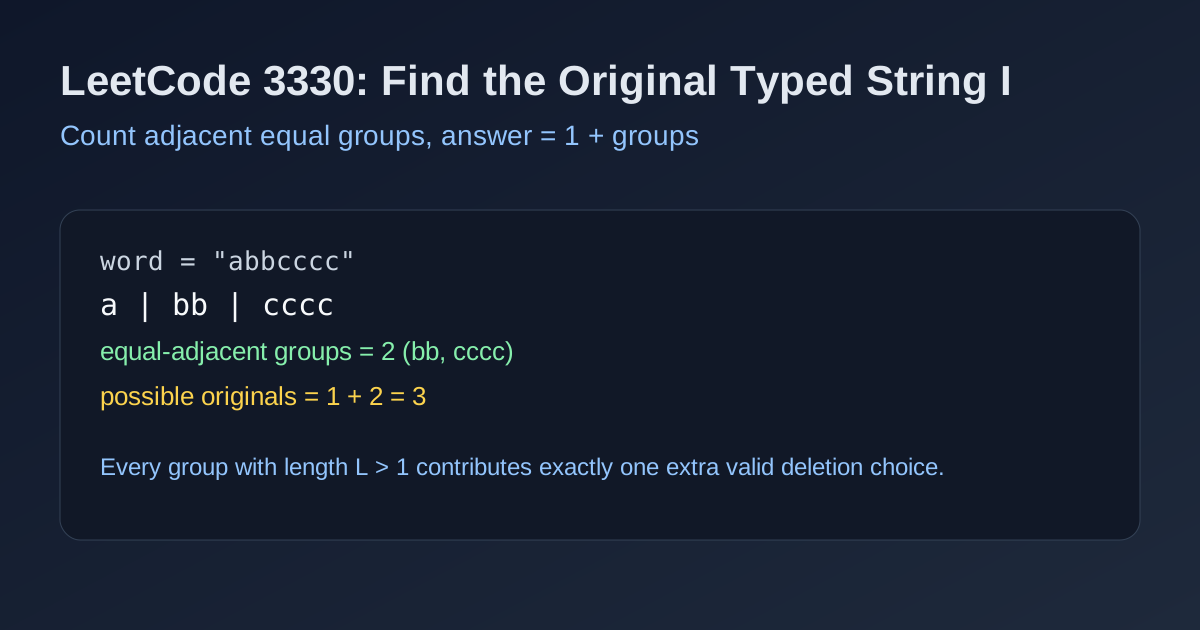
The only freedom comes from a run of identical adjacent characters. For every adjacent equal pair word[i] == word[i-1], we gain exactly one additional valid original string, besides keeping the string unchanged.
Algorithm
- Initialize answer as 1 (no deletion case).
- Scan from index 1 to end.
- If current char equals previous char, increment answer.
Complexity Analysis
Time: O(n).
Space: O(1).
Common Pitfalls
- Starting from 0 and reading i-1 out of bounds.
- Forgetting the base case 1 (the original string can be unchanged).
- Overthinking with DP although one pass is enough.
Reference Implementations (Java / Go / C++ / Python / JavaScript)
class Solution {
    public int possibleStringCount(String word) {
        int ans = 1;
        for (int i = 1; i < word.length(); i++) {
            if (word.charAt(i) == word.charAt(i - 1)) {
                ans++;
            }
        }
        return ans;
    }
}
func possibleStringCount(word string) int {
ans := 1
for i := 1; i < len(word); i++ {
if word[i] == word[i-1] {
ans++
}
}
return ans
}class Solution {
public:
int possibleStringCount(string word) {
int ans = 1;
for (int i = 1; i < (int)word.size(); i++) {
if (word[i] == word[i - 1]) {
ans++;
}
}
return ans;
}
};class Solution:
def possibleStringCount(self, word: str) -> int:
ans = 1
for i in range(1, len(word)):
if word[i] == word[i - 1]:
ans += 1
return ans/**
* @param {string} word
* @return {number}
*/
var possibleStringCount = function(word) {
let ans = 1;
for (let i = 1; i < word.length; i++) {
if (word[i] === word[i - 1]) {
ans++;
}
}
return ans;
};中文
题目概述
给定最终输入结果 word,其中可能发生过一次“长按”导致某个字符重复。请返回可能的原始字符串数量。
核心思路
变化只会来自相邻相同字符的连续段。每出现一次 word[i] == word[i-1],就多一种可行原串(删去该连续段中的一个重复),再加上“不删”的 1 种。
算法步骤
- 先令答案为 1(表示不做删除)。
- 从下标 1 开始线性扫描。
- 若当前字符与前一字符相同,答案加一。
复杂度分析
时间复杂度:O(n)。
空间复杂度:O(1)。
常见陷阱
- 从 0 开始比较导致访问越界。
- 忘记把“不删除”的情况计入答案(初值应为 1)。
- 把简单计数问题复杂化成不必要的 DP。
多语言参考实现(Java / Go / C++ / Python / JavaScript)
class Solution {
    public int possibleStringCount(String word) {
        int ans = 1;
        for (int i = 1; i < word.length(); i++) {
            if (word.charAt(i) == word.charAt(i - 1)) {
                ans++;
            }
        }
        return ans;
    }
}
func possibleStringCount(word string) int {
ans := 1
for i := 1; i < len(word); i++ {
if word[i] == word[i-1] {
ans++
}
}
return ans
}class Solution {
public:
int possibleStringCount(string word) {
int ans = 1;
for (int i = 1; i < (int)word.size(); i++) {
if (word[i] == word[i - 1]) {
ans++;
}
}
return ans;
}
};class Solution:
def possibleStringCount(self, word: str) -> int:
ans = 1
for i in range(1, len(word)):
if word[i] == word[i - 1]:
ans += 1
return ans/**
* @param {string} word
* @return {number}
*/
var possibleStringCount = function(word) {
let ans = 1;
for (let i = 1; i < word.length; i++) {
if (word[i] === word[i - 1]) {
ans++;
}
}
return ans;
};
Comments