LeetCode 318: Maximum Product of Word Lengths (Bitmask Disjoint Check)
LeetCode 318BitmaskStringToday we solve LeetCode 318 - Maximum Product of Word Lengths.
Source: https://leetcode.com/problems/maximum-product-of-word-lengths/
English
Problem Summary
Given an array of lowercase words, choose two words that share no common letters. Return the maximum product of their lengths.
Key Idea
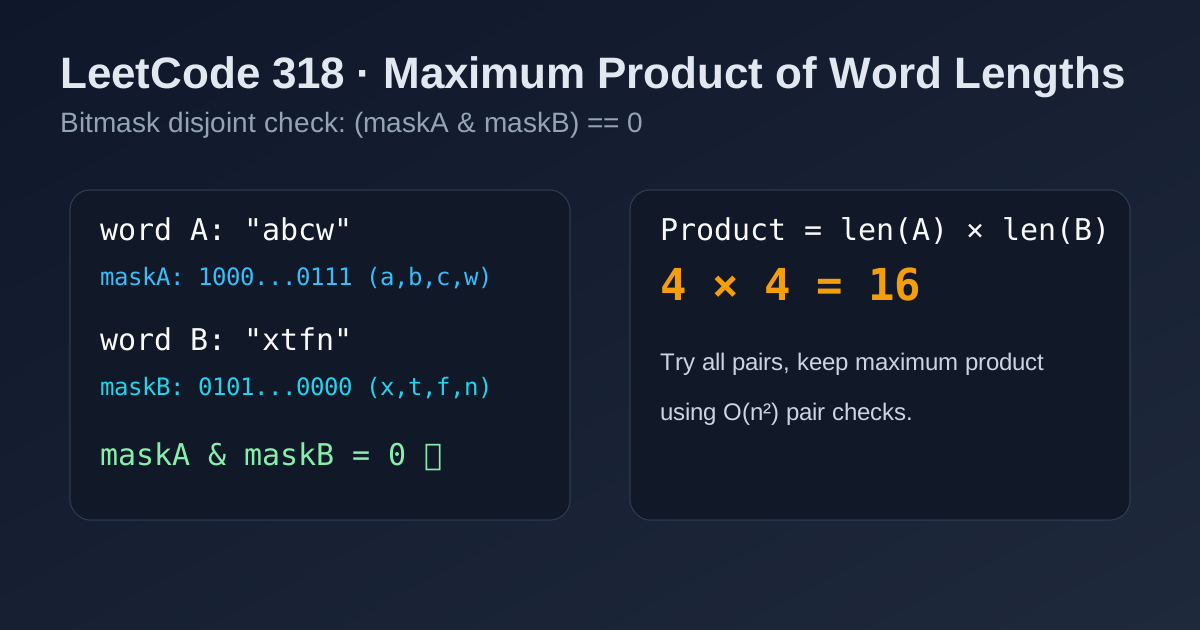
Encode each word into a 26-bit integer mask. Bit b is 1 if character 'a' + b appears in the word.
Two words are disjoint iff (mask[i] & mask[j]) == 0. Then their candidate score is len[i] * len[j].
Algorithm
1) Build mask[i] and len[i] for each word.
2) Enumerate all pairs (i, j) with i < j.
3) If masks do not overlap, update answer with product.
4) Return the maximum.
Complexity
Building masks: O(totalChars). Pair scan: O(n^2). Extra space: O(n).
Reference Implementations (Java / Go / C++ / Python / JavaScript)
class Solution {
    public int maxProduct(String[] words) {
        int n = words.length;
        int[] masks = new int[n];
        int[] lens = new int[n];

        for (int i = 0; i < n; i++) {
            int mask = 0;
            for (char c : words[i].toCharArray()) {
                mask |= 1 << (c - 'a');
            }
            masks[i] = mask;
            lens[i] = words[i].length();
        }

        int ans = 0;
        for (int i = 0; i < n; i++) {
            for (int j = i + 1; j < n; j++) {
                if ((masks[i] & masks[j]) == 0) {
                    ans = Math.max(ans, lens[i] * lens[j]);
                }
            }
        }
        return ans;
    }
}
func maxProduct(words []string) int {
n := len(words)
masks := make([]int, n)
lens := make([]int, n)
for i, w := range words {
mask := 0
for _, ch := range w {
mask |= 1 << (ch - 'a')
}
masks[i] = mask
lens[i] = len(w)
}
ans := 0
for i := 0; i < n; i++ {
for j := i + 1; j < n; j++ {
if (masks[i] & masks[j]) == 0 {
p := lens[i] * lens[j]
if p > ans {
ans = p
}
}
}
}
return ans
}class Solution {
public:
int maxProduct(vector<string>& words) {
int n = (int)words.size();
vector<int> masks(n), lens(n);
for (int i = 0; i < n; ++i) {
int mask = 0;
for (char c : words[i]) {
mask |= 1 << (c - 'a');
}
masks[i] = mask;
lens[i] = (int)words[i].size();
}
int ans = 0;
for (int i = 0; i < n; ++i) {
for (int j = i + 1; j < n; ++j) {
if ((masks[i] & masks[j]) == 0) {
ans = max(ans, lens[i] * lens[j]);
}
}
}
return ans;
}
};class Solution:
def maxProduct(self, words: List[str]) -> int:
n = len(words)
masks = [0] * n
lens = [0] * n
for i, w in enumerate(words):
mask = 0
for ch in w:
mask |= 1 << (ord(ch) - ord('a'))
masks[i] = mask
lens[i] = len(w)
ans = 0
for i in range(n):
for j in range(i + 1, n):
if masks[i] & masks[j] == 0:
ans = max(ans, lens[i] * lens[j])
return ansvar maxProduct = function(words) {
const n = words.length;
const masks = new Array(n).fill(0);
const lens = new Array(n).fill(0);
for (let i = 0; i < n; i++) {
let mask = 0;
for (const ch of words[i]) {
mask |= 1 << (ch.charCodeAt(0) - 97);
}
masks[i] = mask;
lens[i] = words[i].length;
}
let ans = 0;
for (let i = 0; i < n; i++) {
for (let j = i + 1; j < n; j++) {
if ((masks[i] & masks[j]) === 0) {
ans = Math.max(ans, lens[i] * lens[j]);
}
}
}
return ans;
};中文
题目概述
给定一组只含小写字母的单词,选择两个没有公共字符的单词,使它们长度乘积最大,返回这个最大值。
核心思路
用一个 26 位整数表示每个单词的字符集合:如果单词中出现了某个字母,就把对应位设为 1。
两个单词没有公共字符,当且仅当 (mask[i] & mask[j]) == 0。满足时可尝试更新答案 len[i] * len[j]。
算法步骤
1)预处理每个单词的位掩码和长度。
2)双重循环枚举所有 i < j 的单词对。
3)若掩码按位与为 0,说明无重叠字符,更新最大乘积。
4)返回答案。
复杂度分析
构建掩码耗时 O(totalChars),枚举对数耗时 O(n^2),额外空间 O(n)。
参考实现(Java / Go / C++ / Python / JavaScript)
class Solution {
    public int maxProduct(String[] words) {
        int n = words.length;
        int[] masks = new int[n];
        int[] lens = new int[n];

        for (int i = 0; i < n; i++) {
            int mask = 0;
            for (char c : words[i].toCharArray()) {
                mask |= 1 << (c - 'a');
            }
            masks[i] = mask;
            lens[i] = words[i].length();
        }

        int ans = 0;
        for (int i = 0; i < n; i++) {
            for (int j = i + 1; j < n; j++) {
                if ((masks[i] & masks[j]) == 0) {
                    ans = Math.max(ans, lens[i] * lens[j]);
                }
            }
        }
        return ans;
    }
}
func maxProduct(words []string) int {
n := len(words)
masks := make([]int, n)
lens := make([]int, n)
for i, w := range words {
mask := 0
for _, ch := range w {
mask |= 1 << (ch - 'a')
}
masks[i] = mask
lens[i] = len(w)
}
ans := 0
for i := 0; i < n; i++ {
for j := i + 1; j < n; j++ {
if (masks[i] & masks[j]) == 0 {
p := lens[i] * lens[j]
if p > ans {
ans = p
}
}
}
}
return ans
}class Solution {
public:
int maxProduct(vector<string>& words) {
int n = (int)words.size();
vector<int> masks(n), lens(n);
for (int i = 0; i < n; ++i) {
int mask = 0;
for (char c : words[i]) {
mask |= 1 << (c - 'a');
}
masks[i] = mask;
lens[i] = (int)words[i].size();
}
int ans = 0;
for (int i = 0; i < n; ++i) {
for (int j = i + 1; j < n; ++j) {
if ((masks[i] & masks[j]) == 0) {
ans = max(ans, lens[i] * lens[j]);
}
}
}
return ans;
}
};class Solution:
def maxProduct(self, words: List[str]) -> int:
n = len(words)
masks = [0] * n
lens = [0] * n
for i, w in enumerate(words):
mask = 0
for ch in w:
mask |= 1 << (ord(ch) - ord('a'))
masks[i] = mask
lens[i] = len(w)
ans = 0
for i in range(n):
for j in range(i + 1, n):
if masks[i] & masks[j] == 0:
ans = max(ans, lens[i] * lens[j])
return ansvar maxProduct = function(words) {
const n = words.length;
const masks = new Array(n).fill(0);
const lens = new Array(n).fill(0);
for (let i = 0; i < n; i++) {
let mask = 0;
for (const ch of words[i]) {
mask |= 1 << (ch.charCodeAt(0) - 97);
}
masks[i] = mask;
lens[i] = words[i].length;
}
let ans = 0;
for (let i = 0; i < n; i++) {
for (let j = i + 1; j < n; j++) {
if ((masks[i] & masks[j]) === 0) {
ans = Math.max(ans, lens[i] * lens[j]);
}
}
}
return ans;
};
Comments