LeetCode 3042: Count Prefix and Suffix Pairs I (Double Loop + Prefix/Suffix Check)
LeetCode 3042StringBrute ForceToday we solve LeetCode 3042 - Count Prefix and Suffix Pairs I.
Source: https://leetcode.com/problems/count-prefix-and-suffix-pairs-i/
English
Problem Summary
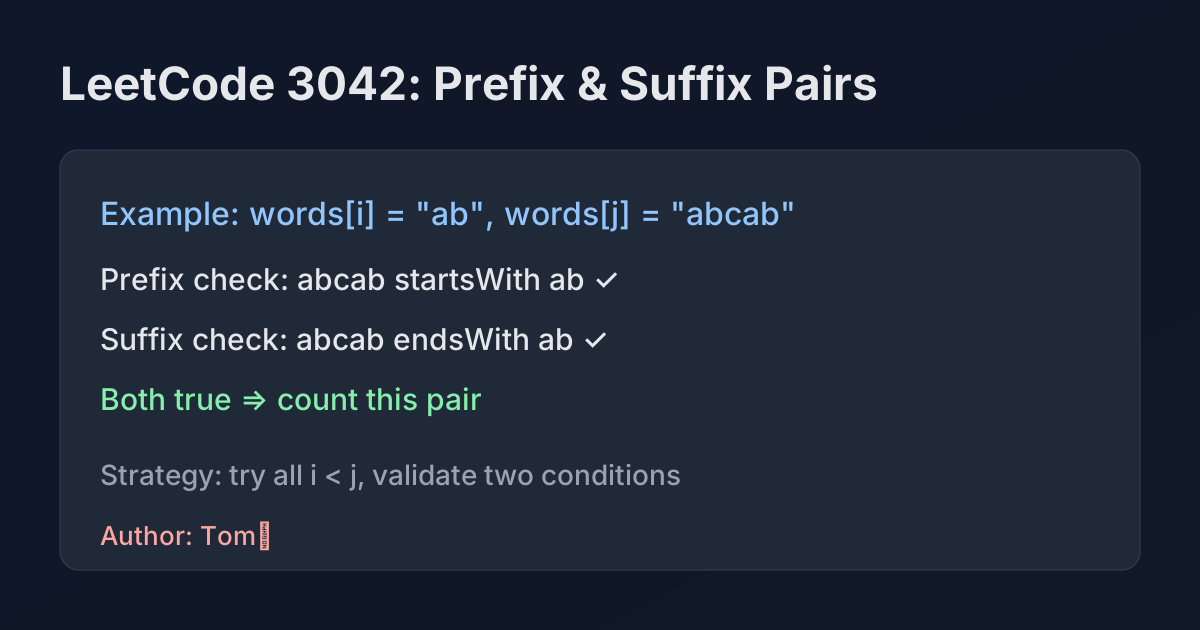
Given an array of strings, count pairs (i, j) with i < j where words[i] is both a prefix and a suffix of words[j].
Key Insight
For each ordered pair (i, j), directly verify two conditions on words[j]: starts with words[i], and ends with words[i]. This exactly matches the definition.
Brute Force and Limitations
Try every pair (i, j). Because constraints are small in version I, an O(n² * m) approach is acceptable and simple.
Optimal Algorithm Steps
1) Iterate i from 0 to n-1.
2) Iterate j from i+1 to n-1.
3) Check both prefix and suffix conditions.
4) Increase answer when both are true.
Complexity Analysis
Let n be number of words and m be average word length.
Time: O(n^2 * m).
Space: O(1) extra.
Common Pitfalls
- Forgetting i < j order.
- Checking only prefix or only suffix.
- Mishandling equal strings, which are valid when i < j.
Reference Implementations (Java / Go / C++ / Python / JavaScript)
class Solution {
    public int countPrefixSuffixPairs(String[] words) {
        int n = words.length;
        int ans = 0;

        for (int i = 0; i < n; i++) {
            for (int j = i + 1; j < n; j++) {
                if (isPrefixAndSuffix(words[i], words[j])) {
                    ans++;
                }
            }
        }

        return ans;
    }

    private boolean isPrefixAndSuffix(String a, String b) {
        return b.startsWith(a) && b.endsWith(a);
    }
}
func countPrefixSuffixPairs(words []string) int {
n := len(words)
ans := 0
for i := 0; i < n; i++ {
for j := i + 1; j < n; j++ {
if strings.HasPrefix(words[j], words[i]) && strings.HasSuffix(words[j], words[i]) {
ans++
}
}
}
return ans
}class Solution {
public:
int countPrefixSuffixPairs(vector<string>& words) {
int n = (int)words.size();
int ans = 0;
for (int i = 0; i < n; i++) {
for (int j = i + 1; j < n; j++) {
if (isPrefixAndSuffix(words[i], words[j])) {
ans++;
}
}
}
return ans;
}
private:
bool isPrefixAndSuffix(const string& a, const string& b) {
if (a.size() > b.size()) return false;
return b.compare(0, a.size(), a) == 0 &&
b.compare(b.size() - a.size(), a.size(), a) == 0;
}
};class Solution:
def countPrefixSuffixPairs(self, words: list[str]) -> int:
n = len(words)
ans = 0
for i in range(n):
for j in range(i + 1, n):
a = words[i]
b = words[j]
if b.startswith(a) and b.endswith(a):
ans += 1
return ans/**
* @param {string[]} words
* @return {number}
*/
var countPrefixSuffixPairs = function(words) {
const n = words.length;
let ans = 0;
for (let i = 0; i < n; i++) {
for (let j = i + 1; j < n; j++) {
const a = words[i];
const b = words[j];
if (b.startsWith(a) && b.endsWith(a)) {
ans++;
}
}
}
return ans;
};中文
题目概述
给定字符串数组,统计满足 i < j 且 words[i] 同时是 words[j] 前缀和后缀的下标对数量。
核心思路
按照定义逐对检查最直接:对每个 (i, j),只要 words[j] 以 words[i] 开头且以 words[i] 结尾,就计数。
暴力解法与不足
版本 I 的数据范围较小,双重循环枚举所有下标对即可,逻辑清晰且不易出错。
最优算法步骤
1)枚举 i。
2)枚举 j(j > i)。
3)判断 words[j] 是否同时满足前缀与后缀条件。
4)满足则答案加一。
复杂度分析
设字符串数量为 n,平均长度为 m。
时间复杂度:O(n^2 * m)。
空间复杂度:O(1)。
常见陷阱
- 忘记只统计 i < j。
- 只判断前缀或只判断后缀。
- 忽略相同字符串也可能构成合法对。
多语言参考实现(Java / Go / C++ / Python / JavaScript)
class Solution {
    public int countPrefixSuffixPairs(String[] words) {
        int n = words.length;
        int ans = 0;

        for (int i = 0; i < n; i++) {
            for (int j = i + 1; j < n; j++) {
                if (isPrefixAndSuffix(words[i], words[j])) {
                    ans++;
                }
            }
        }

        return ans;
    }

    private boolean isPrefixAndSuffix(String a, String b) {
        return b.startsWith(a) && b.endsWith(a);
    }
}
func countPrefixSuffixPairs(words []string) int {
n := len(words)
ans := 0
for i := 0; i < n; i++ {
for j := i + 1; j < n; j++ {
if strings.HasPrefix(words[j], words[i]) && strings.HasSuffix(words[j], words[i]) {
ans++
}
}
}
return ans
}class Solution {
public:
int countPrefixSuffixPairs(vector<string>& words) {
int n = (int)words.size();
int ans = 0;
for (int i = 0; i < n; i++) {
for (int j = i + 1; j < n; j++) {
if (isPrefixAndSuffix(words[i], words[j])) {
ans++;
}
}
}
return ans;
}
private:
bool isPrefixAndSuffix(const string& a, const string& b) {
if (a.size() > b.size()) return false;
return b.compare(0, a.size(), a) == 0 &&
b.compare(b.size() - a.size(), a.size(), a) == 0;
}
};class Solution:
def countPrefixSuffixPairs(self, words: list[str]) -> int:
n = len(words)
ans = 0
for i in range(n):
for j in range(i + 1, n):
a = words[i]
b = words[j]
if b.startswith(a) and b.endswith(a):
ans += 1
return ans/**
* @param {string[]} words
* @return {number}
*/
var countPrefixSuffixPairs = function(words) {
const n = words.length;
let ans = 0;
for (let i = 0; i < n; i++) {
for (let j = i + 1; j < n; j++) {
const a = words[i];
const b = words[j];
if (b.startsWith(a) && b.endsWith(a)) {
ans++;
}
}
}
return ans;
};
Comments