LeetCode 2996: Smallest Missing Integer Greater Than Sequential Prefix Sum (Prefix Run + Hash Set)
LeetCode 2996ArrayHash SetToday we solve LeetCode 2996 - Smallest Missing Integer Greater Than Sequential Prefix Sum.
Source: https://leetcode.com/problems/smallest-missing-integer-greater-than-sequential-prefix-sum/
English
Problem Summary
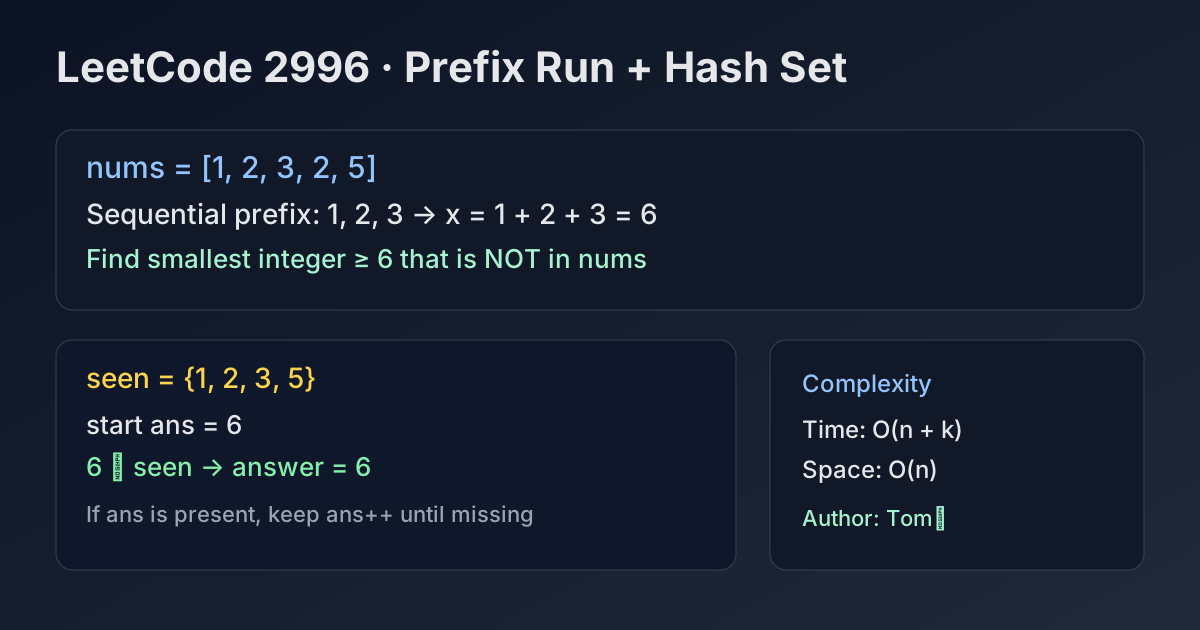
Given an array nums, first find the longest prefix where every next number is exactly +1. Let x be the sum of this prefix. Return the smallest integer >= x that does not appear in nums.
Key Insight
The task has two independent parts: (1) compute the sequential-prefix sum once, (2) test membership quickly while increasing from that sum. A hash set makes each existence check O(1) average.
Algorithm
- Initialize sum = nums[0].
- Extend the prefix while nums[i] == nums[i-1] + 1, and accumulate into sum.
- Put all numbers into a hash set seen.
- Start from ans = sum; while ans exists in seen, increment ans.
- Return ans.
Complexity Analysis
Time: O(n + k), where k is the number of consecutive present integers checked from sum upward.
Space: O(n).
Common Pitfalls
- Summing the entire array instead of only the sequential prefix.
- Misreading condition as non-decreasing (>=) instead of exactly +1.
- Starting search from sum + 1 (must start from sum itself).
Reference Implementations (Java / Go / C++ / Python / JavaScript)
class Solution {
    public int missingInteger(int[] nums) {
        int n = nums.length;
        int sum = nums[0];

        int i = 1;
        while (i < n && nums[i] == nums[i - 1] + 1) {
            sum += nums[i];
            i++;
        }

        java.util.HashSet<Integer> seen = new java.util.HashSet<>();
        for (int v : nums) {
            seen.add(v);
        }

        int ans = sum;
        while (seen.contains(ans)) {
            ans++;
        }
        return ans;
    }
}
func missingInteger(nums []int) int {
n := len(nums)
sum := nums[0]
i := 1
for i < n && nums[i] == nums[i-1]+1 {
sum += nums[i]
i++
}
seen := make(map[int]bool, n)
for _, v := range nums {
seen[v] = true
}
ans := sum
for seen[ans] {
ans++
}
return ans
}class Solution {
public:
int missingInteger(vector<int>& nums) {
int n = (int)nums.size();
int sum = nums[0];
int i = 1;
while (i < n && nums[i] == nums[i - 1] + 1) {
sum += nums[i];
i++;
}
unordered_set<int> seen(nums.begin(), nums.end());
int ans = sum;
while (seen.count(ans)) {
ans++;
}
return ans;
}
};class Solution:
def missingInteger(self, nums: List[int]) -> int:
n = len(nums)
total = nums[0]
i = 1
while i < n and nums[i] == nums[i - 1] + 1:
total += nums[i]
i += 1
seen = set(nums)
ans = total
while ans in seen:
ans += 1
return ansvar missingInteger = function(nums) {
const n = nums.length;
let sum = nums[0];
let i = 1;
while (i < n && nums[i] === nums[i - 1] + 1) {
sum += nums[i];
i++;
}
const seen = new Set(nums);
let ans = sum;
while (seen.has(ans)) {
ans++;
}
return ans;
};中文
题目概述
给定数组 nums,先找到最长前缀,使得相邻元素严格满足 +1 递增。设这个前缀和为 x。然后返回最小的、满足 >= x 且不在数组中的整数。
核心思路
问题可拆成两步:第一步只负责算“连续前缀和”;第二步从该和开始向上找第一个缺失值。用哈希集合做存在性判断,查询是均摊 O(1)。
算法步骤
- 初始化 sum = nums[0]。
- 当 nums[i] == nums[i-1] + 1 时继续扩展前缀并累加。
- 用哈希集合保存所有数组元素。
- 从 ans = sum 开始,如果集合里存在就不断 ans++。
- 第一个不存在的 ans 即答案。
复杂度分析
时间复杂度:O(n + k),其中 k 是从 sum 往上连续命中的次数。
空间复杂度:O(n)。
常见陷阱
- 把整个数组求和,而不是只求“连续前缀”的和。
- 条件写成非递减,正确条件应是“严格 +1”。
- 从 sum + 1 开始找,导致漏掉 sum 本身可能缺失的情况。
多语言参考实现(Java / Go / C++ / Python / JavaScript)
class Solution {
    public int missingInteger(int[] nums) {
        int n = nums.length;
        int sum = nums[0];

        int i = 1;
        while (i < n && nums[i] == nums[i - 1] + 1) {
            sum += nums[i];
            i++;
        }

        java.util.HashSet<Integer> seen = new java.util.HashSet<>();
        for (int v : nums) {
            seen.add(v);
        }

        int ans = sum;
        while (seen.contains(ans)) {
            ans++;
        }
        return ans;
    }
}
func missingInteger(nums []int) int {
n := len(nums)
sum := nums[0]
i := 1
for i < n && nums[i] == nums[i-1]+1 {
sum += nums[i]
i++
}
seen := make(map[int]bool, n)
for _, v := range nums {
seen[v] = true
}
ans := sum
for seen[ans] {
ans++
}
return ans
}class Solution {
public:
int missingInteger(vector<int>& nums) {
int n = (int)nums.size();
int sum = nums[0];
int i = 1;
while (i < n && nums[i] == nums[i - 1] + 1) {
sum += nums[i];
i++;
}
unordered_set<int> seen(nums.begin(), nums.end());
int ans = sum;
while (seen.count(ans)) {
ans++;
}
return ans;
}
};class Solution:
def missingInteger(self, nums: List[int]) -> int:
n = len(nums)
total = nums[0]
i = 1
while i < n and nums[i] == nums[i - 1] + 1:
total += nums[i]
i += 1
seen = set(nums)
ans = total
while ans in seen:
ans += 1
return ansvar missingInteger = function(nums) {
const n = nums.length;
let sum = nums[0];
let i = 1;
while (i < n && nums[i] === nums[i - 1] + 1) {
sum += nums[i];
i++;
}
const seen = new Set(nums);
let ans = sum;
while (seen.has(ans)) {
ans++;
}
return ans;
};
Comments