LeetCode 2960: Count Tested Devices After Test Operations (Greedy Decrement Tracking)
LeetCode 2960GreedySimulationToday we solve LeetCode 2960 - Count Tested Devices After Test Operations.
Source: https://leetcode.com/problems/count-tested-devices-after-test-operations/
English
Problem Summary
You process devices from left to right. If a device has positive battery, you test it and every device to its right loses 1 battery (not below 0). Return how many devices are tested.
Key Insight
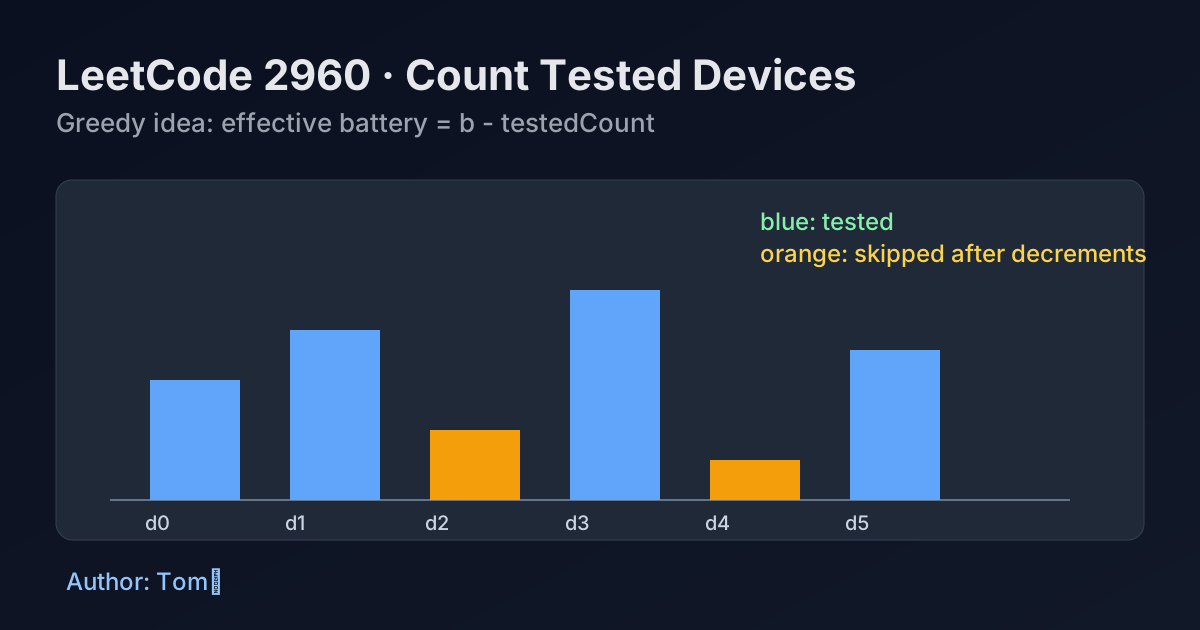
Instead of decrementing all suffix elements each time, track how many tests already happened: dec. For current battery b, its effective value is b - dec. If that is still positive, this device can be tested and dec increases by 1.
Algorithm
- Initialize tested = 0 and dec = 0.
- Scan each b in batteryPercentages.
- If b - dec > 0, test this device: tested++, dec++.
- Otherwise skip it.
- Return tested.
Complexity Analysis
Time: O(n).
Space: O(1).
Common Pitfalls
- Simulating full suffix decrements gives O(n^2) unnecessarily.
- Forgetting that battery cannot go below 0 in the simulation model.
- Using b > 0 directly instead of b - dec > 0.
Reference Implementations (Java / Go / C++ / Python / JavaScript)
class Solution {
    public int countTestedDevices(int[] batteryPercentages) {
        int tested = 0;
        int dec = 0;
        for (int b : batteryPercentages) {
            if (b - dec > 0) {
                tested++;
                dec++;
            }
        }
        return tested;
    }
}
func countTestedDevices(batteryPercentages []int) int {
tested, dec := 0, 0
for _, b := range batteryPercentages {
if b-dec > 0 {
tested++
dec++
}
}
return tested
}class Solution {
public:
int countTestedDevices(vector<int>& batteryPercentages) {
int tested = 0, dec = 0;
for (int b : batteryPercentages) {
if (b - dec > 0) {
tested++;
dec++;
}
}
return tested;
}
};class Solution:
def countTestedDevices(self, batteryPercentages: List[int]) -> int:
tested = 0
dec = 0
for b in batteryPercentages:
if b - dec > 0:
tested += 1
dec += 1
return testedvar countTestedDevices = function(batteryPercentages) {
let tested = 0;
let dec = 0;
for (const b of batteryPercentages) {
if (b - dec > 0) {
tested++;
dec++;
}
}
return tested;
};中文
题目概述
按顺序处理设备。若当前设备电量大于 0,则测试该设备,并让其右侧所有设备电量各减 1(最低到 0)。求最终可测试设备数量。
核心思路
不需要每次真的把后缀全部减一,只要记录已经触发过多少次减一:dec。遍历到电量 b 时,它的“有效电量”是 b - dec。若仍大于 0,就能测试并让 dec 再加 1。
算法步骤
- 初始化 tested = 0、dec = 0。
- 线性遍历数组中的每个 b。
- 若 b - dec > 0,说明该设备仍有电:tested++ 且 dec++。
- 否则跳过当前设备。
- 遍历结束返回 tested。
复杂度分析
时间复杂度:O(n)。
空间复杂度:O(1)。
常见陷阱
- 用后缀逐个递减模拟,复杂度退化到 O(n^2)。
- 忽略“电量最低为 0”的边界语义。
- 条件写成 b > 0 而不是 b - dec > 0。
多语言参考实现(Java / Go / C++ / Python / JavaScript)
class Solution {
    public int countTestedDevices(int[] batteryPercentages) {
        int tested = 0;
        int dec = 0;
        for (int b : batteryPercentages) {
            if (b - dec > 0) {
                tested++;
                dec++;
            }
        }
        return tested;
    }
}
func countTestedDevices(batteryPercentages []int) int {
tested, dec := 0, 0
for _, b := range batteryPercentages {
if b-dec > 0 {
tested++
dec++
}
}
return tested
}class Solution {
public:
int countTestedDevices(vector<int>& batteryPercentages) {
int tested = 0, dec = 0;
for (int b : batteryPercentages) {
if (b - dec > 0) {
tested++;
dec++;
}
}
return tested;
}
};class Solution:
def countTestedDevices(self, batteryPercentages: List[int]) -> int:
tested = 0
dec = 0
for b in batteryPercentages:
if b - dec > 0:
tested += 1
dec += 1
return testedvar countTestedDevices = function(batteryPercentages) {
let tested = 0;
let dec = 0;
for (const b of batteryPercentages) {
if (b - dec > 0) {
tested++;
dec++;
}
}
return tested;
};
Comments