LeetCode 2824: Count Pairs Whose Sum is Less than Target (Sort + Two Pointers)
LeetCode 2824Two PointersSortingToday we solve LeetCode 2824 - Count Pairs Whose Sum is Less than Target.
Source: https://leetcode.com/problems/count-pairs-whose-sum-is-less-than-target/
English
Problem Summary
Given an integer array nums and an integer target, count pairs (i, j) such that 0 <= i < j < n and nums[i] + nums[j] < target.
Key Insight
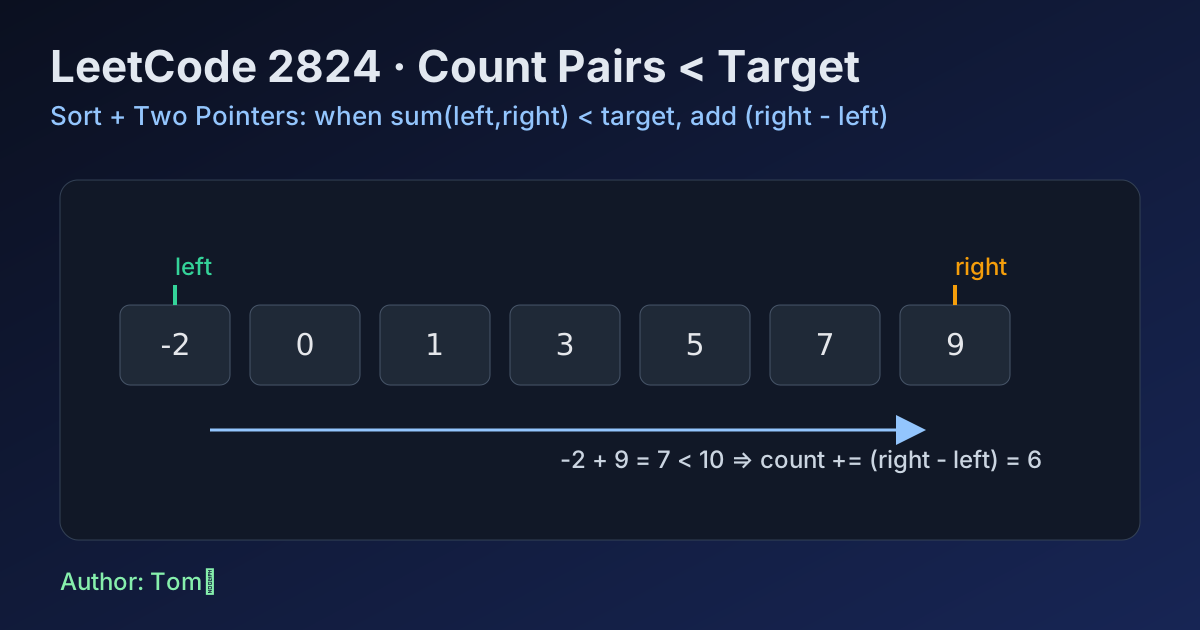
After sorting, if nums[left] + nums[right] < target, then every index between left+1 and right can pair with left and still satisfy the condition. So we can add right - left at once.
Algorithm
- Sort the array in non-decreasing order.
- Use two pointers: left = 0, right = n - 1.
- If nums[left] + nums[right] < target, add right - left to answer, then left++.
- Otherwise, decrease right-- to reduce the sum.
- Continue until left >= right.
Complexity Analysis
Let n be the array length.
Time: O(n log n) due to sorting; two-pointer scan is O(n).
Space: O(1) extra (excluding sort implementation overhead).
Common Pitfalls
- Forgetting the strict inequality (< target, not <= target).
- Moving both pointers when condition is true, which misses valid pairs.
- Doing a nested loop after sorting and losing the two-pointer optimization.
Reference Implementations (Java / Go / C++ / Python / JavaScript)
class Solution {
    public int countPairs(List<Integer> nums, int target) {
        Collections.sort(nums);
        int left = 0, right = nums.size() - 1;
        int ans = 0;

        while (left < right) {
            if (nums.get(left) + nums.get(right) < target) {
                ans += right - left;
                left++;
            } else {
                right--;
            }
        }

        return ans;
    }
}
func countPairs(nums []int, target int) int {
sort.Ints(nums)
left, right := 0, len(nums)-1
ans := 0
for left < right {
if nums[left]+nums[right] < target {
ans += right - left
left++
} else {
right--
}
}
return ans
}class Solution {
public:
int countPairs(vector<int>& nums, int target) {
sort(nums.begin(), nums.end());
int left = 0, right = (int)nums.size() - 1;
int ans = 0;
while (left < right) {
if (nums[left] + nums[right] < target) {
ans += right - left;
left++;
} else {
right--;
}
}
return ans;
}
};class Solution:
def countPairs(self, nums: List[int], target: int) -> int:
nums.sort()
left, right = 0, len(nums) - 1
ans = 0
while left < right:
if nums[left] + nums[right] < target:
ans += right - left
left += 1
else:
right -= 1
return ansvar countPairs = function(nums, target) {
nums.sort((a, b) => a - b);
let left = 0, right = nums.length - 1;
let ans = 0;
while (left < right) {
if (nums[left] + nums[right] < target) {
ans += right - left;
left++;
} else {
right--;
}
}
return ans;
};中文
题目概述
给定整数数组 nums 和整数 target,统计满足 0 <= i < j < n 且 nums[i] + nums[j] < target 的下标对数量。
核心思路
排序后使用双指针。如果 nums[left] + nums[right] < target,由于数组有序,则从 left+1 到 right 的所有元素都可以和 left 组成合法对,一次性增加 right - left。
算法步骤
- 先将数组升序排序。
- 设双指针 left = 0、right = n - 1。
- 若 nums[left] + nums[right] < target,答案加上 right - left,并令 left++。
- 否则说明和过大,令 right--。
- 循环直到 left >= right。
复杂度分析
设数组长度为 n。
时间复杂度:O(n log n)(排序主导),双指针扫描为 O(n)。
空间复杂度:O(1) 额外空间(不计排序内部开销)。
常见陷阱
- 把条件写成 <= target,题目要求是严格小于。
- 条件成立时同时移动两个指针,导致漏计。
- 排序后仍用双重循环,失去双指针的效率优势。
多语言参考实现(Java / Go / C++ / Python / JavaScript)
class Solution {
    public int countPairs(List<Integer> nums, int target) {
        Collections.sort(nums);
        int left = 0, right = nums.size() - 1;
        int ans = 0;

        while (left < right) {
            if (nums.get(left) + nums.get(right) < target) {
                ans += right - left;
                left++;
            } else {
                right--;
            }
        }

        return ans;
    }
}
func countPairs(nums []int, target int) int {
sort.Ints(nums)
left, right := 0, len(nums)-1
ans := 0
for left < right {
if nums[left]+nums[right] < target {
ans += right - left
left++
} else {
right--
}
}
return ans
}class Solution {
public:
int countPairs(vector<int>& nums, int target) {
sort(nums.begin(), nums.end());
int left = 0, right = (int)nums.size() - 1;
int ans = 0;
while (left < right) {
if (nums[left] + nums[right] < target) {
ans += right - left;
left++;
} else {
right--;
}
}
return ans;
}
};class Solution:
def countPairs(self, nums: List[int], target: int) -> int:
nums.sort()
left, right = 0, len(nums) - 1
ans = 0
while left < right:
if nums[left] + nums[right] < target:
ans += right - left
left += 1
else:
right -= 1
return ansvar countPairs = function(nums, target) {
nums.sort((a, b) => a - b);
let left = 0, right = nums.length - 1;
let ans = 0;
while (left < right) {
if (nums[left] + nums[right] < target) {
ans += right - left;
left++;
} else {
right--;
}
}
return ans;
};
Comments