LeetCode 2744: Find Maximum Number of String Pairs (Reverse Match Counting with Seen Set)
LeetCode 2744StringHash SetToday we solve LeetCode 2744 - Find Maximum Number of String Pairs.
Source: https://leetcode.com/problems/find-maximum-number-of-string-pairs/
English
Problem Summary
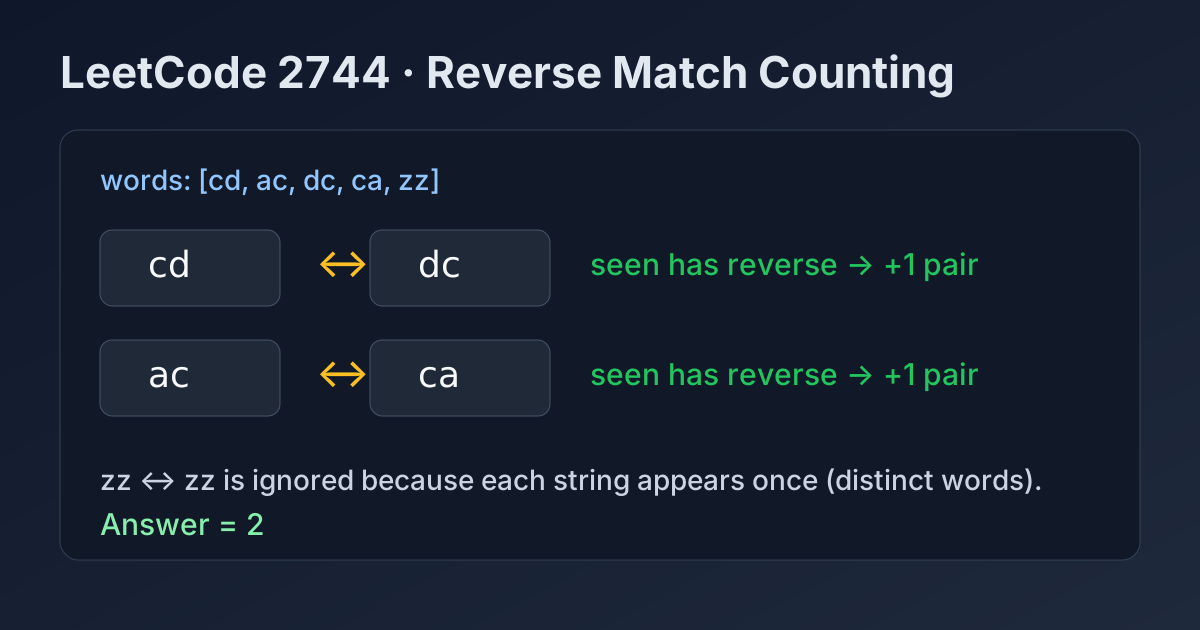
Given an array of distinct 2-letter strings words, count how many pairs (i, j) satisfy words[i] equals the reverse of words[j].
Key Insight
For each word, its only possible partner is the reversed string. So while scanning, if reverse(word) has already appeared, we form one new pair immediately.
Algorithm
- Initialize an empty hash set seen and answer ans = 0.
- For each word w: compute rev by swapping its two characters.
- If rev is in seen, increment ans.
- Add w to seen.
- Return ans.
Complexity Analysis
Let n be the number of strings.
Time: O(n).
Space: O(n) for the set.
Common Pitfalls
- Trying nested loops (O(n²)) is unnecessary.
- Forgetting words are distinct, which simplifies duplicate handling.
- Building reverse incorrectly for 2-char strings.
Reference Implementations (Java / Go / C++ / Python / JavaScript)
class Solution {
    public int maximumNumberOfStringPairs(String[] words) {
        Set<String> seen = new HashSet<>();
        int ans = 0;
        for (String w : words) {
            String rev = "" + w.charAt(1) + w.charAt(0);
            if (seen.contains(rev)) {
                ans++;
            }
            seen.add(w);
        }
        return ans;
    }
}
func maximumNumberOfStringPairs(words []string) int {
seen := make(map[string]bool)
ans := 0
for _, w := range words {
rev := string([]byte{w[1], w[0]})
if seen[rev] {
ans++
}
seen[w] = true
}
return ans
}class Solution {
public:
int maximumNumberOfStringPairs(vector<string>& words) {
unordered_set<string> seen;
int ans = 0;
for (const string& w : words) {
string rev;
rev.push_back(w[1]);
rev.push_back(w[0]);
if (seen.count(rev)) {
ans++;
}
seen.insert(w);
}
return ans;
}
};class Solution:
def maximumNumberOfStringPairs(self, words: List[str]) -> int:
seen = set()
ans = 0
for w in words:
rev = w[1] + w[0]
if rev in seen:
ans += 1
seen.add(w)
return ansvar maximumNumberOfStringPairs = function(words) {
const seen = new Set();
let ans = 0;
for (const w of words) {
const rev = w[1] + w[0];
if (seen.has(rev)) {
ans++;
}
seen.add(w);
}
return ans;
};中文
题目概述
给定一个由互不相同的 2 字符字符串组成的数组 words,统计有多少对下标 (i, j) 满足 words[i] 等于 words[j] 的反转字符串。
核心思路
每个字符串最多只有一个“候选配对”:它的反转串。遍历时只要发现反转串已经出现过,就能立刻新增一对。
算法步骤
- 用哈希集合 seen 记录已遍历字符串,答案 ans=0。
- 遍历每个字符串 w,构造反转串 rev。
- 若 rev 在 seen 中,ans++。
- 把 w 放入 seen。
- 遍历结束返回 ans。
复杂度分析
设字符串数量为 n。
时间复杂度:O(n)。
空间复杂度:O(n)。
常见陷阱
- 使用双重循环会退化到 O(n²),没有必要。
- 忘记题目已保证字符串互不相同。
- 2 字符串反转写错顺序。
多语言参考实现(Java / Go / C++ / Python / JavaScript)
class Solution {
    public int maximumNumberOfStringPairs(String[] words) {
        Set<String> seen = new HashSet<>();
        int ans = 0;
        for (String w : words) {
            String rev = "" + w.charAt(1) + w.charAt(0);
            if (seen.contains(rev)) {
                ans++;
            }
            seen.add(w);
        }
        return ans;
    }
}
func maximumNumberOfStringPairs(words []string) int {
seen := make(map[string]bool)
ans := 0
for _, w := range words {
rev := string([]byte{w[1], w[0]})
if seen[rev] {
ans++
}
seen[w] = true
}
return ans
}class Solution {
public:
int maximumNumberOfStringPairs(vector<string>& words) {
unordered_set<string> seen;
int ans = 0;
for (const string& w : words) {
string rev;
rev.push_back(w[1]);
rev.push_back(w[0]);
if (seen.count(rev)) {
ans++;
}
seen.insert(w);
}
return ans;
}
};class Solution:
def maximumNumberOfStringPairs(self, words: List[str]) -> int:
seen = set()
ans = 0
for w in words:
rev = w[1] + w[0]
if rev in seen:
ans += 1
seen.add(w)
return ansvar maximumNumberOfStringPairs = function(words) {
const seen = new Set();
let ans = 0;
for (const w of words) {
const rev = w[1] + w[0];
if (seen.has(rev)) {
ans++;
}
seen.add(w);
}
return ans;
};
Comments