LeetCode 266: Palindrome Permutation (Odd-Frequency Character Rule)
LeetCode 266StringCountingToday we solve LeetCode 266 - Palindrome Permutation.
Source: https://leetcode.com/problems/palindrome-permutation/
English
Problem Summary
Given a string s, return true if any permutation of s can form a palindrome, otherwise return false.
Key Insight
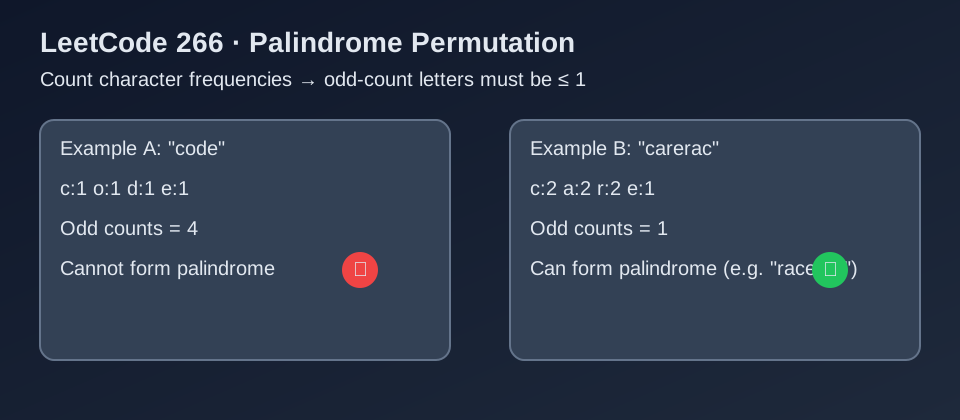
A palindrome can have at most one character with an odd frequency. All other characters must appear an even number of times.
Algorithm
- Count each character frequency.
- Count how many characters have odd frequency.
- Return true if odd-count ≤ 1, else false.
Complexity Analysis
Let n be the length of s.
Time: O(n).
Space: O(k), where k is number of distinct characters.
Common Pitfalls
- Mistakenly requiring zero odd frequencies; odd-length palindromes allow exactly one odd count.
- Sorting the string first; it works but is unnecessary and slower than counting.
- Forgetting empty string should return true.
Reference Implementations (Java / Go / C++ / Python / JavaScript)
class Solution {
    public boolean canPermutePalindrome(String s) {
        int[] freq = new int[128];
        for (char c : s.toCharArray()) {
            freq[c]++;
        }
        int odd = 0;
        for (int f : freq) {
            if ((f & 1) == 1) odd++;
            if (odd > 1) return false;
        }
        return true;
    }
}
func canPermutePalindrome(s string) bool {
freq := make(map[rune]int)
for _, ch := range s {
freq[ch]++
}
odd := 0
for _, f := range freq {
if f%2 == 1 {
odd++
if odd > 1 {
return false
}
}
}
return true
}class Solution {
public:
bool canPermutePalindrome(string s) {
unordered_map<char, int> freq;
for (char c : s) freq[c]++;
int odd = 0;
for (auto &[ch, f] : freq) {
if (f % 2 == 1) {
odd++;
if (odd > 1) return false;
}
}
return true;
}
};class Solution:
def canPermutePalindrome(self, s: str) -> bool:
from collections import Counter
odd = 0
for f in Counter(s).values():
if f % 2 == 1:
odd += 1
if odd > 1:
return False
return Truevar canPermutePalindrome = function(s) {
const freq = new Map();
for (const ch of s) {
freq.set(ch, (freq.get(ch) || 0) + 1);
}
let odd = 0;
for (const f of freq.values()) {
if (f % 2 === 1) {
odd++;
if (odd > 1) return false;
}
}
return true;
};中文
题目概述
给定字符串 s,判断是否存在某种重排方式,使它能够构成回文串。
核心思路
回文串的字符频次有一个关键性质:最多只能有一个字符出现奇数次(位于中心),其余字符都必须成对出现。
算法步骤
- 统计每个字符出现次数。
- 统计奇数频次的字符个数。
- 若奇数频次个数 ≤ 1,返回 true;否则返回 false。
复杂度分析
设字符串长度为 n。
时间复杂度:O(n)。
空间复杂度:O(k),k 为不同字符个数。
常见陷阱
- 误以为必须没有奇数频次;其实奇数长度回文允许 1 个奇数频次。
- 先排序再判断虽然可行,但比计数法更慢。
- 忽略空字符串,空串也可以视为回文排列。
多语言参考实现(Java / Go / C++ / Python / JavaScript)
class Solution {
    public boolean canPermutePalindrome(String s) {
        int[] freq = new int[128];
        for (char c : s.toCharArray()) {
            freq[c]++;
        }
        int odd = 0;
        for (int f : freq) {
            if ((f & 1) == 1) odd++;
            if (odd > 1) return false;
        }
        return true;
    }
}
func canPermutePalindrome(s string) bool {
freq := make(map[rune]int)
for _, ch := range s {
freq[ch]++
}
odd := 0
for _, f := range freq {
if f%2 == 1 {
odd++
if odd > 1 {
return false
}
}
}
return true
}class Solution {
public:
bool canPermutePalindrome(string s) {
unordered_map<char, int> freq;
for (char c : s) freq[c]++;
int odd = 0;
for (auto &[ch, f] : freq) {
if (f % 2 == 1) {
odd++;
if (odd > 1) return false;
}
}
return true;
}
};class Solution:
def canPermutePalindrome(self, s: str) -> bool:
from collections import Counter
odd = 0
for f in Counter(s).values():
if f % 2 == 1:
odd += 1
if odd > 1:
return False
return Truevar canPermutePalindrome = function(s) {
const freq = new Map();
for (const ch of s) {
freq.set(ch, (freq.get(ch) || 0) + 1);
}
let odd = 0;
for (const f of freq.values()) {
if (f % 2 === 1) {
odd++;
if (odd > 1) return false;
}
}
return true;
};
Comments