LeetCode 1952: Three Divisors (Prime-Square Characterization)
LeetCode 1952MathNumber TheoryToday we solve LeetCode 1952 - Three Divisors.
Source: https://leetcode.com/problems/three-divisors/
English
Problem Summary
Given an integer n, return true if it has exactly three positive divisors; otherwise return false.
Key Insight
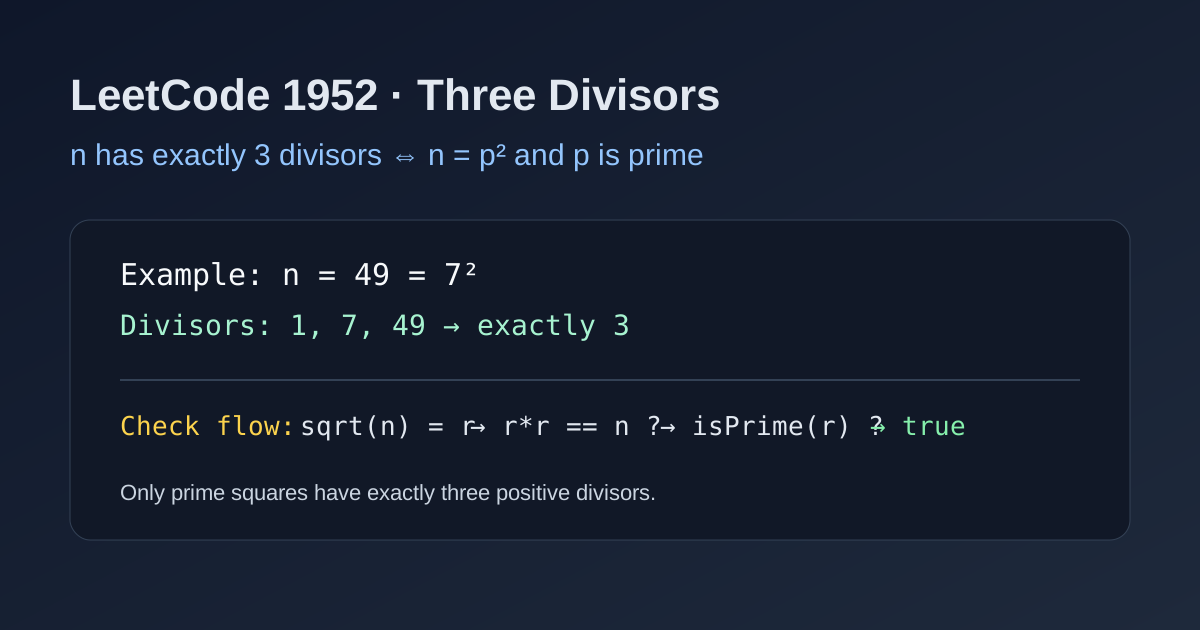
A number has exactly three divisors iff it is the square of a prime: divisors are 1, p, and p². So we only need to check whether n is a perfect square and whether its square root is prime.
Algorithm
- Compute r = floor(sqrt(n)).
- If r * r != n, return false.
- Check whether r is prime by trial division up to sqrt(r).
- Return that primality result.
Complexity Analysis
Time: O(sqrt(sqrt(n))) for primality test on r.
Space: O(1).
Common Pitfalls
- Brute-forcing all divisors of n; this is unnecessary work.
- Forgetting that 1 is not prime.
- Floating-point precision concerns for very large values (safe here under problem constraints).
Reference Implementations (Java / Go / C++ / Python / JavaScript)
class Solution {
    public boolean isThree(int n) {
        int r = (int) Math.sqrt(n);
        if (r * r != n) return false;
        return isPrime(r);
    }

    private boolean isPrime(int x) {
        if (x < 2) return false;
        for (int d = 2; d * d <= x; d++) {
            if (x % d == 0) return false;
        }
        return true;
    }
}
func isThree(n int) bool {
r := int(math.Sqrt(float64(n)))
if r*r != n {
return false
}
return isPrime(r)
}
func isPrime(x int) bool {
if x < 2 {
return false
}
for d := 2; d*d <= x; d++ {
if x%d == 0 {
return false
}
}
return true
}class Solution {
public:
bool isThree(int n) {
int r = (int)std::sqrt(n);
if (r * r != n) return false;
return isPrime(r);
}
private:
bool isPrime(int x) {
if (x < 2) return false;
for (int d = 2; d * d <= x; d++) {
if (x % d == 0) return false;
}
return true;
}
};class Solution:
def isThree(self, n: int) -> bool:
r = int(n ** 0.5)
if r * r != n:
return False
return self.is_prime(r)
def is_prime(self, x: int) -> bool:
if x < 2:
return False
d = 2
while d * d <= x:
if x % d == 0:
return False
d += 1
return Truevar isThree = function(n) {
const r = Math.floor(Math.sqrt(n));
if (r * r !== n) return false;
return isPrime(r);
};
function isPrime(x) {
if (x < 2) return false;
for (let d = 2; d * d <= x; d++) {
if (x % d === 0) return false;
}
return true;
}中文
题目概述
给定整数 n,如果它恰好有 3 个正因数则返回 true,否则返回 false。
核心思路
一个数恰好有 3 个正因数,当且仅当它是某个质数的平方:因数正好是 1、p、p²。因此只需判断 n 是否为完全平方数,且平方根是否为质数。
算法步骤
- 计算 r = floor(sqrt(n))。
- 若 r * r != n,直接返回 false。
- 判断 r 是否为质数(试除到 sqrt(r))。
- 返回质数判断结果。
复杂度分析
时间复杂度:O(sqrt(sqrt(n)))。
空间复杂度:O(1)。
常见陷阱
- 直接枚举 n 的全部因数,计算量不必要。
- 忘记 1 不是质数。
- 在超大整数场景忽略浮点开方误差(本题约束下通常安全)。
多语言参考实现(Java / Go / C++ / Python / JavaScript)
class Solution {
    public boolean isThree(int n) {
        int r = (int) Math.sqrt(n);
        if (r * r != n) return false;
        return isPrime(r);
    }

    private boolean isPrime(int x) {
        if (x < 2) return false;
        for (int d = 2; d * d <= x; d++) {
            if (x % d == 0) return false;
        }
        return true;
    }
}
func isThree(n int) bool {
r := int(math.Sqrt(float64(n)))
if r*r != n {
return false
}
return isPrime(r)
}
func isPrime(x int) bool {
if x < 2 {
return false
}
for d := 2; d*d <= x; d++ {
if x%d == 0 {
return false
}
}
return true
}class Solution {
public:
bool isThree(int n) {
int r = (int)std::sqrt(n);
if (r * r != n) return false;
return isPrime(r);
}
private:
bool isPrime(int x) {
if (x < 2) return false;
for (int d = 2; d * d <= x; d++) {
if (x % d == 0) return false;
}
return true;
}
};class Solution:
def isThree(self, n: int) -> bool:
r = int(n ** 0.5)
if r * r != n:
return False
return self.is_prime(r)
def is_prime(self, x: int) -> bool:
if x < 2:
return False
d = 2
while d * d <= x:
if x % d == 0:
return False
d += 1
return Truevar isThree = function(n) {
const r = Math.floor(Math.sqrt(n));
if (r * r !== n) return false;
return isPrime(r);
};
function isPrime(x) {
if (x < 2) return false;
for (let d = 2; d * d <= x; d++) {
if (x % d === 0) return false;
}
return true;
}
Comments