LeetCode 1736: Latest Time by Replacing Hidden Digits (Greedy Hour/Minute Digit Filling)
LeetCode 1736StringGreedyTime FormattingToday we solve LeetCode 1736 - Latest Time by Replacing Hidden Digits.
Source: https://leetcode.com/problems/latest-time-by-replacing-hidden-digits/
English
Problem Summary
Given a time string in format HH:MM with some '?' characters, replace each '?' with digits so the resulting time is valid and as late as possible.
Key Insight
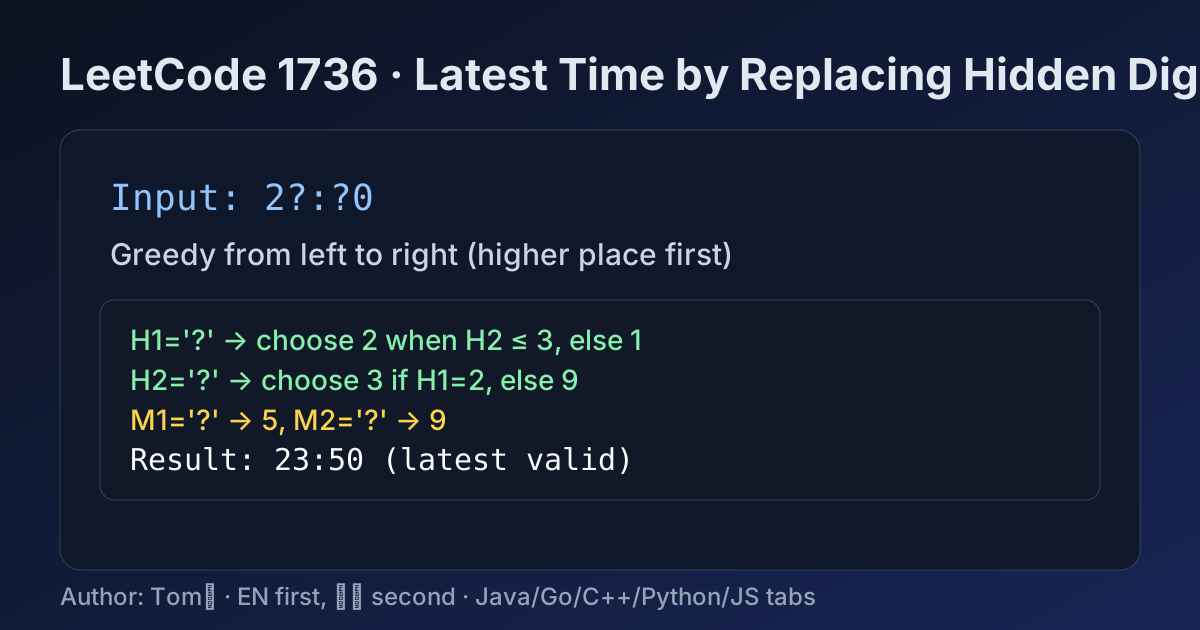
Because the format has only 4 editable positions and strict bounds, the globally latest time can be built greedily from left to right: maximize hour digits first (most significant), then minute digits.
Brute Force and Limitations
You can try all 24×60 times and check compatibility with the pattern. It works, but it is unnecessary overhead for such fixed-position constraints.
Optimal Algorithm Steps
1) For H1: if '?', choose '2' when H2 is '?' or ≤ '3', else choose '1'.
2) For H2: if '?', choose '3' if H1 == '2', else '9'.
3) For M1: if '?', choose '5'.
4) For M2: if '?', choose '9'.
Complexity Analysis
Time: O(1).
Space: O(1).
Common Pitfalls
- Setting H1='2' while fixed H2 > '3' (invalid hour).
- Forgetting minute tens must be ≤ 5.
- Maximizing right digits before left digits, which can reduce final time.
Reference Implementations (Java / Go / C++ / Python / JavaScript)
class Solution {
    public String maximumTime(String time) {
        char[] t = time.toCharArray();

        if (t[0] == '?') {
            if (t[1] == '?' || t[1] <= '3') t[0] = '2';
            else t[0] = '1';
        }

        if (t[1] == '?') {
            if (t[0] == '2') t[1] = '3';
            else t[1] = '9';
        }

        if (t[3] == '?') t[3] = '5';
        if (t[4] == '?') t[4] = '9';

        return new String(t);
    }
}
func maximumTime(time string) string {
t := []byte(time)
if t[0] == '?' {
if t[1] == '?' || t[1] <= '3' {
t[0] = '2'
} else {
t[0] = '1'
}
}
if t[1] == '?' {
if t[0] == '2' {
t[1] = '3'
} else {
t[1] = '9'
}
}
if t[3] == '?' {
t[3] = '5'
}
if t[4] == '?' {
t[4] = '9'
}
return string(t)
}class Solution {
public:
string maximumTime(string time) {
if (time[0] == '?') {
if (time[1] == '?' || time[1] <= '3') time[0] = '2';
else time[0] = '1';
}
if (time[1] == '?') {
if (time[0] == '2') time[1] = '3';
else time[1] = '9';
}
if (time[3] == '?') time[3] = '5';
if (time[4] == '?') time[4] = '9';
return time;
}
};class Solution:
def maximumTime(self, time: str) -> str:
t = list(time)
if t[0] == '?':
t[0] = '2' if t[1] == '?' or t[1] <= '3' else '1'
if t[1] == '?':
t[1] = '3' if t[0] == '2' else '9'
if t[3] == '?':
t[3] = '5'
if t[4] == '?':
t[4] = '9'
return ''.join(t)var maximumTime = function(time) {
const t = time.split('');
if (t[0] === '?') {
t[0] = (t[1] === '?' || t[1] <= '3') ? '2' : '1';
}
if (t[1] === '?') {
t[1] = (t[0] === '2') ? '3' : '9';
}
if (t[3] === '?') t[3] = '5';
if (t[4] === '?') t[4] = '9';
return t.join('');
};中文
题目概述
给定格式为 HH:MM 的时间字符串,其中部分字符是 '?'。请将所有 '?' 替换为数字,使结果时间合法且尽可能晚。
核心思路
时间从左到右位权递减,因此按位贪心即可:先最大化小时,再最大化分钟;每一位都在合法约束下取最大数字。
暴力解法与不足
可以枚举 00:00 到 23:59 再匹配模板,虽然也能通过,但比按位约束直接构造更啰嗦。
最优算法步骤
1)处理 H1:若为 '?',当 H2 是 '?' 或 ≤ '3' 时取 '2',否则取 '1'。
2)处理 H2:若为 '?',当 H1='2' 时取 '3',否则取 '9'。
3)处理 M1:若为 '?',取 '5'。
4)处理 M2:若为 '?',取 '9'。
复杂度分析
时间复杂度:O(1)。
空间复杂度:O(1)。
常见陷阱
- 固定的 H2 大于 3 时还把 H1 设为 2,会得到非法小时。
- 忽略分钟十位上限 5。
- 没有优先最大化高位,导致整体时间不是最晚。
多语言参考实现(Java / Go / C++ / Python / JavaScript)
class Solution {
    public String maximumTime(String time) {
        char[] t = time.toCharArray();

        if (t[0] == '?') {
            if (t[1] == '?' || t[1] <= '3') t[0] = '2';
            else t[0] = '1';
        }

        if (t[1] == '?') {
            if (t[0] == '2') t[1] = '3';
            else t[1] = '9';
        }

        if (t[3] == '?') t[3] = '5';
        if (t[4] == '?') t[4] = '9';

        return new String(t);
    }
}
func maximumTime(time string) string {
t := []byte(time)
if t[0] == '?' {
if t[1] == '?' || t[1] <= '3' {
t[0] = '2'
} else {
t[0] = '1'
}
}
if t[1] == '?' {
if t[0] == '2' {
t[1] = '3'
} else {
t[1] = '9'
}
}
if t[3] == '?' {
t[3] = '5'
}
if t[4] == '?' {
t[4] = '9'
}
return string(t)
}class Solution {
public:
string maximumTime(string time) {
if (time[0] == '?') {
if (time[1] == '?' || time[1] <= '3') time[0] = '2';
else time[0] = '1';
}
if (time[1] == '?') {
if (time[0] == '2') time[1] = '3';
else time[1] = '9';
}
if (time[3] == '?') time[3] = '5';
if (time[4] == '?') time[4] = '9';
return time;
}
};class Solution:
def maximumTime(self, time: str) -> str:
t = list(time)
if t[0] == '?':
t[0] = '2' if t[1] == '?' or t[1] <= '3' else '1'
if t[1] == '?':
t[1] = '3' if t[0] == '2' else '9'
if t[3] == '?':
t[3] = '5'
if t[4] == '?':
t[4] = '9'
return ''.join(t)var maximumTime = function(time) {
const t = time.split('');
if (t[0] === '?') {
t[0] = (t[1] === '?' || t[1] <= '3') ? '2' : '1';
}
if (t[1] === '?') {
t[1] = (t[0] === '2') ? '3' : '9';
}
if (t[3] === '?') t[3] = '5';
if (t[4] === '?') t[4] = '9';
return t.join('');
};
Comments