LeetCode 1232: Check If It Is a Straight Line (Cross Product Collinearity)
LeetCode 1232GeometryMathToday we solve LeetCode 1232 - Check If It Is a Straight Line.
Source: https://leetcode.com/problems/check-if-it-is-a-straight-line/
English
Problem Summary
Given multiple 2D points, determine whether all points lie on one straight line.
Key Insight
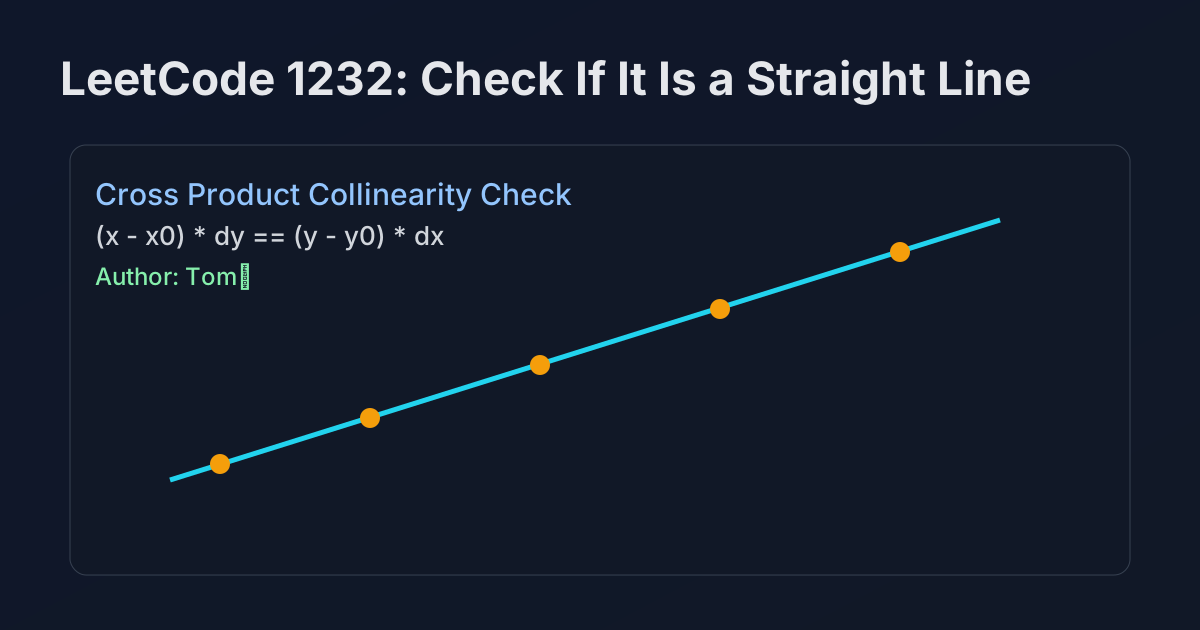
Use the first two points to define a direction vector (dx, dy). For every other point, if vectors are collinear with this direction, all points are on the same line. We avoid floating-point slope division by using cross products.
Algorithm
- Let (x0, y0) and (x1, y1) be the first two points, then dx = x1 - x0, dy = y1 - y0.
- For each point (xi, yi) from index 2 onward, check:
(xi - x0) * dy == (yi - y0) * dx.
- If any point fails, return false; otherwise return true.
Complexity Analysis
Time: O(n).
Space: O(1).
Common Pitfalls
- Comparing slopes with division can cause precision issues.
- Forgetting vertical lines where dx = 0.
- Using wrong base point in the cross-product equation.
Reference Implementations (Java / Go / C++ / Python / JavaScript)
class Solution {
    public boolean checkStraightLine(int[][] coordinates) {
        int x0 = coordinates[0][0], y0 = coordinates[0][1];
        int x1 = coordinates[1][0], y1 = coordinates[1][1];
        int dx = x1 - x0, dy = y1 - y0;

        for (int i = 2; i < coordinates.length; i++) {
            int x = coordinates[i][0], y = coordinates[i][1];
            if ((x - x0) * dy != (y - y0) * dx) {
                return false;
            }
        }
        return true;
    }
}
func checkStraightLine(coordinates [][]int) bool {
x0, y0 := coordinates[0][0], coordinates[0][1]
x1, y1 := coordinates[1][0], coordinates[1][1]
dx, dy := x1-x0, y1-y0
for i := 2; i < len(coordinates); i++ {
x, y := coordinates[i][0], coordinates[i][1]
if (x-x0)*dy != (y-y0)*dx {
return false
}
}
return true
}class Solution {
public:
bool checkStraightLine(vector<vector<int>>& coordinates) {
int x0 = coordinates[0][0], y0 = coordinates[0][1];
int x1 = coordinates[1][0], y1 = coordinates[1][1];
int dx = x1 - x0, dy = y1 - y0;
for (int i = 2; i < (int)coordinates.size(); i++) {
int x = coordinates[i][0], y = coordinates[i][1];
if ((x - x0) * dy != (y - y0) * dx) {
return false;
}
}
return true;
}
};class Solution:
def checkStraightLine(self, coordinates: List[List[int]]) -> bool:
x0, y0 = coordinates[0]
x1, y1 = coordinates[1]
dx, dy = x1 - x0, y1 - y0
for x, y in coordinates[2:]:
if (x - x0) * dy != (y - y0) * dx:
return False
return True/**
* @param {number[][]} coordinates
* @return {boolean}
*/
var checkStraightLine = function(coordinates) {
const [x0, y0] = coordinates[0];
const [x1, y1] = coordinates[1];
const dx = x1 - x0;
const dy = y1 - y0;
for (let i = 2; i < coordinates.length; i++) {
const [x, y] = coordinates[i];
if ((x - x0) * dy !== (y - y0) * dx) {
return false;
}
}
return true;
};中文
题目概述
给定一组二维坐标点,判断它们是否全部位于同一条直线上。
核心思路
用前两个点确定方向向量 (dx, dy),然后让其余点都与起点形成向量,使用叉积判共线。这样可以避免斜率除法带来的浮点误差。
算法步骤
- 取前两个点 (x0, y0)、(x1, y1),计算 dx、dy。
- 遍历后续每个点 (x, y),检查:
(x - x0) * dy == (y - y0) * dx。
- 若有一个不满足,返回 false;全部满足则返回 true。
复杂度分析
时间复杂度:O(n)。
空间复杂度:O(1)。
常见陷阱
- 用斜率除法比较,容易出现精度问题。
- 忽略垂直直线(dx = 0)场景。
- 叉积判断时基准点写错。
多语言参考实现(Java / Go / C++ / Python / JavaScript)
class Solution {
    public boolean checkStraightLine(int[][] coordinates) {
        int x0 = coordinates[0][0], y0 = coordinates[0][1];
        int x1 = coordinates[1][0], y1 = coordinates[1][1];
        int dx = x1 - x0, dy = y1 - y0;

        for (int i = 2; i < coordinates.length; i++) {
            int x = coordinates[i][0], y = coordinates[i][1];
            if ((x - x0) * dy != (y - y0) * dx) {
                return false;
            }
        }
        return true;
    }
}
func checkStraightLine(coordinates [][]int) bool {
x0, y0 := coordinates[0][0], coordinates[0][1]
x1, y1 := coordinates[1][0], coordinates[1][1]
dx, dy := x1-x0, y1-y0
for i := 2; i < len(coordinates); i++ {
x, y := coordinates[i][0], coordinates[i][1]
if (x-x0)*dy != (y-y0)*dx {
return false
}
}
return true
}class Solution {
public:
bool checkStraightLine(vector<vector<int>>& coordinates) {
int x0 = coordinates[0][0], y0 = coordinates[0][1];
int x1 = coordinates[1][0], y1 = coordinates[1][1];
int dx = x1 - x0, dy = y1 - y0;
for (int i = 2; i < (int)coordinates.size(); i++) {
int x = coordinates[i][0], y = coordinates[i][1];
if ((x - x0) * dy != (y - y0) * dx) {
return false;
}
}
return true;
}
};class Solution:
def checkStraightLine(self, coordinates: List[List[int]]) -> bool:
x0, y0 = coordinates[0]
x1, y1 = coordinates[1]
dx, dy = x1 - x0, y1 - y0
for x, y in coordinates[2:]:
if (x - x0) * dy != (y - y0) * dx:
return False
return True/**
* @param {number[][]} coordinates
* @return {boolean}
*/
var checkStraightLine = function(coordinates) {
const [x0, y0] = coordinates[0];
const [x1, y1] = coordinates[1];
const dx = x1 - x0;
const dy = y1 - y0;
for (let i = 2; i < coordinates.length; i++) {
const [x, y] = coordinates[i];
if ((x - x0) * dy !== (y - y0) * dx) {
return false;
}
}
return true;
};
Comments