LeetCode 1175: Prime Arrangements (Sieve + Factorial Mod)
LeetCode 1175MathCombinatoricsToday we solve LeetCode 1175 - Prime Arrangements.
Source: https://leetcode.com/problems/prime-arrangements/
English
Problem Summary
Given n, arrange numbers from 1 to n so that prime numbers occupy prime indices (1-indexed). Return the number of valid permutations modulo 1e9+7.
Key Insight
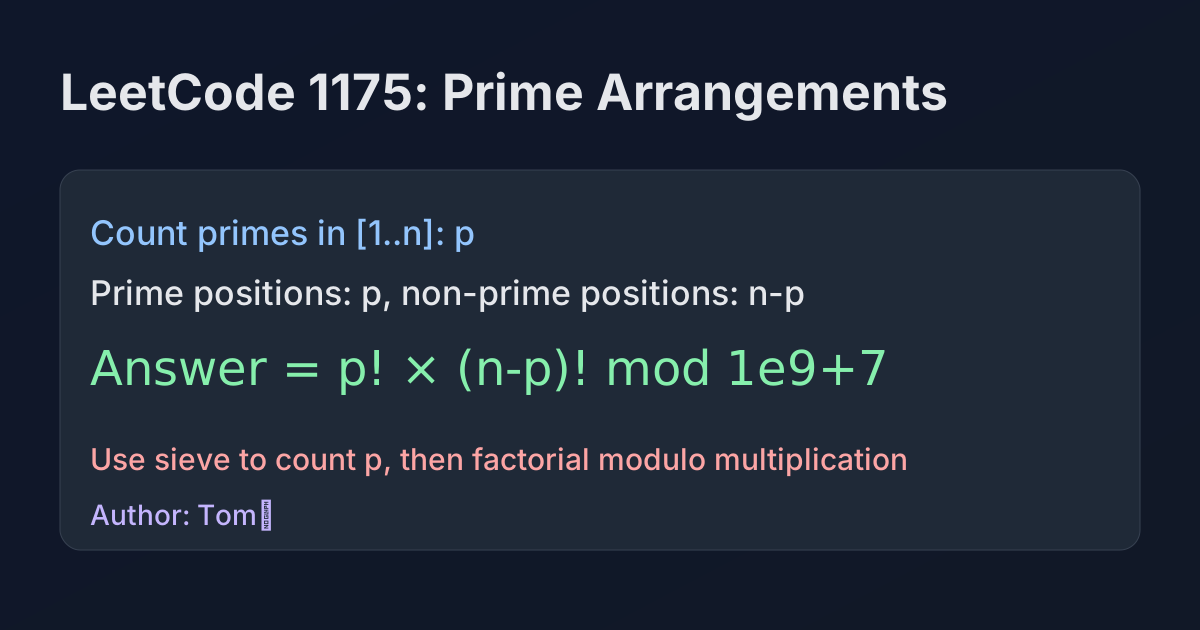
If there are p primes in [1..n], then there are exactly p prime positions and n-p non-prime positions. So the answer is:
p! * (n - p)! (mod 1e9+7).
Algorithm
- Use sieve to count primes <= n as p.
- Compute factorial p! modulo MOD.
- Compute factorial (n-p)! modulo MOD.
- Multiply both modulo MOD.
Complexity Analysis
Time: O(n log log n) (sieve dominates).
Space: O(n).
Common Pitfalls
- Forgetting indices are 1-based in the statement.
- Overflow when multiplying factorials without modulo each step.
- Counting primes incorrectly for small values like n = 1 or n = 2.
Reference Implementations (Java / Go / C++ / Python / JavaScript)
class Solution {
    private static final long MOD = 1_000_000_007L;

    public int numPrimeArrangements(int n) {
        int p = countPrimes(n);
        long ans = fact(p) * fact(n - p) % MOD;
        return (int) ans;
    }

    private int countPrimes(int n) {
        if (n < 2) return 0;
        boolean[] isPrime = new boolean[n + 1];
        java.util.Arrays.fill(isPrime, true);
        isPrime[0] = false;
        isPrime[1] = false;
        for (int i = 2; i * i <= n; i++) {
            if (isPrime[i]) {
                for (int j = i * i; j <= n; j += i) {
                    isPrime[j] = false;
                }
            }
        }
        int cnt = 0;
        for (int i = 2; i <= n; i++) if (isPrime[i]) cnt++;
        return cnt;
    }

    private long fact(int x) {
        long res = 1L;
        for (int i = 2; i <= x; i++) {
            res = (res * i) % MOD;
        }
        return res;
    }
}
const MOD int64 = 1_000_000_007
func numPrimeArrangements(n int) int {
p := countPrimes(n)
ans := fact(p) * fact(n-p) % MOD
return int(ans)
}
func countPrimes(n int) int {
if n < 2 {
return 0
}
isPrime := make([]bool, n+1)
for i := 0; i <= n; i++ {
isPrime[i] = true
}
isPrime[0], isPrime[1] = false, false
for i := 2; i*i <= n; i++ {
if isPrime[i] {
for j := i * i; j <= n; j += i {
isPrime[j] = false
}
}
}
cnt := 0
for i := 2; i <= n; i++ {
if isPrime[i] {
cnt++
}
}
return cnt
}
func fact(x int) int64 {
res := int64(1)
for i := 2; i <= x; i++ {
res = res * int64(i) % MOD
}
return res
}class Solution {
public:
static constexpr long long MOD = 1'000'000'007LL;
int numPrimeArrangements(int n) {
int p = countPrimes(n);
long long ans = fact(p) * fact(n - p) % MOD;
return (int)ans;
}
private:
int countPrimes(int n) {
if (n < 2) return 0;
vector<bool> isPrime(n + 1, true);
isPrime[0] = false;
isPrime[1] = false;
for (int i = 2; i * i <= n; ++i) {
if (isPrime[i]) {
for (int j = i * i; j <= n; j += i) {
isPrime[j] = false;
}
}
}
int cnt = 0;
for (int i = 2; i <= n; ++i) {
if (isPrime[i]) ++cnt;
}
return cnt;
}
long long fact(int x) {
long long res = 1;
for (int i = 2; i <= x; ++i) {
res = (res * i) % MOD;
}
return res;
}
};class Solution:
MOD = 1_000_000_007
def numPrimeArrangements(self, n: int) -> int:
p = self.count_primes(n)
return (self.fact(p) * self.fact(n - p)) % self.MOD
def count_primes(self, n: int) -> int:
if n < 2:
return 0
is_prime = [True] * (n + 1)
is_prime[0] = is_prime[1] = False
i = 2
while i * i <= n:
if is_prime[i]:
j = i * i
while j <= n:
is_prime[j] = False
j += i
i += 1
return sum(is_prime[2:])
def fact(self, x: int) -> int:
res = 1
for i in range(2, x + 1):
res = (res * i) % self.MOD
return resconst MOD = 1000000007n;
var numPrimeArrangements = function(n) {
const p = countPrimes(n);
const ans = (fact(p) * fact(n - p)) % MOD;
return Number(ans);
};
function countPrimes(n) {
if (n < 2) return 0;
const isPrime = new Array(n + 1).fill(true);
isPrime[0] = false;
isPrime[1] = false;
for (let i = 2; i * i <= n; i++) {
if (isPrime[i]) {
for (let j = i * i; j <= n; j += i) {
isPrime[j] = false;
}
}
}
let cnt = 0;
for (let i = 2; i <= n; i++) {
if (isPrime[i]) cnt++;
}
return cnt;
}
function fact(x) {
let res = 1n;
for (let i = 2; i <= x; i++) {
res = (res * BigInt(i)) % MOD;
}
return res;
}中文
题目概述
给定 n,将 1..n 排列,使得所有质数都出现在质数下标位置(下标从 1 开始)。返回满足条件的排列数,对 1e9+7 取模。
核心思路
设 [1..n] 中质数个数为 p。那么质数位置也正好有 p 个,非质数位置有 n-p 个。答案就是:
p! * (n - p)! (mod 1e9+7)。
算法步骤
- 用筛法统计 1..n 的质数数量 p。
- 计算 p!(每步取模)。
- 计算 (n-p)!(每步取模)。
- 两者相乘后再次取模得到结果。
复杂度分析
时间复杂度:O(n log log n)(筛法主导)。
空间复杂度:O(n)。
常见陷阱
- 忘记题目下标是 1-based。
- 阶乘乘法不及时取模导致溢出。
- 小规模输入(如 n=1、n=2)的质数计数写错。
多语言参考实现(Java / Go / C++ / Python / JavaScript)
class Solution {
    private static final long MOD = 1_000_000_007L;

    public int numPrimeArrangements(int n) {
        int p = countPrimes(n);
        long ans = fact(p) * fact(n - p) % MOD;
        return (int) ans;
    }

    private int countPrimes(int n) {
        if (n < 2) return 0;
        boolean[] isPrime = new boolean[n + 1];
        java.util.Arrays.fill(isPrime, true);
        isPrime[0] = false;
        isPrime[1] = false;
        for (int i = 2; i * i <= n; i++) {
            if (isPrime[i]) {
                for (int j = i * i; j <= n; j += i) {
                    isPrime[j] = false;
                }
            }
        }
        int cnt = 0;
        for (int i = 2; i <= n; i++) if (isPrime[i]) cnt++;
        return cnt;
    }

    private long fact(int x) {
        long res = 1L;
        for (int i = 2; i <= x; i++) {
            res = (res * i) % MOD;
        }
        return res;
    }
}
const MOD int64 = 1_000_000_007
func numPrimeArrangements(n int) int {
p := countPrimes(n)
ans := fact(p) * fact(n-p) % MOD
return int(ans)
}
func countPrimes(n int) int {
if n < 2 {
return 0
}
isPrime := make([]bool, n+1)
for i := 0; i <= n; i++ {
isPrime[i] = true
}
isPrime[0], isPrime[1] = false, false
for i := 2; i*i <= n; i++ {
if isPrime[i] {
for j := i * i; j <= n; j += i {
isPrime[j] = false
}
}
}
cnt := 0
for i := 2; i <= n; i++ {
if isPrime[i] {
cnt++
}
}
return cnt
}
func fact(x int) int64 {
res := int64(1)
for i := 2; i <= x; i++ {
res = res * int64(i) % MOD
}
return res
}class Solution {
public:
static constexpr long long MOD = 1'000'000'007LL;
int numPrimeArrangements(int n) {
int p = countPrimes(n);
long long ans = fact(p) * fact(n - p) % MOD;
return (int)ans;
}
private:
int countPrimes(int n) {
if (n < 2) return 0;
vector<bool> isPrime(n + 1, true);
isPrime[0] = false;
isPrime[1] = false;
for (int i = 2; i * i <= n; ++i) {
if (isPrime[i]) {
for (int j = i * i; j <= n; j += i) {
isPrime[j] = false;
}
}
}
int cnt = 0;
for (int i = 2; i <= n; ++i) {
if (isPrime[i]) ++cnt;
}
return cnt;
}
long long fact(int x) {
long long res = 1;
for (int i = 2; i <= x; ++i) {
res = (res * i) % MOD;
}
return res;
}
};class Solution:
MOD = 1_000_000_007
def numPrimeArrangements(self, n: int) -> int:
p = self.count_primes(n)
return (self.fact(p) * self.fact(n - p)) % self.MOD
def count_primes(self, n: int) -> int:
if n < 2:
return 0
is_prime = [True] * (n + 1)
is_prime[0] = is_prime[1] = False
i = 2
while i * i <= n:
if is_prime[i]:
j = i * i
while j <= n:
is_prime[j] = False
j += i
i += 1
return sum(is_prime[2:])
def fact(self, x: int) -> int:
res = 1
for i in range(2, x + 1):
res = (res * i) % self.MOD
return resconst MOD = 1000000007n;
var numPrimeArrangements = function(n) {
const p = countPrimes(n);
const ans = (fact(p) * fact(n - p)) % MOD;
return Number(ans);
};
function countPrimes(n) {
if (n < 2) return 0;
const isPrime = new Array(n + 1).fill(true);
isPrime[0] = false;
isPrime[1] = false;
for (let i = 2; i * i <= n; i++) {
if (isPrime[i]) {
for (let j = i * i; j <= n; j += i) {
isPrime[j] = false;
}
}
}
let cnt = 0;
for (let i = 2; i <= n; i++) {
if (isPrime[i]) cnt++;
}
return cnt;
}
function fact(x) {
let res = 1n;
for (let i = 2; i <= x; i++) {
res = (res * BigInt(i)) % MOD;
}
return res;
}
Comments