LeetCode 1128: Number of Equivalent Domino Pairs (Canonical Key Counting)
LeetCode 1128ArrayHash CountingToday we solve LeetCode 1128 - Number of Equivalent Domino Pairs.
Source: https://leetcode.com/problems/number-of-equivalent-domino-pairs/
English
Problem Summary
Each domino is [a, b]. Two dominoes are equivalent if one can be rotated to match the other, so [1,2] is equivalent to [2,1]. Return how many index pairs (i, j) with i < j are equivalent.
Key Insight
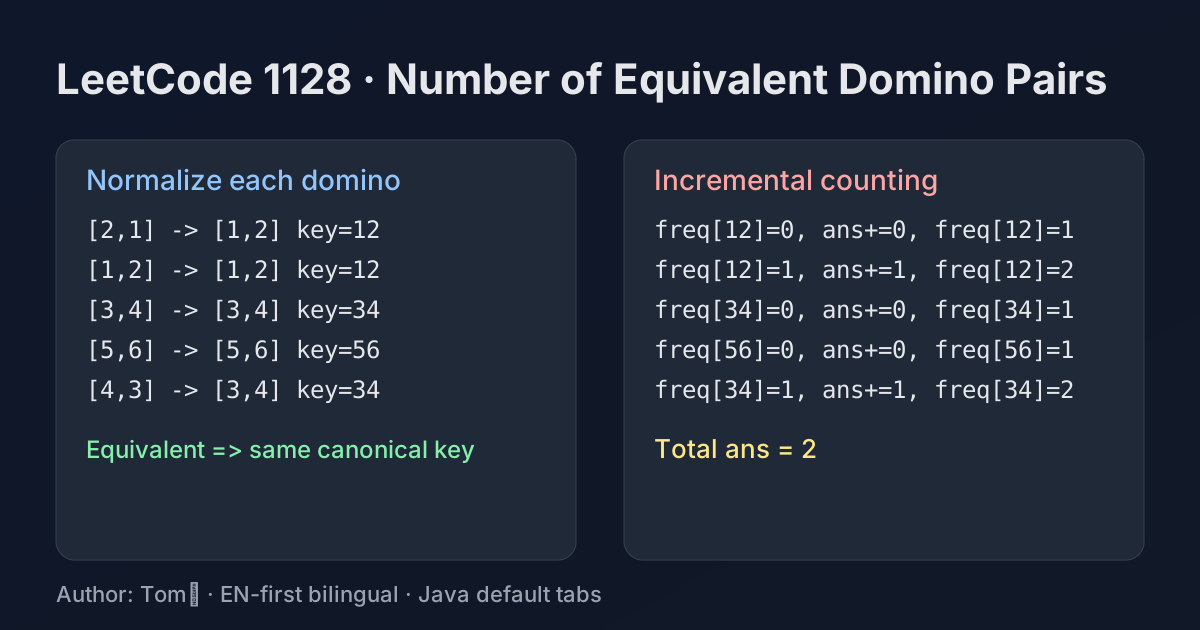
Normalize every domino into a canonical order (min(a,b), max(a,b)). Then equivalent dominoes share the same key. If a key appears k times, it contributes k * (k - 1) / 2 pairs.
Algorithm
- Maintain a frequency map from canonical key to count.
- For each domino, normalize it and encode as key = x * 10 + y (values are 1..9).
- Before incrementing this key, add its current count to answer.
- Increment the key count and continue.
Complexity Analysis
Let n be domino count.
Time: O(n).
Space: O(1) to O(100) possible keys.
Common Pitfalls
- Forgetting to normalize, causing [1,2] and [2,1] to be counted separately.
- Computing combinations at the end is fine, but one-pass incremental counting is cleaner.
- Overcomplicating key encoding when value range is tiny.
Reference Implementations (Java / Go / C++ / Python / JavaScript)
class Solution {
    public int numEquivDominoPairs(int[][] dominoes) {
        int[] freq = new int[100];
        int ans = 0;
        for (int[] d : dominoes) {
            int x = Math.min(d[0], d[1]);
            int y = Math.max(d[0], d[1]);
            int key = x * 10 + y;
            ans += freq[key];
            freq[key]++;
        }
        return ans;
    }
}
func numEquivDominoPairs(dominoes [][]int) int {
freq := make([]int, 100)
ans := 0
for _, d := range dominoes {
x, y := d[0], d[1]
if x > y {
x, y = y, x
}
key := x*10 + y
ans += freq[key]
freq[key]++
}
return ans
}class Solution {
public:
int numEquivDominoPairs(vector<vector<int>>& dominoes) {
vector<int> freq(100, 0);
int ans = 0;
for (auto &d : dominoes) {
int x = min(d[0], d[1]);
int y = max(d[0], d[1]);
int key = x * 10 + y;
ans += freq[key];
freq[key]++;
}
return ans;
}
};class Solution:
def numEquivDominoPairs(self, dominoes: List[List[int]]) -> int:
freq = [0] * 100
ans = 0
for a, b in dominoes:
x, y = (a, b) if a <= b else (b, a)
key = x * 10 + y
ans += freq[key]
freq[key] += 1
return ansvar numEquivDominoPairs = function(dominoes) {
const freq = new Array(100).fill(0);
let ans = 0;
for (const [a, b] of dominoes) {
const x = Math.min(a, b);
const y = Math.max(a, b);
const key = x * 10 + y;
ans += freq[key];
freq[key] += 1;
}
return ans;
};中文
题目概述
每个多米诺骨牌为 [a, b]。若旋转后可相同,则两张骨牌等价,因此 [1,2] 与 [2,1] 等价。请返回满足 i < j 的等价下标对数量。
核心思路
把每张骨牌标准化成 (min(a,b), max(a,b))。标准化后等价骨牌一定映射到同一个 key。某个 key 出现 k 次,会贡献 k * (k - 1) / 2 对。
算法步骤
- 用频次数组/哈希表记录每个标准 key 的出现次数。
- 遍历骨牌,先标准化,再编码 key = x * 10 + y。
- 当前 key 已出现 c 次时,新来一张可立刻新增 c 对。
- 然后将该 key 计数加一,继续遍历。
复杂度分析
设骨牌数量为 n。
时间复杂度:O(n)。
空间复杂度:O(1)(最多约 100 个 key)。
常见陷阱
- 不做标准化,导致 [1,2] 与 [2,1] 被拆成两类。
- 先全统计再做组合也可以,但边遍历边累加更简洁。
- 忽略了题目给出的数值范围,写了不必要的复杂编码。
多语言参考实现(Java / Go / C++ / Python / JavaScript)
class Solution {
    public int numEquivDominoPairs(int[][] dominoes) {
        int[] freq = new int[100];
        int ans = 0;
        for (int[] d : dominoes) {
            int x = Math.min(d[0], d[1]);
            int y = Math.max(d[0], d[1]);
            int key = x * 10 + y;
            ans += freq[key];
            freq[key]++;
        }
        return ans;
    }
}
func numEquivDominoPairs(dominoes [][]int) int {
freq := make([]int, 100)
ans := 0
for _, d := range dominoes {
x, y := d[0], d[1]
if x > y {
x, y = y, x
}
key := x*10 + y
ans += freq[key]
freq[key]++
}
return ans
}class Solution {
public:
int numEquivDominoPairs(vector<vector<int>>& dominoes) {
vector<int> freq(100, 0);
int ans = 0;
for (auto &d : dominoes) {
int x = min(d[0], d[1]);
int y = max(d[0], d[1]);
int key = x * 10 + y;
ans += freq[key];
freq[key]++;
}
return ans;
}
};class Solution:
def numEquivDominoPairs(self, dominoes: List[List[int]]) -> int:
freq = [0] * 100
ans = 0
for a, b in dominoes:
x, y = (a, b) if a <= b else (b, a)
key = x * 10 + y
ans += freq[key]
freq[key] += 1
return ansvar numEquivDominoPairs = function(dominoes) {
const freq = new Array(100).fill(0);
let ans = 0;
for (const [a, b] of dominoes) {
const x = Math.min(a, b);
const y = Math.max(a, b);
const key = x * 10 + y;
ans += freq[key];
freq[key] += 1;
}
return ans;
};
Comments