LeetCode 1089: Duplicate Zeros (Two-Pass In-place Backfill)
LeetCode 1089ArrayTwo PointersToday we solve LeetCode 1089 - Duplicate Zeros.
Source: https://leetcode.com/problems/duplicate-zeros/
English
Problem Summary
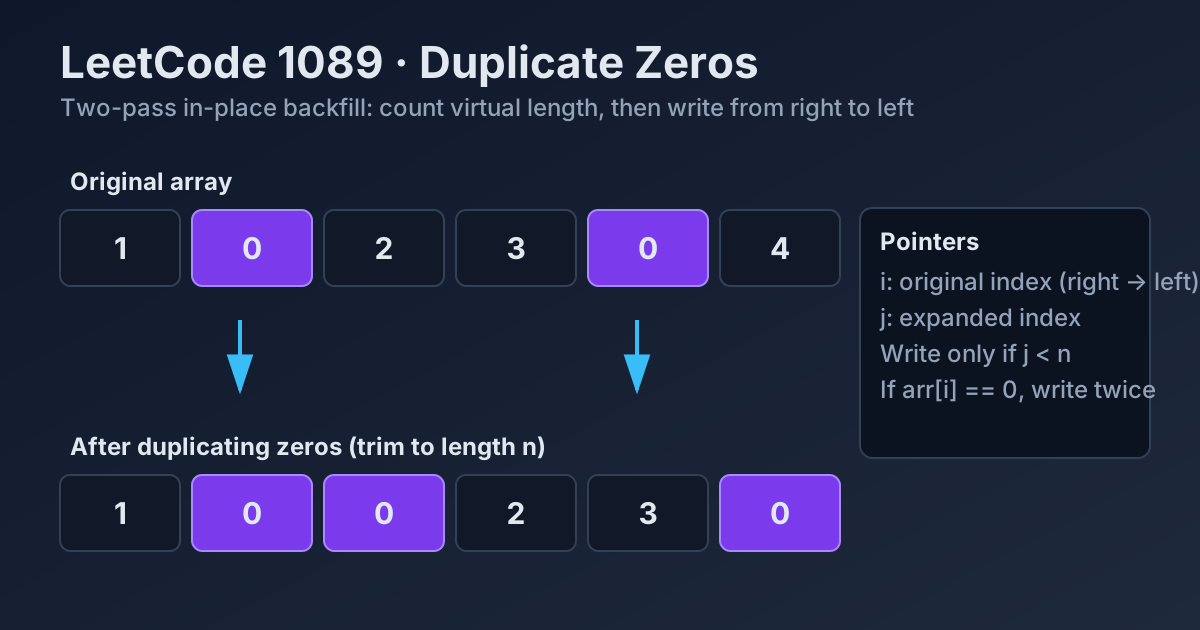
Given a fixed-length integer array, duplicate every 0 by shifting following elements to the right. Elements that move beyond the original length are discarded. The operation must be done in-place.
Key Insight
Direct left-to-right shifting is expensive and may overwrite needed values. Instead, count a virtual expanded length first, then write backward with two pointers:
- i: original index from right to left.
- j: virtual index in expanded array.
- Only write when j < n (inside real array bounds).
Algorithm
- Pass 1: compute expanded length len where each zero contributes 2, non-zero contributes 1.
- Set i = n - 1, j = len - 1.
- While i >= 0:
1) If j < n, write arr[j] = arr[i].
2) If arr[i] == 0, decrement j and write another zero when in bounds.
3) Decrement both pointers.
Complexity Analysis
Time: O(n).
Space: O(1).
Reference Implementations (Java / Go / C++ / Python / JavaScript)
class Solution {
    public void duplicateZeros(int[] arr) {
        int n = arr.length;
        int len = 0;
        for (int x : arr) {
            len += (x == 0) ? 2 : 1;
        }

        int i = n - 1, j = len - 1;
        while (i >= 0) {
            if (j < n) arr[j] = arr[i];
            if (arr[i] == 0) {
                j--;
                if (j < n) arr[j] = 0;
            }
            i--;
            j--;
        }
    }
}
func duplicateZeros(arr []int) {
n := len(arr)
expanded := 0
for _, x := range arr {
if x == 0 {
expanded += 2
} else {
expanded++
}
}
i, j := n-1, expanded-1
for i >= 0 {
if j < n {
arr[j] = arr[i]
}
if arr[i] == 0 {
j--
if j < n {
arr[j] = 0
}
}
i--
j--
}
}class Solution {
public:
void duplicateZeros(vector<int>& arr) {
int n = (int)arr.size();
int expanded = 0;
for (int x : arr) expanded += (x == 0 ? 2 : 1);
int i = n - 1, j = expanded - 1;
while (i >= 0) {
if (j < n) arr[j] = arr[i];
if (arr[i] == 0) {
--j;
if (j < n) arr[j] = 0;
}
--i;
--j;
}
}
};class Solution:
def duplicateZeros(self, arr: List[int]) -> None:
n = len(arr)
expanded = 0
for x in arr:
expanded += 2 if x == 0 else 1
i, j = n - 1, expanded - 1
while i >= 0:
if j < n:
arr[j] = arr[i]
if arr[i] == 0:
j -= 1
if j < n:
arr[j] = 0
i -= 1
j -= 1var duplicateZeros = function(arr) {
const n = arr.length;
let expanded = 0;
for (const x of arr) {
expanded += (x === 0 ? 2 : 1);
}
let i = n - 1, j = expanded - 1;
while (i >= 0) {
if (j < n) arr[j] = arr[i];
if (arr[i] === 0) {
j--;
if (j < n) arr[j] = 0;
}
i--;
j--;
}
};中文
题目概述
给定一个定长整数数组,把每个 0 复制一份,并将后续元素整体右移;超出数组长度的元素被丢弃。要求原地修改。
核心思路
如果从左到右直接挪动,容易反复搬运且覆盖未处理数据。更稳妥的方法是先计算“扩展后的虚拟长度”,再从右向左回填:
- i 指向原数组末尾。
- j 指向虚拟扩展数组末尾。
- 只有当 j < n 时才真正写入原数组。
算法步骤
- 第 1 遍统计扩展长度:普通数贡献 1,零贡献 2。
- 初始化 i = n - 1、j = expanded - 1。
- 从右往左遍历:
1) 若 j < n,写入 arr[j] = arr[i]。
2) 若当前是 0,再额外写一次 0(同样先判断 j < n)。
3) 指针继续左移直到结束。
复杂度分析
时间复杂度:O(n)。
空间复杂度:O(1)。
多语言参考实现(Java / Go / C++ / Python / JavaScript)
class Solution {
    public void duplicateZeros(int[] arr) {
        int n = arr.length;
        int len = 0;
        for (int x : arr) {
            len += (x == 0) ? 2 : 1;
        }

        int i = n - 1, j = len - 1;
        while (i >= 0) {
            if (j < n) arr[j] = arr[i];
            if (arr[i] == 0) {
                j--;
                if (j < n) arr[j] = 0;
            }
            i--;
            j--;
        }
    }
}
func duplicateZeros(arr []int) {
n := len(arr)
expanded := 0
for _, x := range arr {
if x == 0 {
expanded += 2
} else {
expanded++
}
}
i, j := n-1, expanded-1
for i >= 0 {
if j < n {
arr[j] = arr[i]
}
if arr[i] == 0 {
j--
if j < n {
arr[j] = 0
}
}
i--
j--
}
}class Solution {
public:
void duplicateZeros(vector<int>& arr) {
int n = (int)arr.size();
int expanded = 0;
for (int x : arr) expanded += (x == 0 ? 2 : 1);
int i = n - 1, j = expanded - 1;
while (i >= 0) {
if (j < n) arr[j] = arr[i];
if (arr[i] == 0) {
--j;
if (j < n) arr[j] = 0;
}
--i;
--j;
}
}
};class Solution:
def duplicateZeros(self, arr: List[int]) -> None:
n = len(arr)
expanded = 0
for x in arr:
expanded += 2 if x == 0 else 1
i, j = n - 1, expanded - 1
while i >= 0:
if j < n:
arr[j] = arr[i]
if arr[i] == 0:
j -= 1
if j < n:
arr[j] = 0
i -= 1
j -= 1var duplicateZeros = function(arr) {
const n = arr.length;
let expanded = 0;
for (const x of arr) {
expanded += (x === 0 ? 2 : 1);
}
let i = n - 1, j = expanded - 1;
while (i >= 0) {
if (j < n) arr[j] = arr[i];
if (arr[i] === 0) {
j--;
if (j < n) arr[j] = 0;
}
i--;
j--;
}
};
Comments