LeetCode 1009: Complement of Base 10 Integer (Bitmask + XOR Flip)
LeetCode 1009Bit ManipulationBitmaskToday we solve LeetCode 1009 - Complement of Base 10 Integer.
Source: https://leetcode.com/problems/complement-of-base-10-integer/
English
Problem Summary
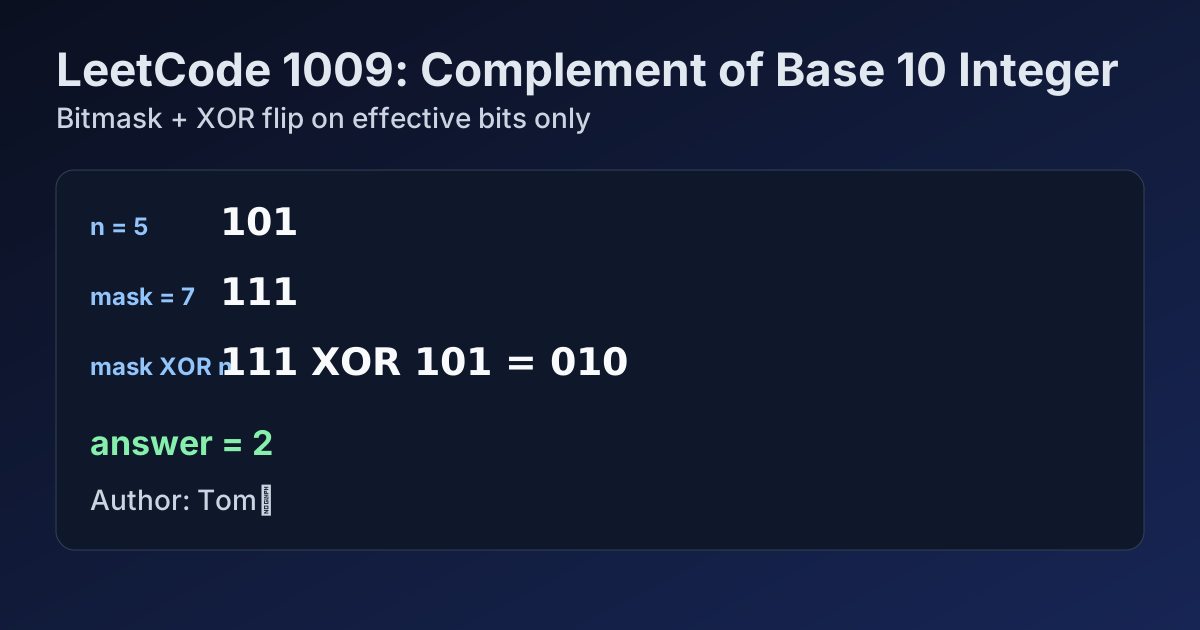
Given a non-negative integer n, return the bitwise complement of its binary representation, but only across the bits actually used by n. For example, 5 (101) becomes 2 (010).
Key Insight
Directly applying ~n flips all machine bits, including leading bits we do not want. So we first build a mask like 111...111 with exactly the same bit-length as n, then compute mask ^ n. That flips only the valid part.
Algorithm
- Special case: if n == 0, answer is 1 (binary 0 complement is 1).
- Copy n into x, initialize mask = 0.
- While x > 0: left shift mask by 1 and add 1 (grow from 1 to 11 to 111 ...), then shift x right by 1.
- Return mask ^ n.
Complexity Analysis
Let k be the number of bits in n.
Time: O(k).
Space: O(1).
Common Pitfalls
- Forgetting the n = 0 edge case.
- Using ~n directly and getting negative values due to extra leading 1s.
- Building mask with wrong length (one bit too short or too long).
Reference Implementations (Java / Go / C++ / Python / JavaScript)
class Solution {
    public int bitwiseComplement(int n) {
        if (n == 0) return 1;

        int mask = 0;
        int x = n;
        while (x > 0) {
            mask = (mask << 1) | 1;
            x >>= 1;
        }
        return mask ^ n;
    }
}
func bitwiseComplement(n int) int {
if n == 0 {
return 1
}
mask := 0
x := n
for x > 0 {
mask = (mask << 1) | 1
x >>= 1
}
return mask ^ n
}class Solution {
public:
int bitwiseComplement(int n) {
if (n == 0) return 1;
int mask = 0;
int x = n;
while (x > 0) {
mask = (mask << 1) | 1;
x >>= 1;
}
return mask ^ n;
}
};class Solution:
def bitwiseComplement(self, n: int) -> int:
if n == 0:
return 1
mask = 0
x = n
while x > 0:
mask = (mask << 1) | 1
x >>= 1
return mask ^ nvar bitwiseComplement = function(n) {
if (n === 0) return 1;
let mask = 0;
let x = n;
while (x > 0) {
mask = (mask << 1) | 1;
x >>= 1;
}
return mask ^ n;
};中文
题目概述
给定一个非负整数 n,返回它二进制表示的补数,但只翻转 n 实际使用到的位。比如 5 (101) 的补数是 2 (010)。
核心思路
不能直接用 ~n,因为它会把机器字长里所有位都翻转,导致高位出现多余的 1。正确做法是先构造一个与 n 位数相同的掩码 111...111,再做 mask ^ n,只翻转有效位。
算法步骤
- 特判:当 n == 0 时,结果为 1。
- 令 x = n,mask = 0。
- 当 x > 0 时:执行 mask = (mask << 1) | 1,然后 x >>= 1。
- 最终返回 mask ^ n。
复杂度分析
设 k 为 n 的二进制位数。
时间复杂度:O(k)。
空间复杂度:O(1)。
常见陷阱
- 忘记处理 n = 0。
- 直接使用 ~n 导致结果不符合题意。
- 掩码位数构造错误,造成翻转范围不正确。
多语言参考实现(Java / Go / C++ / Python / JavaScript)
class Solution {
    public int bitwiseComplement(int n) {
        if (n == 0) return 1;

        int mask = 0;
        int x = n;
        while (x > 0) {
            mask = (mask << 1) | 1;
            x >>= 1;
        }
        return mask ^ n;
    }
}
func bitwiseComplement(n int) int {
if n == 0 {
return 1
}
mask := 0
x := n
for x > 0 {
mask = (mask << 1) | 1
x >>= 1
}
return mask ^ n
}class Solution {
public:
int bitwiseComplement(int n) {
if (n == 0) return 1;
int mask = 0;
int x = n;
while (x > 0) {
mask = (mask << 1) | 1;
x >>= 1;
}
return mask ^ n;
}
};class Solution:
def bitwiseComplement(self, n: int) -> int:
if n == 0:
return 1
mask = 0
x = n
while x > 0:
mask = (mask << 1) | 1
x >>= 1
return mask ^ nvar bitwiseComplement = function(n) {
if (n === 0) return 1;
let mask = 0;
let x = n;
while (x > 0) {
mask = (mask << 1) | 1;
x >>= 1;
}
return mask ^ n;
};
Comments