LeetCode 771: Jewels and Stones (Character Set Membership Counting)
LeetCode 771Hash SetString CountingToday we solve LeetCode 771 - Jewels and Stones.
Source: https://leetcode.com/problems/jewels-and-stones/
English
Problem Summary
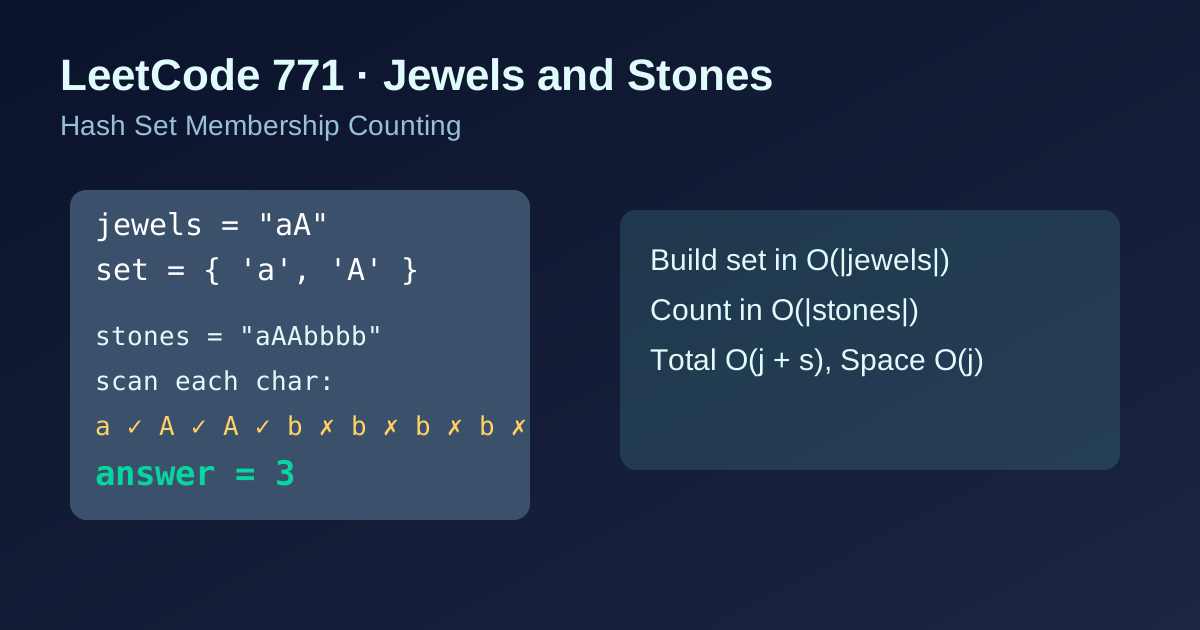
You are given two strings: jewels and stones. Every character in jewels is a jewel type, and every character in stones is a stone you own. Return how many stones are jewels.
Key Insight
Membership checking should be O(1) average. Put all jewel characters into a hash set, then scan stones once and count matches.
Brute Force and Limitations
Brute force checks each stone against all jewel characters, which is O(|jewels| * |stones|). This is unnecessary because jewel types are just a lookup dictionary.
Optimal Algorithm Steps
1) Insert every character of jewels into a set.
2) Initialize answer count = 0.
3) Traverse each character in stones; if it exists in set, increment count.
4) Return count.
Complexity Analysis
Time: O(|jewels| + |stones|).
Space: O(|jewels|).
Common Pitfalls
- Treating uppercase and lowercase as the same (they are different).
- Using nested loops instead of set lookup.
- Forgetting edge cases like empty strings.
Reference Implementations (Java / Go / C++ / Python / JavaScript)
class Solution {
    public int numJewelsInStones(String jewels, String stones) {
        Set<Character> set = new HashSet<>();
        for (char ch : jewels.toCharArray()) {
            set.add(ch);
        }

        int count = 0;
        for (char ch : stones.toCharArray()) {
            if (set.contains(ch)) count++;
        }
        return count;
    }
}
func numJewelsInStones(jewels string, stones string) int {
set := make(map[byte]bool)
for i := 0; i < len(jewels); i++ {
set[jewels[i]] = true
}
count := 0
for i := 0; i < len(stones); i++ {
if set[stones[i]] {
count++
}
}
return count
}class Solution {
public:
int numJewelsInStones(string jewels, string stones) {
unordered_set<char> st(jewels.begin(), jewels.end());
int count = 0;
for (char ch : stones) {
if (st.count(ch)) count++;
}
return count;
}
};class Solution:
def numJewelsInStones(self, jewels: str, stones: str) -> int:
jewel_set = set(jewels)
count = 0
for ch in stones:
if ch in jewel_set:
count += 1
return countvar numJewelsInStones = function(jewels, stones) {
const set = new Set(jewels.split(''));
let count = 0;
for (const ch of stones) {
if (set.has(ch)) count++;
}
return count;
};中文
题目概述
给你两个字符串:jewels 和 stones。jewels 中的字符表示“宝石类型”,stones 中的字符表示你拥有的石头。返回你拥有的石头中有多少颗是宝石。
核心思路
先把所有宝石字符放进哈希集合,然后线性遍历 stones,每个字符做一次集合查询,命中就计数。
暴力解法与不足
暴力做法是每颗石头都去遍历 jewels 查找,复杂度 O(|jewels| * |stones|)。题目本质是“集合成员判断”,不需要双重循环。
最优算法步骤
1)把 jewels 的每个字符加入集合。
2)初始化答案 count = 0。
3)遍历 stones,若当前字符在集合中,count++。
4)返回 count。
复杂度分析
时间复杂度:O(|jewels| + |stones|)。
空间复杂度:O(|jewels|)。
常见陷阱
- 忽略大小写敏感('a' 和 'A' 是不同字符)。
- 仍然使用双重循环,导致复杂度偏高。
- 没处理空字符串边界情况。
多语言参考实现(Java / Go / C++ / Python / JavaScript)
class Solution {
    public int numJewelsInStones(String jewels, String stones) {
        Set<Character> set = new HashSet<>();
        for (char ch : jewels.toCharArray()) {
            set.add(ch);
        }

        int count = 0;
        for (char ch : stones.toCharArray()) {
            if (set.contains(ch)) count++;
        }
        return count;
    }
}
func numJewelsInStones(jewels string, stones string) int {
set := make(map[byte]bool)
for i := 0; i < len(jewels); i++ {
set[jewels[i]] = true
}
count := 0
for i := 0; i < len(stones); i++ {
if set[stones[i]] {
count++
}
}
return count
}class Solution {
public:
int numJewelsInStones(string jewels, string stones) {
unordered_set<char> st(jewels.begin(), jewels.end());
int count = 0;
for (char ch : stones) {
if (st.count(ch)) count++;
}
return count;
}
};class Solution:
def numJewelsInStones(self, jewels: str, stones: str) -> int:
jewel_set = set(jewels)
count = 0
for ch in stones:
if ch in jewel_set:
count += 1
return countvar numJewelsInStones = function(jewels, stones) {
const set = new Set(jewels.split(''));
let count = 0;
for (const ch of stones) {
if (set.has(ch)) count++;
}
return count;
};
Comments