LeetCode 279: Perfect Squares (1D DP Over Square Choices)
LeetCode 279Dynamic ProgrammingMathUnbounded Knapsack PatternToday we solve LeetCode 279 - Perfect Squares.
Source: https://leetcode.com/problems/perfect-squares/
English
Problem Summary
Given an integer n, return the minimum number of perfect square numbers (like 1, 4, 9, 16, ...) whose sum is exactly n.
Key Insight
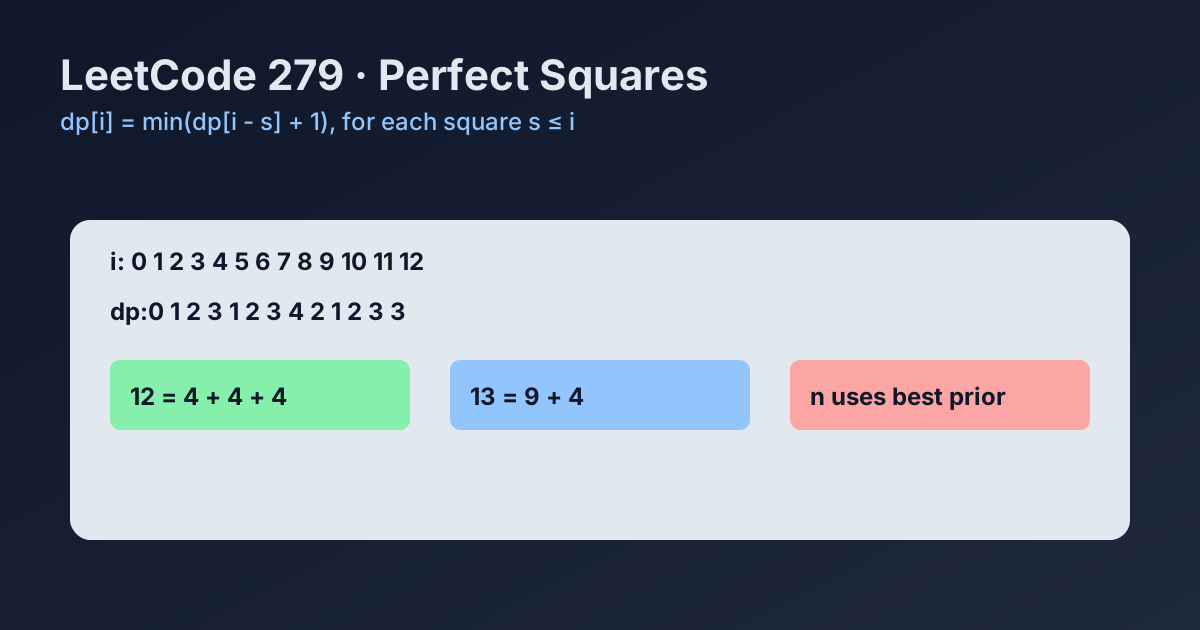
This is a classic unbounded-choice DP: for each value i, try taking one square s and append the best answer for i - s. The recurrence is:
dp[i] = min(dp[i], dp[i - s] + 1) for every square s ≤ i.
Brute Force and Limitations
Brute-force DFS over all square combinations explodes exponentially and repeats subproblems heavily.
Optimal Algorithm Steps
1) Build all squares up to n.
2) Initialize dp[0] = 0, and dp[i] as a large value for i > 0.
3) For each i from 1..n, test each square s ≤ i and relax dp[i].
4) Return dp[n].
Complexity Analysis
Time: O(n * sqrt(n)).
Space: O(n).
Common Pitfalls
- Forgetting dp[0] = 0 causes all states to remain invalid.
- Looping squares without checking s ≤ i.
- Using BFS/DFS without visited pruning, causing heavy repetition.
Reference Implementations (Java / Go / C++ / Python / JavaScript)
class Solution {
    public int numSquares(int n) {
        int[] dp = new int[n + 1];
        java.util.Arrays.fill(dp, Integer.MAX_VALUE / 2);
        dp[0] = 0;

        java.util.List<Integer> squares = new java.util.ArrayList<>();
        for (int x = 1; x * x <= n; x++) squares.add(x * x);

        for (int i = 1; i <= n; i++) {
            for (int s : squares) {
                if (s > i) break;
                dp[i] = Math.min(dp[i], dp[i - s] + 1);
            }
        }
        return dp[n];
    }
}
func numSquares(n int) int {
dp := make([]int, n+1)
const inf = int(1e9)
for i := 1; i <= n; i++ {
dp[i] = inf
}
squares := []int{}
for x := 1; x*x <= n; x++ {
squares = append(squares, x*x)
}
for i := 1; i <= n; i++ {
for _, s := range squares {
if s > i {
break
}
if dp[i-s]+1 < dp[i] {
dp[i] = dp[i-s] + 1
}
}
}
return dp[n]
}class Solution {
public:
int numSquares(int n) {
vector<int> dp(n + 1, INT_MAX / 2);
dp[0] = 0;
vector<int> squares;
for (int x = 1; x * x <= n; x++) squares.push_back(x * x);
for (int i = 1; i <= n; i++) {
for (int s : squares) {
if (s > i) break;
dp[i] = min(dp[i], dp[i - s] + 1);
}
}
return dp[n];
}
};class Solution:
def numSquares(self, n: int) -> int:
dp = [10**9] * (n + 1)
dp[0] = 0
squares = []
x = 1
while x * x <= n:
squares.append(x * x)
x += 1
for i in range(1, n + 1):
for s in squares:
if s > i:
break
dp[i] = min(dp[i], dp[i - s] + 1)
return dp[n]var numSquares = function(n) {
const dp = new Array(n + 1).fill(1e9);
dp[0] = 0;
const squares = [];
for (let x = 1; x * x <= n; x++) squares.push(x * x);
for (let i = 1; i <= n; i++) {
for (const s of squares) {
if (s > i) break;
dp[i] = Math.min(dp[i], dp[i - s] + 1);
}
}
return dp[n];
};中文
题目概述
给定整数 n,返回和为 n 的完全平方数(如 1, 4, 9, 16...)最少个数。
核心思路
这是典型的“完全背包式”动态规划。设 dp[i] 表示凑出 i 的最少平方数个数,则对每个平方数 s ≤ i,都可以从 dp[i - s] 转移:
dp[i] = min(dp[i], dp[i - s] + 1)。
暴力解法与不足
暴力 DFS 会枚举大量重复组合,复杂度指数级,容易超时。
最优算法步骤
1)预生成所有不超过 n 的平方数。
2)初始化 dp[0] = 0,其余设为极大值。
3)从 1 到 n 枚举每个 i,再枚举平方数 s 做状态转移。
4)最终返回 dp[n]。
复杂度分析
时间复杂度:O(n * sqrt(n))。
空间复杂度:O(n)。
常见陷阱
- 忘记设置 dp[0] = 0,导致后续状态无法正确转移。
- 平方数循环未限制 s ≤ i。
- 使用 BFS/DFS 时没有有效去重,重复状态太多。
多语言参考实现(Java / Go / C++ / Python / JavaScript)
class Solution {
    public int numSquares(int n) {
        int[] dp = new int[n + 1];
        java.util.Arrays.fill(dp, Integer.MAX_VALUE / 2);
        dp[0] = 0;

        java.util.List<Integer> squares = new java.util.ArrayList<>();
        for (int x = 1; x * x <= n; x++) squares.add(x * x);

        for (int i = 1; i <= n; i++) {
            for (int s : squares) {
                if (s > i) break;
                dp[i] = Math.min(dp[i], dp[i - s] + 1);
            }
        }
        return dp[n];
    }
}
func numSquares(n int) int {
dp := make([]int, n+1)
const inf = int(1e9)
for i := 1; i <= n; i++ {
dp[i] = inf
}
squares := []int{}
for x := 1; x*x <= n; x++ {
squares = append(squares, x*x)
}
for i := 1; i <= n; i++ {
for _, s := range squares {
if s > i {
break
}
if dp[i-s]+1 < dp[i] {
dp[i] = dp[i-s] + 1
}
}
}
return dp[n]
}class Solution {
public:
int numSquares(int n) {
vector<int> dp(n + 1, INT_MAX / 2);
dp[0] = 0;
vector<int> squares;
for (int x = 1; x * x <= n; x++) squares.push_back(x * x);
for (int i = 1; i <= n; i++) {
for (int s : squares) {
if (s > i) break;
dp[i] = min(dp[i], dp[i - s] + 1);
}
}
return dp[n];
}
};class Solution:
def numSquares(self, n: int) -> int:
dp = [10**9] * (n + 1)
dp[0] = 0
squares = []
x = 1
while x * x <= n:
squares.append(x * x)
x += 1
for i in range(1, n + 1):
for s in squares:
if s > i:
break
dp[i] = min(dp[i], dp[i - s] + 1)
return dp[n]var numSquares = function(n) {
const dp = new Array(n + 1).fill(1e9);
dp[0] = 0;
const squares = [];
for (let x = 1; x * x <= n; x++) squares.push(x * x);
for (let i = 1; i <= n; i++) {
for (const s of squares) {
if (s > i) break;
dp[i] = Math.min(dp[i], dp[i - s] + 1);
}
}
return dp[n];
};
Comments