LeetCode 27: Remove Element (Two Pointers Overwrite)
LeetCode 27ArrayTwo PointersToday we solve LeetCode 27 - Remove Element.
Source: https://leetcode.com/problems/remove-element/
English
Problem Summary
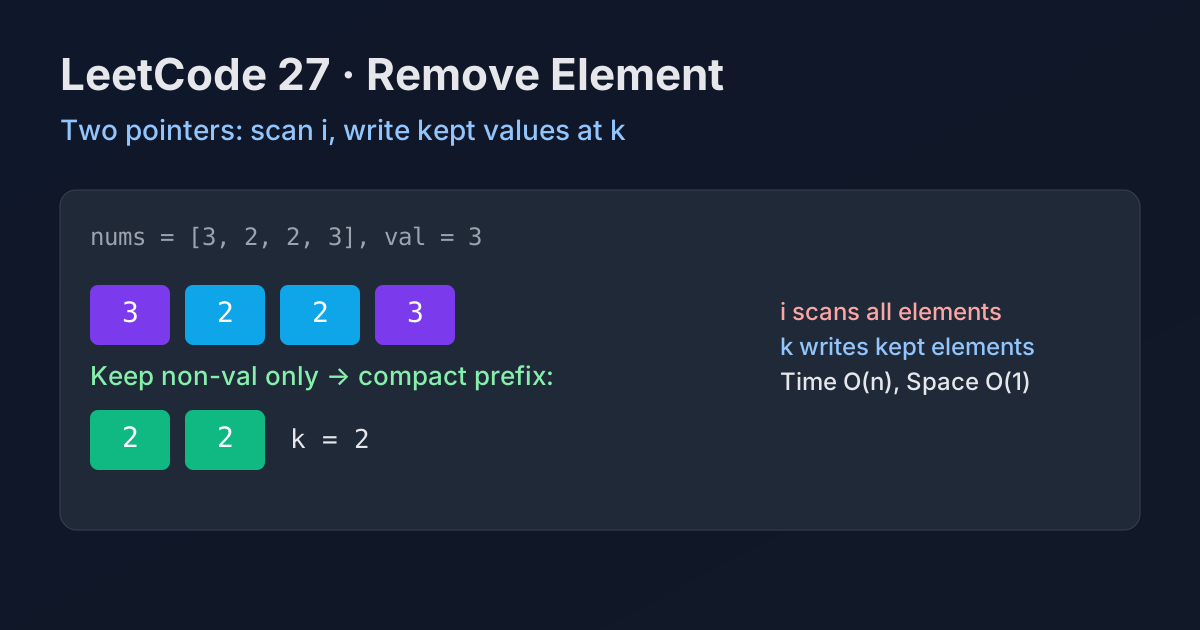
Given an integer array nums and an integer val, remove all occurrences of val in-place and return the number of remaining elements k. The first k positions of nums should contain the kept values.
Key Insight
Maintain a write pointer k for the next kept slot. Scan each number once: if it is not val, write it to nums[k] and increment k. This keeps the prefix [0, k) always valid.
Brute Force and Why Insufficient
A naive way repeatedly deletes elements or shifts the tail each time we see val. In worst case this causes many shifts and can degrade toward O(n^2). The overwrite-pointer method does a single linear pass.
Optimal Algorithm (Step-by-Step)
1) Initialize k = 0.
2) Iterate every element x in nums.
3) If x != val, set nums[k] = x and increment k.
4) Return k after traversal.
Complexity Analysis
Time: O(n).
Space: O(1) extra space.
Common Pitfalls
- Forgetting that only the first k elements matter after processing.
- Incrementing k even when current number equals val.
- Trying to preserve original tail order beyond k (not required).
Reference Implementations (Java / Go / C++ / Python / JavaScript)
class Solution {
    public int removeElement(int[] nums, int val) {
        int k = 0;
        for (int x : nums) {
            if (x != val) {
                nums[k++] = x;
            }
        }
        return k;
    }
}
func removeElement(nums []int, val int) int {
k := 0
for _, x := range nums {
if x != val {
nums[k] = x
k++
}
}
return k
}class Solution {
public:
int removeElement(vector<int>& nums, int val) {
int k = 0;
for (int x : nums) {
if (x != val) {
nums[k++] = x;
}
}
return k;
}
};class Solution:
def removeElement(self, nums: list[int], val: int) -> int:
k = 0
for x in nums:
if x != val:
nums[k] = x
k += 1
return kvar removeElement = function(nums, val) {
let k = 0;
for (const x of nums) {
if (x !== val) {
nums[k++] = x;
}
}
return k;
};中文
题目概述
给定整数数组 nums 和整数 val,要求原地删除所有等于 val 的元素,并返回剩余元素个数 k。处理后只要求数组前 k 个位置是保留值。
核心思路
用写指针 k 表示“下一个可写入的保留位置”。遍历每个元素:若不等于 val,就写到 nums[k],再 k++。这样能保证区间 [0, k) 始终是有效结果。
朴素解法与不足
朴素做法是每遇到一个 val 就把后面的元素整体左移,或做删除操作。最坏情况下会频繁移动数据,复杂度可能退化到 O(n^2)。双指针覆盖写入只需一次线性扫描。
最优算法(步骤)
1)初始化 k = 0。
2)顺序遍历数组中的每个元素 x。
3)若 x != val,执行 nums[k] = x,然后 k++。
4)遍历结束后返回 k。
复杂度分析
时间复杂度:O(n)。
空间复杂度:O(1) 额外空间。
常见陷阱
- 忘记题目只关心前 k 个元素,后半段内容可忽略。
- 遇到 val 时仍错误递增 k。
- 误以为必须保持 k 之后的顺序或值。
多语言参考实现(Java / Go / C++ / Python / JavaScript)
class Solution {
    public int removeElement(int[] nums, int val) {
        int k = 0;
        for (int x : nums) {
            if (x != val) {
                nums[k++] = x;
            }
        }
        return k;
    }
}
func removeElement(nums []int, val int) int {
k := 0
for _, x := range nums {
if x != val {
nums[k] = x
k++
}
}
return k
}class Solution {
public:
int removeElement(vector<int>& nums, int val) {
int k = 0;
for (int x : nums) {
if (x != val) {
nums[k++] = x;
}
}
return k;
}
};class Solution:
def removeElement(self, nums: list[int], val: int) -> int:
k = 0
for x in nums:
if x != val:
nums[k] = x
k += 1
return kvar removeElement = function(nums, val) {
let k = 0;
for (const x of nums) {
if (x !== val) {
nums[k++] = x;
}
}
return k;
};
Comments