LeetCode 2427: Number of Common Factors (GCD + Divisor Counting)
LeetCode 2427MathNumber TheoryToday we solve LeetCode 2427 - Number of Common Factors.
Source: https://leetcode.com/problems/number-of-common-factors/
English
Problem Summary
Given two integers a and b, return how many positive integers divide both numbers.
Key Insight
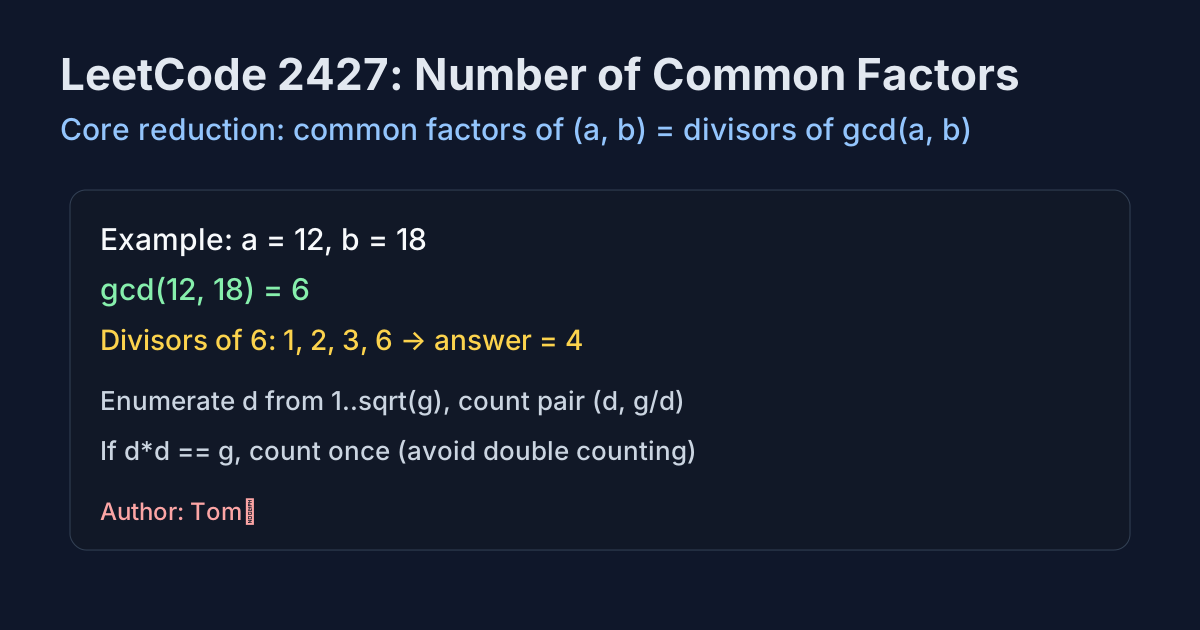
If an integer divides both a and b, then it must divide gcd(a, b). So the problem becomes: count divisors of g = gcd(a, b).
Brute Force and Limitations
Brute force checks every x from 1 to min(a, b), and tests a % x == 0 && b % x == 0. This is easy but unnecessary because only divisors of gcd(a, b) matter.
Optimal Algorithm Steps
1) Compute g = gcd(a, b) with Euclid's algorithm.
2) Initialize answer to 0.
3) Enumerate d from 1 to ⌊sqrt(g)⌋.
4) If g % d == 0, count divisor d, and also count g / d if different.
5) Return total count.
Complexity Analysis
Time: O(log(min(a,b)) + sqrt(g)), where g = gcd(a,b).
Space: O(1).
Common Pitfalls
- Looping all the way to g instead of sqrt(g).
- Forgetting to avoid double-counting when d * d == g.
- Implementing GCD incorrectly when one number becomes zero.
Reference Implementations (Java / Go / C++ / Python / JavaScript)
class Solution {
    public int commonFactors(int a, int b) {
        int g = gcd(a, b);
        int ans = 0;
        for (int d = 1; d * d <= g; d++) {
            if (g % d == 0) {
                ans++;
                if (d != g / d) ans++;
            }
        }
        return ans;
    }

    private int gcd(int x, int y) {
        while (y != 0) {
            int t = x % y;
            x = y;
            y = t;
        }
        return x;
    }
}
func commonFactors(a int, b int) int {
g := gcd(a, b)
ans := 0
for d := 1; d*d <= g; d++ {
if g%d == 0 {
ans++
if d != g/d {
ans++
}
}
}
return ans
}
func gcd(x int, y int) int {
for y != 0 {
x, y = y, x%y
}
return x
}class Solution {
public:
int commonFactors(int a, int b) {
int g = std::gcd(a, b);
int ans = 0;
for (int d = 1; 1LL * d * d <= g; ++d) {
if (g % d == 0) {
++ans;
if (d != g / d) ++ans;
}
}
return ans;
}
};class Solution:
def commonFactors(self, a: int, b: int) -> int:
g = self._gcd(a, b)
ans = 0
d = 1
while d * d <= g:
if g % d == 0:
ans += 1
if d != g // d:
ans += 1
d += 1
return ans
def _gcd(self, x: int, y: int) -> int:
while y:
x, y = y, x % y
return xfunction commonFactors(a, b) {
const g = gcd(a, b);
let ans = 0;
for (let d = 1; d * d <= g; d++) {
if (g % d === 0) {
ans++;
if (d !== Math.floor(g / d)) {
ans++;
}
}
}
return ans;
}
function gcd(x, y) {
while (y !== 0) {
const t = x % y;
x = y;
y = t;
}
return x;
}中文
题目概述
给你两个整数 a 和 b,返回同时整除这两个数的正整数个数。
核心思路
能同时整除 a 和 b 的数,一定也能整除 gcd(a, b)。所以问题可转化为:统计 g = gcd(a, b) 的正因子数量。
暴力解法与不足
暴力法是从 1 枚举到 min(a,b),逐个判断是否同时整除。虽然直观,但会做很多无效检查,不如直接围绕 gcd 做因子统计。
最优算法步骤
1)用欧几里得算法求 g = gcd(a,b)。
2)答案初始化为 0。
3)枚举 d 从 1 到 ⌊sqrt(g)⌋。
4)若 g % d == 0,先计入 d,若 d != g/d 再计入另一个因子。
5)返回总数。
复杂度分析
时间复杂度:O(log(min(a,b)) + sqrt(g)),其中 g = gcd(a,b)。
空间复杂度:O(1)。
常见陷阱
- 因子枚举写成到 g,导致不必要的线性复杂度。
- 当 d*d == g 时重复计数。
- gcd 循环终止条件写错,导致边界错误。
多语言参考实现(Java / Go / C++ / Python / JavaScript)
class Solution {
    public int commonFactors(int a, int b) {
        int g = gcd(a, b);
        int ans = 0;
        for (int d = 1; d * d <= g; d++) {
            if (g % d == 0) {
                ans++;
                if (d != g / d) ans++;
            }
        }
        return ans;
    }

    private int gcd(int x, int y) {
        while (y != 0) {
            int t = x % y;
            x = y;
            y = t;
        }
        return x;
    }
}
func commonFactors(a int, b int) int {
g := gcd(a, b)
ans := 0
for d := 1; d*d <= g; d++ {
if g%d == 0 {
ans++
if d != g/d {
ans++
}
}
}
return ans
}
func gcd(x int, y int) int {
for y != 0 {
x, y = y, x%y
}
return x
}class Solution {
public:
int commonFactors(int a, int b) {
int g = std::gcd(a, b);
int ans = 0;
for (int d = 1; 1LL * d * d <= g; ++d) {
if (g % d == 0) {
++ans;
if (d != g / d) ++ans;
}
}
return ans;
}
};class Solution:
def commonFactors(self, a: int, b: int) -> int:
g = self._gcd(a, b)
ans = 0
d = 1
while d * d <= g:
if g % d == 0:
ans += 1
if d != g // d:
ans += 1
d += 1
return ans
def _gcd(self, x: int, y: int) -> int:
while y:
x, y = y, x % y
return xfunction commonFactors(a, b) {
const g = gcd(a, b);
let ans = 0;
for (let d = 1; d * d <= g; d++) {
if (g % d === 0) {
ans++;
if (d !== Math.floor(g / d)) {
ans++;
}
}
}
return ans;
}
function gcd(x, y) {
while (y !== 0) {
const t = x % y;
x = y;
y = t;
}
return x;
}
Comments