LeetCode 220: Contains Duplicate III (Bucketization over Value Ranges)
LeetCode 220BucketizationSliding WindowToday we solve LeetCode 220 - Contains Duplicate III.
Source: https://leetcode.com/problems/contains-duplicate-iii/
English
Problem Summary
Given an integer array nums, return true if there exist different indices i and j such that:
- |i - j| <= indexDiff
- |nums[i] - nums[j]| <= valueDiff
Key Insight
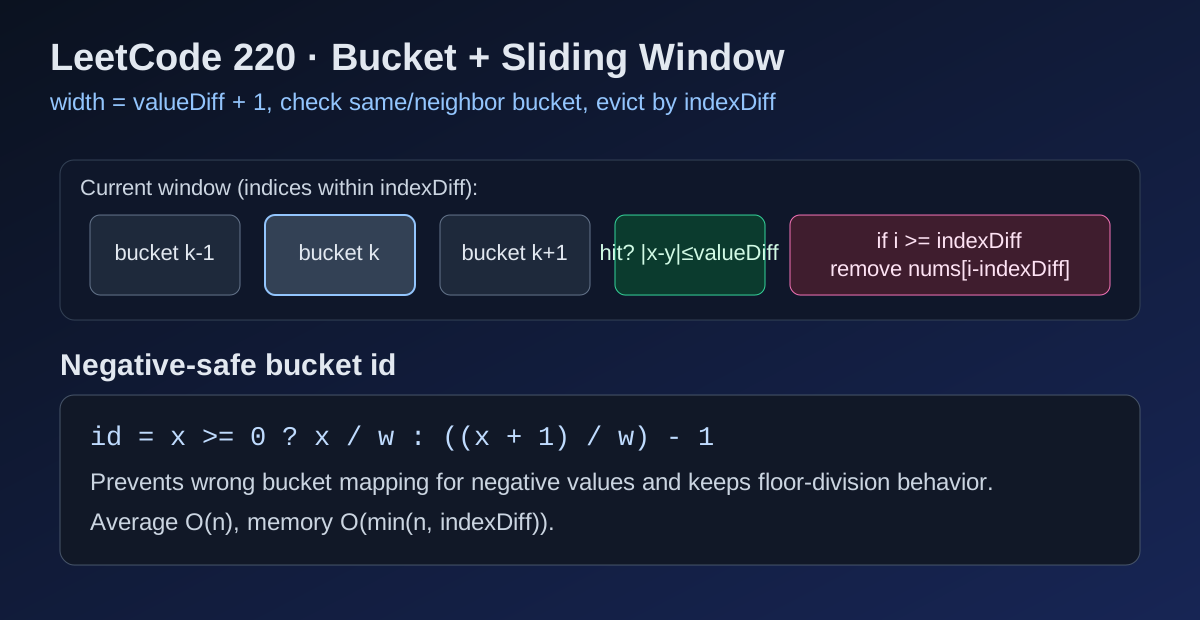
Maintain a sliding window of size at most indexDiff. Within that window, we need near values (difference ≤ valueDiff). Instead of balancing a tree, map values into buckets of width w = valueDiff + 1. Two values within valueDiff must be either in the same bucket or adjacent buckets.
Why Bucket Width Is valueDiff + 1
If bucket width is w = valueDiff + 1, then any two numbers in the same bucket differ by at most w - 1 = valueDiff, so same-bucket hit is an immediate true. For neighbor buckets, we still verify absolute difference to avoid false positives at boundaries.
Algorithm Steps
1) Handle invalid case: if valueDiff < 0, return false.
2) For each index i, compute bucket id of nums[i] using floor division that works for negatives.
3) If current bucket already exists, return true.
4) Check left/right neighbor buckets; if existing value difference ≤ valueDiff, return true.
5) Insert current value into its bucket.
6) If window size exceeded, remove nums[i - indexDiff]'s bucket entry.
7) If scan ends, return false.
Complexity Analysis
Time: O(n) average.
Space: O(min(n, indexDiff)).
Common Pitfalls
- Forgetting to use 64-bit integers (overflow on subtraction).
- Wrong bucket id formula for negative numbers.
- Not evicting old indices, violating |i-j| <= indexDiff.
- Using width valueDiff instead of valueDiff + 1.
Reference Implementations (Java / Go / C++ / Python / JavaScript)
class Solution {
    public boolean containsNearbyAlmostDuplicate(int[] nums, int indexDiff, int valueDiff) {
        if (valueDiff < 0) return false;
        long w = (long) valueDiff + 1;
        Map buckets = new HashMap<>();

        for (int i = 0; i < nums.length; i++) {
            long x = nums[i];
            long id = getBucketId(x, w);

            if (buckets.containsKey(id)) return true;

            if (buckets.containsKey(id - 1) && Math.abs(x - buckets.get(id - 1)) <= valueDiff) return true;
            if (buckets.containsKey(id + 1) && Math.abs(x - buckets.get(id + 1)) <= valueDiff) return true;

            buckets.put(id, x);

            if (i >= indexDiff) {
                long old = nums[i - indexDiff];
                buckets.remove(getBucketId(old, w));
            }
        }
        return false;
    }

    private long getBucketId(long x, long w) {
        return x >= 0 ? x / w : ((x + 1) / w) - 1;
    }
}
func containsNearbyAlmostDuplicate(nums []int, indexDiff int, valueDiff int) bool {
if valueDiff < 0 {
return false
}
w := int64(valueDiff) + 1
buckets := map[int64]int64{}
getID := func(x int64) int64 {
if x >= 0 {
return x / w
}
return (x+1)/w - 1
}
for i, v := range nums {
x := int64(v)
id := getID(x)
if _, ok := buckets[id]; ok {
return true
}
if y, ok := buckets[id-1]; ok && abs64(x-y) <= int64(valueDiff) {
return true
}
if y, ok := buckets[id+1]; ok && abs64(x-y) <= int64(valueDiff) {
return true
}
buckets[id] = x
if i >= indexDiff {
old := int64(nums[i-indexDiff])
delete(buckets, getID(old))
}
}
return false
}
func abs64(x int64) int64 {
if x < 0 {
return -x
}
return x
}class Solution {
public:
bool containsNearbyAlmostDuplicate(vector& nums, int indexDiff, int valueDiff) {
if (valueDiff < 0) return false;
long long w = (long long)valueDiff + 1;
unordered_map buckets;
for (int i = 0; i < (int)nums.size(); ++i) {
long long x = nums[i];
long long id = getBucketId(x, w);
if (buckets.count(id)) return true;
if (buckets.count(id - 1) && llabs(x - buckets[id - 1]) <= valueDiff) return true;
if (buckets.count(id + 1) && llabs(x - buckets[id + 1]) <= valueDiff) return true;
buckets[id] = x;
if (i >= indexDiff) {
long long old = nums[i - indexDiff];
buckets.erase(getBucketId(old, w));
}
}
return false;
}
private:
long long getBucketId(long long x, long long w) {
return x >= 0 ? x / w : ((x + 1) / w) - 1;
}
}; class Solution:
def containsNearbyAlmostDuplicate(self, nums: List[int], indexDiff: int, valueDiff: int) -> bool:
if valueDiff < 0:
return False
w = valueDiff + 1
buckets = {}
def get_id(x: int) -> int:
return x // w if x >= 0 else ((x + 1) // w) - 1
for i, x in enumerate(nums):
bid = get_id(x)
if bid in buckets:
return True
if bid - 1 in buckets and abs(x - buckets[bid - 1]) <= valueDiff:
return True
if bid + 1 in buckets and abs(x - buckets[bid + 1]) <= valueDiff:
return True
buckets[bid] = x
if i >= indexDiff:
old = nums[i - indexDiff]
del buckets[get_id(old)]
return False/**
* @param {number[]} nums
* @param {number} indexDiff
* @param {number} valueDiff
* @return {boolean}
*/
var containsNearbyAlmostDuplicate = function(nums, indexDiff, valueDiff) {
if (valueDiff < 0) return false;
const w = BigInt(valueDiff) + 1n;
const buckets = new Map();
const getId = (x) => {
return x >= 0n ? x / w : ((x + 1n) / w) - 1n;
};
for (let i = 0; i < nums.length; i++) {
const x = BigInt(nums[i]);
const id = getId(x);
if (buckets.has(id)) return true;
if (buckets.has(id - 1n) && absBig(x - buckets.get(id - 1n)) <= BigInt(valueDiff)) return true;
if (buckets.has(id + 1n) && absBig(x - buckets.get(id + 1n)) <= BigInt(valueDiff)) return true;
buckets.set(id, x);
if (i >= indexDiff) {
const old = BigInt(nums[i - indexDiff]);
buckets.delete(getId(old));
}
}
return false;
};
function absBig(x) {
return x < 0n ? -x : x;
}中文
题目概述
给定整数数组 nums,判断是否存在不同下标 i、j,满足:
- |i - j| <= indexDiff
- |nums[i] - nums[j]| <= valueDiff
核心思路
用一个最大长度为 indexDiff 的滑动窗口限制下标距离。在窗口内部,我们要快速找到“数值足够接近”的元素。将数轴按宽度 w = valueDiff + 1 分桶:若两数差值 ≤ valueDiff,它们必在同桶或相邻桶。
为什么桶宽是 valueDiff + 1
桶宽取 w = valueDiff + 1 时,同一桶任意两数最大差值为 w-1,即不超过 valueDiff。因此同桶可直接判真;相邻桶再做一次绝对值校验即可避免边界误判。
算法步骤
1)若 valueDiff < 0,直接返回 false。
2)遍历数组,计算当前值的桶 id(负数要用向下取整逻辑)。
3)当前桶已存在元素,直接返回 true。
4)检查左右相邻桶,若差值 ≤ valueDiff,返回 true。
5)将当前值写入桶。
6)若窗口超出 indexDiff,删除 i-indexDiff 位置元素对应桶。
7)遍历结束仍未命中则返回 false。
复杂度分析
时间复杂度:平均 O(n)。
空间复杂度:O(min(n, indexDiff))。
常见陷阱
- 使用 32 位整数导致减法溢出。
- 负数桶 id 计算错误。
- 忘记淘汰窗口外元素,破坏下标距离约束。
- 桶宽写成 valueDiff 而不是 valueDiff + 1。
多语言参考实现(Java / Go / C++ / Python / JavaScript)
class Solution {
    public boolean containsNearbyAlmostDuplicate(int[] nums, int indexDiff, int valueDiff) {
        if (valueDiff < 0) return false;
        long w = (long) valueDiff + 1;
        Map buckets = new HashMap<>();

        for (int i = 0; i < nums.length; i++) {
            long x = nums[i];
            long id = getBucketId(x, w);

            if (buckets.containsKey(id)) return true;

            if (buckets.containsKey(id - 1) && Math.abs(x - buckets.get(id - 1)) <= valueDiff) return true;
            if (buckets.containsKey(id + 1) && Math.abs(x - buckets.get(id + 1)) <= valueDiff) return true;

            buckets.put(id, x);

            if (i >= indexDiff) {
                long old = nums[i - indexDiff];
                buckets.remove(getBucketId(old, w));
            }
        }
        return false;
    }

    private long getBucketId(long x, long w) {
        return x >= 0 ? x / w : ((x + 1) / w) - 1;
    }
}
func containsNearbyAlmostDuplicate(nums []int, indexDiff int, valueDiff int) bool {
if valueDiff < 0 {
return false
}
w := int64(valueDiff) + 1
buckets := map[int64]int64{}
getID := func(x int64) int64 {
if x >= 0 {
return x / w
}
return (x+1)/w - 1
}
for i, v := range nums {
x := int64(v)
id := getID(x)
if _, ok := buckets[id]; ok {
return true
}
if y, ok := buckets[id-1]; ok && abs64(x-y) <= int64(valueDiff) {
return true
}
if y, ok := buckets[id+1]; ok && abs64(x-y) <= int64(valueDiff) {
return true
}
buckets[id] = x
if i >= indexDiff {
old := int64(nums[i-indexDiff])
delete(buckets, getID(old))
}
}
return false
}
func abs64(x int64) int64 {
if x < 0 {
return -x
}
return x
}class Solution {
public:
bool containsNearbyAlmostDuplicate(vector& nums, int indexDiff, int valueDiff) {
if (valueDiff < 0) return false;
long long w = (long long)valueDiff + 1;
unordered_map buckets;
for (int i = 0; i < (int)nums.size(); ++i) {
long long x = nums[i];
long long id = getBucketId(x, w);
if (buckets.count(id)) return true;
if (buckets.count(id - 1) && llabs(x - buckets[id - 1]) <= valueDiff) return true;
if (buckets.count(id + 1) && llabs(x - buckets[id + 1]) <= valueDiff) return true;
buckets[id] = x;
if (i >= indexDiff) {
long long old = nums[i - indexDiff];
buckets.erase(getBucketId(old, w));
}
}
return false;
}
private:
long long getBucketId(long long x, long long w) {
return x >= 0 ? x / w : ((x + 1) / w) - 1;
}
}; class Solution:
def containsNearbyAlmostDuplicate(self, nums: List[int], indexDiff: int, valueDiff: int) -> bool:
if valueDiff < 0:
return False
w = valueDiff + 1
buckets = {}
def get_id(x: int) -> int:
return x // w if x >= 0 else ((x + 1) // w) - 1
for i, x in enumerate(nums):
bid = get_id(x)
if bid in buckets:
return True
if bid - 1 in buckets and abs(x - buckets[bid - 1]) <= valueDiff:
return True
if bid + 1 in buckets and abs(x - buckets[bid + 1]) <= valueDiff:
return True
buckets[bid] = x
if i >= indexDiff:
old = nums[i - indexDiff]
del buckets[get_id(old)]
return False/**
* @param {number[]} nums
* @param {number} indexDiff
* @param {number} valueDiff
* @return {boolean}
*/
var containsNearbyAlmostDuplicate = function(nums, indexDiff, valueDiff) {
if (valueDiff < 0) return false;
const w = BigInt(valueDiff) + 1n;
const buckets = new Map();
const getId = (x) => {
return x >= 0n ? x / w : ((x + 1n) / w) - 1n;
};
for (let i = 0; i < nums.length; i++) {
const x = BigInt(nums[i]);
const id = getId(x);
if (buckets.has(id)) return true;
if (buckets.has(id - 1n) && absBig(x - buckets.get(id - 1n)) <= BigInt(valueDiff)) return true;
if (buckets.has(id + 1n) && absBig(x - buckets.get(id + 1n)) <= BigInt(valueDiff)) return true;
buckets.set(id, x);
if (i >= indexDiff) {
const old = BigInt(nums[i - indexDiff]);
buckets.delete(getId(old));
}
}
return false;
};
function absBig(x) {
return x < 0n ? -x : x;
}
Comments