LeetCode 22: Generate Parentheses (Backtracking)
LeetCode 22StringBacktrackingDFSToday we solve LeetCode 22 - Generate Parentheses.
Source: https://leetcode.com/problems/generate-parentheses/
English
Problem Summary
Given n pairs of parentheses, generate all combinations of well-formed parentheses.
Key Insight
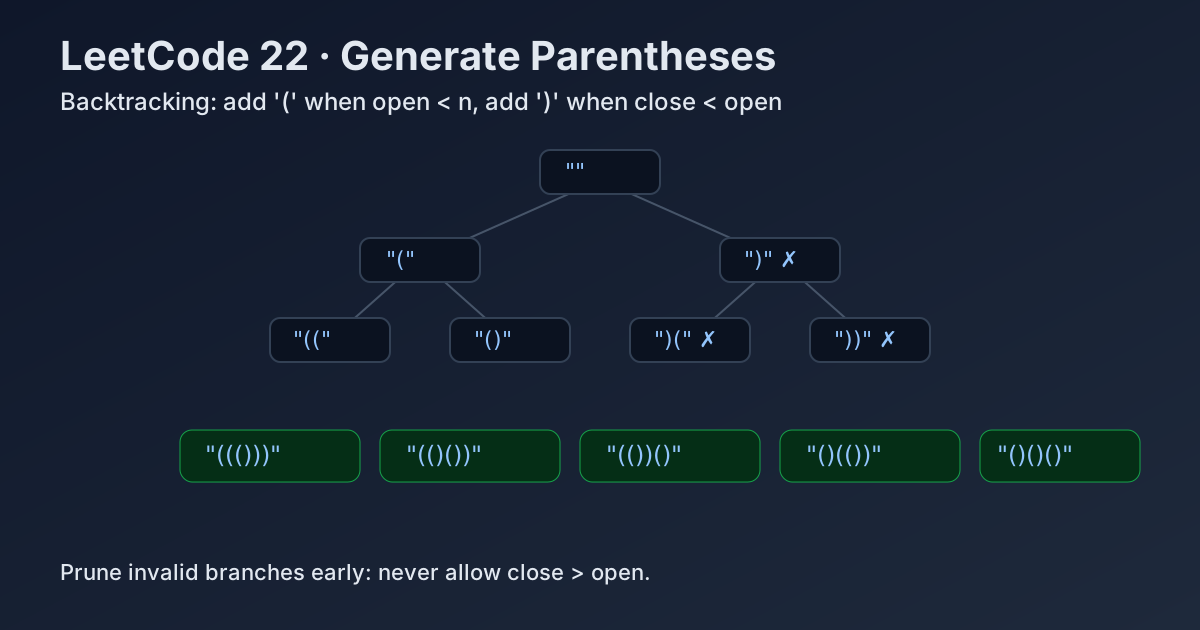
Build the string from left to right using backtracking. Keep two counters: how many ( and ) have been used. A state is valid only if close <= open at every prefix.
Brute Force and Limitations
Brute force generates all 2^(2n) strings of (/) and then validates each one. This wastes huge effort on invalid branches and becomes infeasible quickly.
Optimal Algorithm Steps
1) Start DFS with empty path and open = 0, close = 0.
2) If path length is 2n, record one answer.
3) If open < n, append ( and recurse.
4) If close < open, append ) and recurse.
5) Backtrack by removing the appended character after each recursive call.
Complexity Analysis
Time: O(Cn * n), where Cn is the nth Catalan number (number of valid results).
Space: O(n) recursion depth (excluding output storage).
Common Pitfalls
- Allowing ) when close == open, creating invalid prefixes.
- Forgetting the open < n cap, producing too many left parentheses.
- Reusing mutable builders incorrectly and corrupting saved answers.
- Returning only count instead of actual combinations.
Reference Implementations (Java / Go / C++ / Python / JavaScript)
class Solution {
    public List<String> generateParenthesis(int n) {
        List<String> ans = new ArrayList<>();
        StringBuilder path = new StringBuilder();
        dfs(n, 0, 0, path, ans);
        return ans;
    }

    private void dfs(int n, int open, int close, StringBuilder path, List<String> ans) {
        if (path.length() == 2 * n) {
            ans.add(path.toString());
            return;
        }

        if (open < n) {
            path.append('(');
            dfs(n, open + 1, close, path, ans);
            path.deleteCharAt(path.length() - 1);
        }

        if (close < open) {
            path.append(')');
            dfs(n, open, close + 1, path, ans);
            path.deleteCharAt(path.length() - 1);
        }
    }
}
func generateParenthesis(n int) []string {
ans := make([]string, 0)
path := make([]byte, 0, 2*n)
var dfs func(open, close int)
dfs = func(open, close int) {
if len(path) == 2*n {
ans = append(ans, string(path))
return
}
if open < n {
path = append(path, '(')
dfs(open+1, close)
path = path[:len(path)-1]
}
if close < open {
path = append(path, ')')
dfs(open, close+1)
path = path[:len(path)-1]
}
}
dfs(0, 0)
return ans
}class Solution {
public:
vector<string> generateParenthesis(int n) {
vector<string> ans;
string path;
path.reserve(2 * n);
dfs(n, 0, 0, path, ans);
return ans;
}
private:
void dfs(int n, int open, int close, string& path, vector<string>& ans) {
if ((int)path.size() == 2 * n) {
ans.push_back(path);
return;
}
if (open < n) {
path.push_back('(');
dfs(n, open + 1, close, path, ans);
path.pop_back();
}
if (close < open) {
path.push_back(')');
dfs(n, open, close + 1, path, ans);
path.pop_back();
}
}
};class Solution:
def generateParenthesis(self, n: int) -> list[str]:
ans = []
path = []
def dfs(open_cnt: int, close_cnt: int) -> None:
if len(path) == 2 * n:
ans.append("".join(path))
return
if open_cnt < n:
path.append("(")
dfs(open_cnt + 1, close_cnt)
path.pop()
if close_cnt < open_cnt:
path.append(")")
dfs(open_cnt, close_cnt + 1)
path.pop()
dfs(0, 0)
return ansvar generateParenthesis = function(n) {
const ans = [];
const path = [];
const dfs = (open, close) => {
if (path.length === 2 * n) {
ans.push(path.join(""));
return;
}
if (open < n) {
path.push("(");
dfs(open + 1, close);
path.pop();
}
if (close < open) {
path.push(")");
dfs(open, close + 1);
path.pop();
}
};
dfs(0, 0);
return ans;
};中文
题目概述
给定 n 对括号,生成所有有效(左右括号匹配且顺序合法)的括号组合。
核心思路
用回溯(Backtracking)逐步构造答案。维护已使用的左括号数 open 与右括号数 close,并始终保证前缀合法:close <= open。
暴力解法与不足
暴力法会先枚举长度为 2n 的所有括号串(共 2^(2n) 个),再逐个判断是否有效。绝大多数分支无效,开销非常大。
最优算法步骤
1)从空串开始 DFS,初始 open=0、close=0。
2)当当前长度到达 2n 时,收集该结果。
3)若 open < n,可继续放入 (。
4)若 close < open,可放入 )。
5)每次递归返回后撤销本次选择(回溯)。
复杂度分析
时间复杂度:O(Cn * n),其中 Cn 为第 n 个卡特兰数(有效结果数量)。
空间复杂度:O(n) 递归栈(不含结果存储)。
常见陷阱
- 在 close == open 时仍加入右括号,导致前缀非法。
- 忘记限制 open < n,生成超量左括号。
- 可变字符串回溯不彻底,导致答案串被污染。
- 只返回数量而非所有组合字符串。
多语言参考实现(Java / Go / C++ / Python / JavaScript)
class Solution {
    public List<String> generateParenthesis(int n) {
        List<String> ans = new ArrayList<>();
        StringBuilder path = new StringBuilder();
        dfs(n, 0, 0, path, ans);
        return ans;
    }

    private void dfs(int n, int open, int close, StringBuilder path, List<String> ans) {
        if (path.length() == 2 * n) {
            ans.add(path.toString());
            return;
        }

        if (open < n) {
            path.append('(');
            dfs(n, open + 1, close, path, ans);
            path.deleteCharAt(path.length() - 1);
        }

        if (close < open) {
            path.append(')');
            dfs(n, open, close + 1, path, ans);
            path.deleteCharAt(path.length() - 1);
        }
    }
}
func generateParenthesis(n int) []string {
ans := make([]string, 0)
path := make([]byte, 0, 2*n)
var dfs func(open, close int)
dfs = func(open, close int) {
if len(path) == 2*n {
ans = append(ans, string(path))
return
}
if open < n {
path = append(path, '(')
dfs(open+1, close)
path = path[:len(path)-1]
}
if close < open {
path = append(path, ')')
dfs(open, close+1)
path = path[:len(path)-1]
}
}
dfs(0, 0)
return ans
}class Solution {
public:
vector<string> generateParenthesis(int n) {
vector<string> ans;
string path;
path.reserve(2 * n);
dfs(n, 0, 0, path, ans);
return ans;
}
private:
void dfs(int n, int open, int close, string& path, vector<string>& ans) {
if ((int)path.size() == 2 * n) {
ans.push_back(path);
return;
}
if (open < n) {
path.push_back('(');
dfs(n, open + 1, close, path, ans);
path.pop_back();
}
if (close < open) {
path.push_back(')');
dfs(n, open, close + 1, path, ans);
path.pop_back();
}
}
};class Solution:
def generateParenthesis(self, n: int) -> list[str]:
ans = []
path = []
def dfs(open_cnt: int, close_cnt: int) -> None:
if len(path) == 2 * n:
ans.append("".join(path))
return
if open_cnt < n:
path.append("(")
dfs(open_cnt + 1, close_cnt)
path.pop()
if close_cnt < open_cnt:
path.append(")")
dfs(open_cnt, close_cnt + 1)
path.pop()
dfs(0, 0)
return ansvar generateParenthesis = function(n) {
const ans = [];
const path = [];
const dfs = (open, close) => {
if (path.length === 2 * n) {
ans.push(path.join(""));
return;
}
if (open < n) {
path.push("(");
dfs(open + 1, close);
path.pop();
}
if (close < open) {
path.push(")");
dfs(open, close + 1);
path.pop();
}
};
dfs(0, 0);
return ans;
};
Comments