LeetCode 1980: Find Unique Binary String (Cantor Diagonal Construction)
LeetCode 1980MathDiagonalizationToday we solve LeetCode 1980 - Find Unique Binary String.
Source: https://leetcode.com/problems/find-unique-binary-string/
English
Problem Summary
Given n unique binary strings of length n, return any binary string of length n that is not in the array.
Key Insight
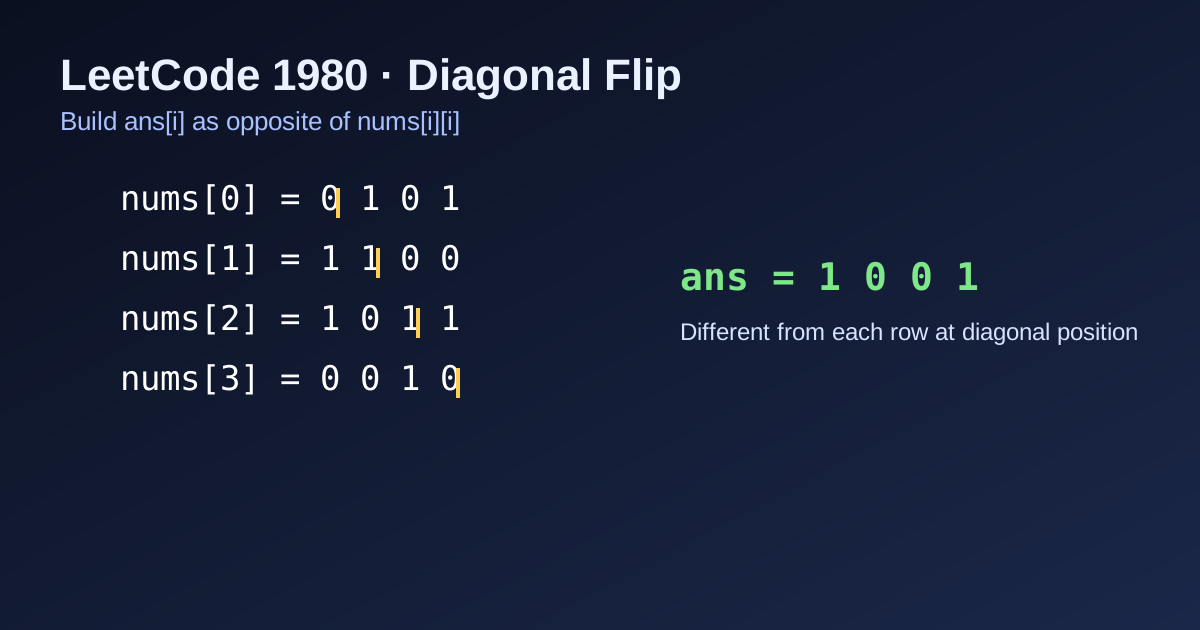
Use Cantor-style diagonal construction: build answer ans[i] by flipping nums[i][i]. Then ans differs from every nums[i] at index i, so it cannot equal any existing string.
Complexity
Time: O(n). Space: O(n) for output.
Reference Implementations (Java / Go / C++ / Python / JavaScript)
class Solution {
    public String findDifferentBinaryString(String[] nums) {
        int n = nums.length;
        char[] ans = new char[n];
        for (int i = 0; i < n; i++) {
            ans[i] = nums[i].charAt(i) == '0' ? '1' : '0';
        }
        return new String(ans);
    }
}
func findDifferentBinaryString(nums []string) string {
n := len(nums)
ans := make([]byte, n)
for i := 0; i < n; i++ {
if nums[i][i] == '0' {
ans[i] = '1'
} else {
ans[i] = '0'
}
}
return string(ans)
}class Solution {
public:
string findDifferentBinaryString(vector<string>& nums) {
int n = nums.size();
string ans(n, '0');
for (int i = 0; i < n; ++i) {
ans[i] = (nums[i][i] == '0') ? '1' : '0';
}
return ans;
}
};class Solution:
def findDifferentBinaryString(self, nums: List[str]) -> str:
n = len(nums)
chars = []
for i in range(n):
chars.append('1' if nums[i][i] == '0' else '0')
return ''.join(chars)/**
* @param {string[]} nums
* @return {string}
*/
var findDifferentBinaryString = function(nums) {
const n = nums.length;
const ans = new Array(n);
for (let i = 0; i < n; i++) {
ans[i] = nums[i][i] === '0' ? '1' : '0';
}
return ans.join('');
};中文
题目概述
给定 n 个长度为 n 的互不相同二进制字符串,返回任意一个不在数组中的长度为 n 的二进制字符串。
核心思路
使用对角线构造(Cantor 对角线思想):令答案第 i 位与 nums[i][i] 相反。这样答案在第 i 位一定与第 i 个字符串不同,因此不可能与任何已有字符串完全相同。
复杂度分析
时间复杂度:O(n)。空间复杂度:O(n)(输出字符串)。
多语言参考实现(Java / Go / C++ / Python / JavaScript)
class Solution {
    public String findDifferentBinaryString(String[] nums) {
        int n = nums.length;
        char[] ans = new char[n];
        for (int i = 0; i < n; i++) {
            ans[i] = nums[i].charAt(i) == '0' ? '1' : '0';
        }
        return new String(ans);
    }
}
func findDifferentBinaryString(nums []string) string {
n := len(nums)
ans := make([]byte, n)
for i := 0; i < n; i++ {
if nums[i][i] == '0' {
ans[i] = '1'
} else {
ans[i] = '0'
}
}
return string(ans)
}class Solution {
public:
string findDifferentBinaryString(vector<string>& nums) {
int n = nums.size();
string ans(n, '0');
for (int i = 0; i < n; ++i) {
ans[i] = (nums[i][i] == '0') ? '1' : '0';
}
return ans;
}
};class Solution:
def findDifferentBinaryString(self, nums: List[str]) -> str:
n = len(nums)
chars = []
for i in range(n):
chars.append('1' if nums[i][i] == '0' else '0')
return ''.join(chars)/**
* @param {string[]} nums
* @return {string}
*/
var findDifferentBinaryString = function(nums) {
const n = nums.length;
const ans = new Array(n);
for (let i = 0; i < n; i++) {
ans[i] = nums[i][i] === '0' ? '1' : '0';
}
return ans.join('');
};
Comments