LeetCode 188: Best Time to Buy and Sell Stock IV (k-Transaction State DP)
LeetCode 188DPState MachineToday we solve LeetCode 188 - Best Time to Buy and Sell Stock IV.
Source: https://leetcode.com/problems/best-time-to-buy-and-sell-stock-iv/
English
Problem Summary
Given an integer k and an array prices, return the maximum profit you can achieve with at most k transactions. You must sell before buying again.
Key Insight
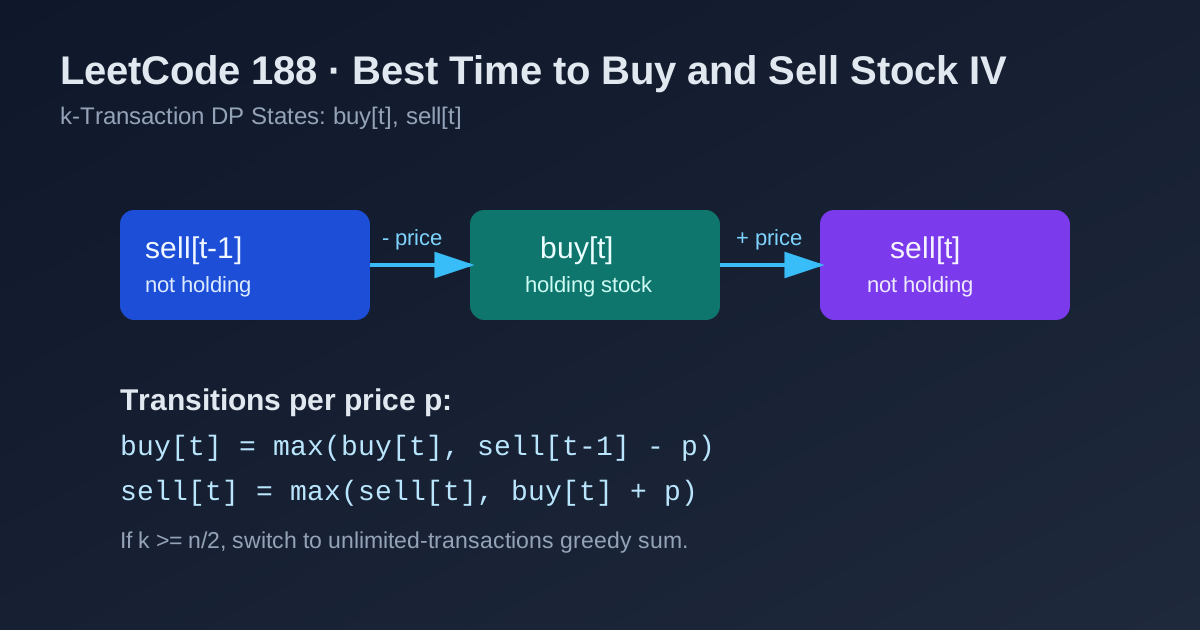
Track buy/sell states per transaction count. For each transaction round t (1..k), we maintain:
buy[t]: max profit after the t-th buy (holding stock).
sell[t]: max profit after the t-th sell (not holding stock).
Optimal Algorithm Steps
1) Edge cases: if prices is empty or k == 0, answer is 0.
2) If k >= n/2, it becomes unlimited transactions (sum all positive rises).
3) Initialize arrays: buy[t] = -INF, sell[t] = 0.
4) For each price p, for t = 1..k:
buy[t] = max(buy[t], sell[t-1] - p)
sell[t] = max(sell[t], buy[t] + p)
5) Final answer is sell[k].
Complexity Analysis
Time: O(n * k).
Space: O(k).
Common Pitfalls
- Forgetting the k >= n/2 fast path.
- Mixing update order between buy[t] and sell[t].
- Wrong initial values for buy[t] causing impossible states to be selected.
Reference Implementations (Java / Go / C++ / Python / JavaScript)
class Solution {
    public int maxProfit(int k, int[] prices) {
        int n = prices.length;
        if (n == 0 || k == 0) return 0;
        if (k >= n / 2) {
            int ans = 0;
            for (int i = 1; i < n; i++) {
                if (prices[i] > prices[i - 1]) ans += prices[i] - prices[i - 1];
            }
            return ans;
        }

        int[] buy = new int[k + 1];
        int[] sell = new int[k + 1];
        for (int t = 1; t <= k; t++) buy[t] = Integer.MIN_VALUE / 2;

        for (int p : prices) {
            for (int t = 1; t <= k; t++) {
                buy[t] = Math.max(buy[t], sell[t - 1] - p);
                sell[t] = Math.max(sell[t], buy[t] + p);
            }
        }
        return sell[k];
    }
}
func maxProfit(k int, prices []int) int {
n := len(prices)
if n == 0 || k == 0 {
return 0
}
if k >= n/2 {
ans := 0
for i := 1; i < n; i++ {
if prices[i] > prices[i-1] {
ans += prices[i] - prices[i-1]
}
}
return ans
}
buy := make([]int, k+1)
sell := make([]int, k+1)
const negInf = -1 << 60
for t := 1; t <= k; t++ {
buy[t] = negInf
}
for _, p := range prices {
for t := 1; t <= k; t++ {
if sell[t-1]-p > buy[t] {
buy[t] = sell[t-1] - p
}
if buy[t]+p > sell[t] {
sell[t] = buy[t] + p
}
}
}
return sell[k]
}class Solution {
public:
int maxProfit(int k, vector<int>& prices) {
int n = (int)prices.size();
if (n == 0 || k == 0) return 0;
if (k >= n / 2) {
int ans = 0;
for (int i = 1; i < n; ++i) {
if (prices[i] > prices[i - 1]) ans += prices[i] - prices[i - 1];
}
return ans;
}
vector<int> buy(k + 1, INT_MIN / 2), sell(k + 1, 0);
for (int p : prices) {
for (int t = 1; t <= k; ++t) {
buy[t] = max(buy[t], sell[t - 1] - p);
sell[t] = max(sell[t], buy[t] + p);
}
}
return sell[k];
}
};class Solution:
def maxProfit(self, k: int, prices: list[int]) -> int:
n = len(prices)
if n == 0 or k == 0:
return 0
if k >= n // 2:
return sum(max(0, prices[i] - prices[i - 1]) for i in range(1, n))
buy = [float("-inf")] * (k + 1)
sell = [0] * (k + 1)
for p in prices:
for t in range(1, k + 1):
buy[t] = max(buy[t], sell[t - 1] - p)
sell[t] = max(sell[t], buy[t] + p)
return sell[k]var maxProfit = function(k, prices) {
const n = prices.length;
if (n === 0 || k === 0) return 0;
if (k >= Math.floor(n / 2)) {
let ans = 0;
for (let i = 1; i < n; i++) {
if (prices[i] > prices[i - 1]) ans += prices[i] - prices[i - 1];
}
return ans;
}
const buy = new Array(k + 1).fill(-Infinity);
const sell = new Array(k + 1).fill(0);
for (const p of prices) {
for (let t = 1; t <= k; t++) {
buy[t] = Math.max(buy[t], sell[t - 1] - p);
sell[t] = Math.max(sell[t], buy[t] + p);
}
}
return sell[k];
};中文
题目概述
给定整数 k 和数组 prices,你最多可以完成 k 笔交易,求最大利润。必须先卖出才能再次买入。
核心思路
把每一笔交易拆成“买入状态”和“卖出状态”。对每个 t(1..k)维护:
buy[t]:完成第 t 次买入后(手里持股)的最大利润。
sell[t]:完成第 t 次卖出后(手里不持股)的最大利润。
最优算法步骤
1)边界处理:空数组或 k=0,答案为 0。
2)若 k >= n/2,退化为不限交易次数,直接累加所有上升差值。
3)初始化:buy[t] = -INF,sell[t] = 0。
4)遍历每个价格 p,对每个 t=1..k 执行:
buy[t] = max(buy[t], sell[t-1] - p)
sell[t] = max(sell[t], buy[t] + p)
5)最终返回 sell[k]。
复杂度分析
时间复杂度:O(n * k)。
空间复杂度:O(k)。
常见陷阱
- 忘记 k >= n/2 的快速分支,导致不必要的高复杂度。
- buy/sell 更新顺序写错,状态被污染。
- buy 初始化不合理,让不可能状态参与比较。
多语言参考实现(Java / Go / C++ / Python / JavaScript)
class Solution {
    public int maxProfit(int k, int[] prices) {
        int n = prices.length;
        if (n == 0 || k == 0) return 0;
        if (k >= n / 2) {
            int ans = 0;
            for (int i = 1; i < n; i++) {
                if (prices[i] > prices[i - 1]) ans += prices[i] - prices[i - 1];
            }
            return ans;
        }

        int[] buy = new int[k + 1];
        int[] sell = new int[k + 1];
        for (int t = 1; t <= k; t++) buy[t] = Integer.MIN_VALUE / 2;

        for (int p : prices) {
            for (int t = 1; t <= k; t++) {
                buy[t] = Math.max(buy[t], sell[t - 1] - p);
                sell[t] = Math.max(sell[t], buy[t] + p);
            }
        }
        return sell[k];
    }
}
func maxProfit(k int, prices []int) int {
n := len(prices)
if n == 0 || k == 0 {
return 0
}
if k >= n/2 {
ans := 0
for i := 1; i < n; i++ {
if prices[i] > prices[i-1] {
ans += prices[i] - prices[i-1]
}
}
return ans
}
buy := make([]int, k+1)
sell := make([]int, k+1)
const negInf = -1 << 60
for t := 1; t <= k; t++ {
buy[t] = negInf
}
for _, p := range prices {
for t := 1; t <= k; t++ {
if sell[t-1]-p > buy[t] {
buy[t] = sell[t-1] - p
}
if buy[t]+p > sell[t] {
sell[t] = buy[t] + p
}
}
}
return sell[k]
}class Solution {
public:
int maxProfit(int k, vector<int>& prices) {
int n = (int)prices.size();
if (n == 0 || k == 0) return 0;
if (k >= n / 2) {
int ans = 0;
for (int i = 1; i < n; ++i) {
if (prices[i] > prices[i - 1]) ans += prices[i] - prices[i - 1];
}
return ans;
}
vector<int> buy(k + 1, INT_MIN / 2), sell(k + 1, 0);
for (int p : prices) {
for (int t = 1; t <= k; ++t) {
buy[t] = max(buy[t], sell[t - 1] - p);
sell[t] = max(sell[t], buy[t] + p);
}
}
return sell[k];
}
};class Solution:
def maxProfit(self, k: int, prices: list[int]) -> int:
n = len(prices)
if n == 0 or k == 0:
return 0
if k >= n // 2:
return sum(max(0, prices[i] - prices[i - 1]) for i in range(1, n))
buy = [float("-inf")] * (k + 1)
sell = [0] * (k + 1)
for p in prices:
for t in range(1, k + 1):
buy[t] = max(buy[t], sell[t - 1] - p)
sell[t] = max(sell[t], buy[t] + p)
return sell[k]var maxProfit = function(k, prices) {
const n = prices.length;
if (n === 0 || k === 0) return 0;
if (k >= Math.floor(n / 2)) {
let ans = 0;
for (let i = 1; i < n; i++) {
if (prices[i] > prices[i - 1]) ans += prices[i] - prices[i - 1];
}
return ans;
}
const buy = new Array(k + 1).fill(-Infinity);
const sell = new Array(k + 1).fill(0);
for (const p of prices) {
for (let t = 1; t <= k; t++) {
buy[t] = Math.max(buy[t], sell[t - 1] - p);
sell[t] = Math.max(sell[t], buy[t] + p);
}
}
return sell[k];
};
Comments