LeetCode 1752: Check if Array Is Sorted and Rotated (Count Circular Drops)
LeetCode 1752ArrayGreedyCircularToday we solve LeetCode 1752 - Check if Array Is Sorted and Rotated.
Source: https://leetcode.com/problems/check-if-array-is-sorted-and-rotated/
English
Problem Summary
Given an integer array nums, return true if it was originally non-decreasing and then rotated some positions (possibly zero); otherwise return false.
Key Insight
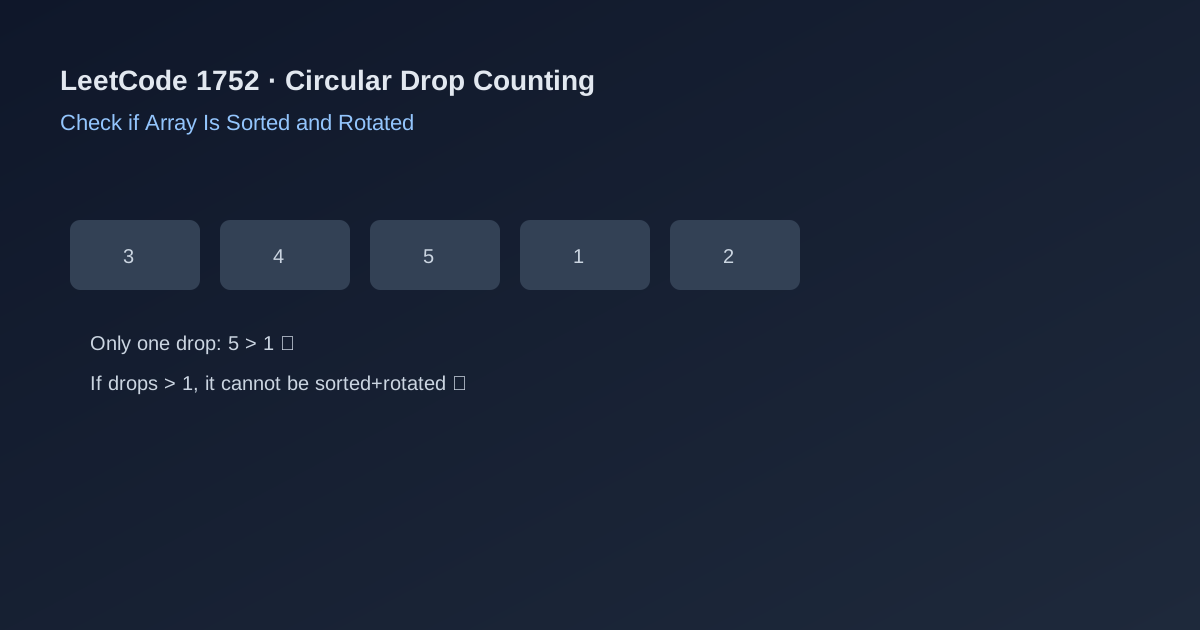
In a non-decreasing circular array, there can be at most one place where order drops, i.e., nums[i] > nums[(i+1) % n]. More than one drop means impossible.
Brute Force and Limitations
Trying all rotations and checking sorted order costs O(n^2). We can do one circular scan in O(n).
Optimal Algorithm Steps
1) Initialize drops = 0.
2) For each index i, compare nums[i] with nums[(i+1) % n].
3) If current is greater than next, increment drops.
4) If drops > 1, return false.
5) After loop, return true.
Complexity Analysis
Time: O(n).
Space: O(1).
Common Pitfalls
- Forgetting the circular comparison from last element to first.
- Using strict increasing logic and rejecting equal neighbors incorrectly.
- Overcomplicating with explicit rotation reconstruction.
Reference Implementations (Java / Go / C++ / Python / JavaScript)
class Solution {
    public boolean check(int[] nums) {
        int drops = 0;
        int n = nums.length;
        for (int i = 0; i < n; i++) {
            if (nums[i] > nums[(i + 1) % n]) {
                drops++;
                if (drops > 1) return false;
            }
        }
        return true;
    }
}
func check(nums []int) bool {
drops := 0
n := len(nums)
for i := 0; i < n; i++ {
if nums[i] > nums[(i+1)%n] {
drops++
if drops > 1 {
return false
}
}
}
return true
}class Solution {
public:
bool check(vector<int>& nums) {
int drops = 0, n = nums.size();
for (int i = 0; i < n; ++i) {
if (nums[i] > nums[(i + 1) % n]) {
++drops;
if (drops > 1) return false;
}
}
return true;
}
};class Solution:
def check(self, nums: List[int]) -> bool:
drops = 0
n = len(nums)
for i in range(n):
if nums[i] > nums[(i + 1) % n]:
drops += 1
if drops > 1:
return False
return Truevar check = function(nums) {
let drops = 0;
const n = nums.length;
for (let i = 0; i < n; i++) {
if (nums[i] > nums[(i + 1) % n]) {
drops++;
if (drops > 1) return false;
}
}
return true;
};中文
题目概述
给定整数数组 nums,判断它是否可以由一个非递减数组旋转得到(也可以旋转 0 次)。
核心思路
如果把数组看成环,非递减序列最多只会出现一次“下降点”,即 nums[i] > nums[(i+1) % n]。超过一次就不可能是合法旋转。
暴力解法与不足
暴力做法是枚举每个旋转再检查有序性,复杂度 O(n^2)。其实一次环形遍历就够了。
最优算法步骤
1)初始化 drops = 0。
2)遍历每个下标 i,比较 nums[i] 和 nums[(i+1) % n]。
3)若前者大于后者,drops++。
4)若 drops > 1,直接返回 false。
5)遍历结束返回 true。
复杂度分析
时间复杂度:O(n)。
空间复杂度:O(1)。
常见陷阱
- 忘记比较最后一个元素和第一个元素(环形)。
- 把“非递减”误写成“严格递增”,导致重复值场景判断错误。
- 过度实现旋转重建,代码复杂且低效。
多语言参考实现(Java / Go / C++ / Python / JavaScript)
class Solution {
    public boolean check(int[] nums) {
        int drops = 0;
        int n = nums.length;
        for (int i = 0; i < n; i++) {
            if (nums[i] > nums[(i + 1) % n]) {
                drops++;
                if (drops > 1) return false;
            }
        }
        return true;
    }
}
func check(nums []int) bool {
drops := 0
n := len(nums)
for i := 0; i < n; i++ {
if nums[i] > nums[(i+1)%n] {
drops++
if drops > 1 {
return false
}
}
}
return true
}class Solution {
public:
bool check(vector<int>& nums) {
int drops = 0, n = nums.size();
for (int i = 0; i < n; ++i) {
if (nums[i] > nums[(i + 1) % n]) {
++drops;
if (drops > 1) return false;
}
}
return true;
}
};class Solution:
def check(self, nums: List[int]) -> bool:
drops = 0
n = len(nums)
for i in range(n):
if nums[i] > nums[(i + 1) % n]:
drops += 1
if drops > 1:
return False
return Truevar check = function(nums) {
let drops = 0;
const n = nums.length;
for (let i = 0; i < n; i++) {
if (nums[i] > nums[(i + 1) % n]) {
drops++;
if (drops > 1) return false;
}
}
return true;
};
Comments