LeetCode 1710: Maximum Units on a Truck (Greedy by Units per Box)
LeetCode 1710GreedySortingToday we solve LeetCode 1710 - Maximum Units on a Truck.
Source: https://leetcode.com/problems/maximum-units-on-a-truck/
English
Problem Summary
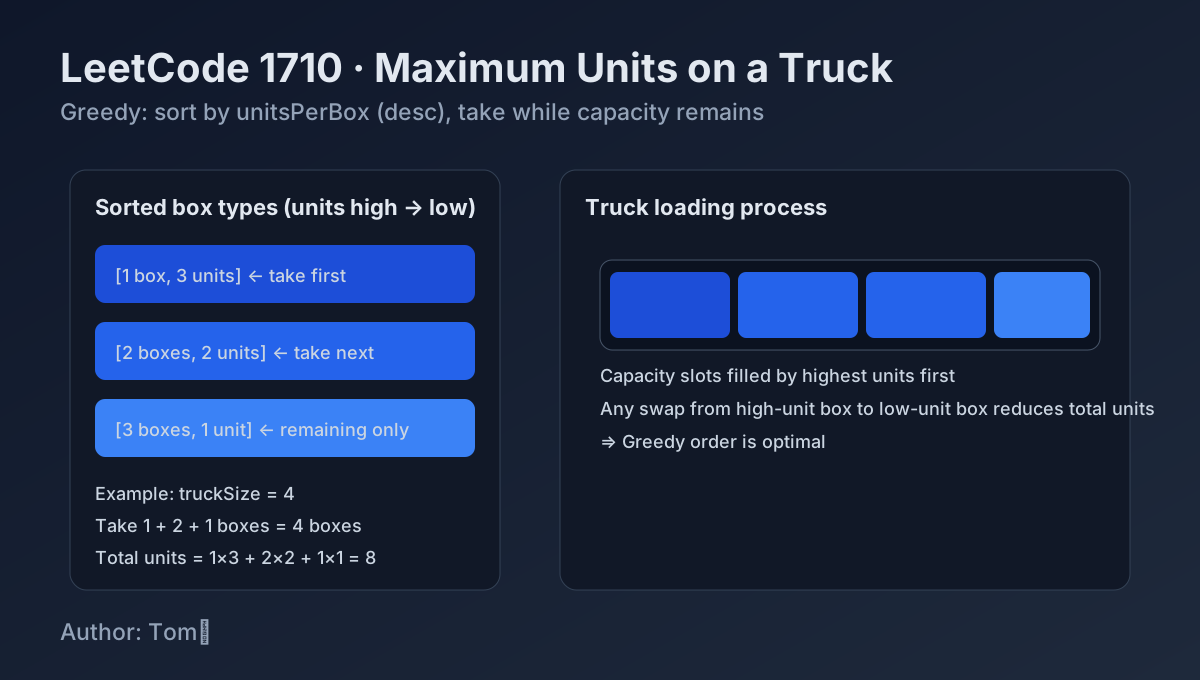
You are given box types [numberOfBoxes, unitsPerBox] and a truck capacity truckSize (max boxes). Choose boxes to maximize total units.
Key Insight
Each box has the same "cost" (occupies 1 slot), but different "value" (unitsPerBox). So this is a classic greedy pick-by-value problem: always take boxes with higher unitsPerBox first.
Algorithm
1) Sort box types by unitsPerBox in descending order.
2) Iterate in that order, each time take min(numberOfBoxes, truckSize).
3) Add taken * unitsPerBox to answer and reduce truckSize.
4) Stop when truck is full.
Why Greedy Works
If we skip a higher-unit box and take a lower-unit box instead, swapping them always increases (or keeps) the total units. Therefore, any optimal solution can be transformed into one that takes higher-unit boxes first.
Complexity
Time: O(n log n) for sorting.
Space: O(1) extra (ignoring sorting implementation details).
Reference Implementations (Java / Go / C++ / Python / JavaScript)
import java.util.Arrays;

class Solution {
    public int maximumUnits(int[][] boxTypes, int truckSize) {
        Arrays.sort(boxTypes, (a, b) -> Integer.compare(b[1], a[1]));

        int ans = 0;
        for (int[] box : boxTypes) {
            if (truckSize == 0) break;
            int take = Math.min(box[0], truckSize);
            ans += take * box[1];
            truckSize -= take;
        }
        return ans;
    }
}
import "sort"
func maximumUnits(boxTypes [][]int, truckSize int) int {
sort.Slice(boxTypes, func(i, j int) bool {
return boxTypes[i][1] > boxTypes[j][1]
})
ans := 0
for _, box := range boxTypes {
if truckSize == 0 {
break
}
take := box[0]
if take > truckSize {
take = truckSize
}
ans += take * box[1]
truckSize -= take
}
return ans
}class Solution {
public:
int maximumUnits(vector<vector<int>>& boxTypes, int truckSize) {
sort(boxTypes.begin(), boxTypes.end(), [](const auto& a, const auto& b) {
return a[1] > b[1];
});
int ans = 0;
for (auto& box : boxTypes) {
if (truckSize == 0) break;
int take = min(box[0], truckSize);
ans += take * box[1];
truckSize -= take;
}
return ans;
}
};class Solution:
def maximumUnits(self, boxTypes: list[list[int]], truckSize: int) -> int:
boxTypes.sort(key=lambda x: -x[1])
ans = 0
for boxes, units in boxTypes:
if truckSize == 0:
break
take = min(boxes, truckSize)
ans += take * units
truckSize -= take
return ans/**
* @param {number[][]} boxTypes
* @param {number} truckSize
* @return {number}
*/
var maximumUnits = function(boxTypes, truckSize) {
boxTypes.sort((a, b) => b[1] - a[1]);
let ans = 0;
for (const [boxes, units] of boxTypes) {
if (truckSize === 0) break;
const take = Math.min(boxes, truckSize);
ans += take * units;
truckSize -= take;
}
return ans;
};中文
题目概述
给定若干箱子类型 [numberOfBoxes, unitsPerBox],以及卡车最多可装箱数 truckSize。目标是在不超过容量的前提下,让总单元数最大。
核心思路
每个箱子占用 1 个容量位,但价值(unitsPerBox)不同。因此应优先拿“单位价值更高”的箱子,也就是按 unitsPerBox 降序贪心装载。
算法步骤
1)按 unitsPerBox 从大到小排序。
2)依次处理每种箱子,取 min(numberOfBoxes, truckSize) 个。
3)答案累加 take * unitsPerBox,并减少剩余容量。
4)容量为 0 时提前结束。
正确性直觉
如果某方案中放了低单位价值箱子,却没放高单位价值箱子,那么把它们交换后,总单元数不会变小,通常会更大。因此最优解一定可以调整成“高单位价值优先”的形式,贪心成立。
复杂度分析
时间复杂度:O(n log n)(排序)。
空间复杂度:O(1) 额外空间(不计排序内部开销)。
多语言参考实现(Java / Go / C++ / Python / JavaScript)
import java.util.Arrays;

class Solution {
    public int maximumUnits(int[][] boxTypes, int truckSize) {
        Arrays.sort(boxTypes, (a, b) -> Integer.compare(b[1], a[1]));

        int ans = 0;
        for (int[] box : boxTypes) {
            if (truckSize == 0) break;
            int take = Math.min(box[0], truckSize);
            ans += take * box[1];
            truckSize -= take;
        }
        return ans;
    }
}
import "sort"
func maximumUnits(boxTypes [][]int, truckSize int) int {
sort.Slice(boxTypes, func(i, j int) bool {
return boxTypes[i][1] > boxTypes[j][1]
})
ans := 0
for _, box := range boxTypes {
if truckSize == 0 {
break
}
take := box[0]
if take > truckSize {
take = truckSize
}
ans += take * box[1]
truckSize -= take
}
return ans
}class Solution {
public:
int maximumUnits(vector<vector<int>>& boxTypes, int truckSize) {
sort(boxTypes.begin(), boxTypes.end(), [](const auto& a, const auto& b) {
return a[1] > b[1];
});
int ans = 0;
for (auto& box : boxTypes) {
if (truckSize == 0) break;
int take = min(box[0], truckSize);
ans += take * box[1];
truckSize -= take;
}
return ans;
}
};class Solution:
def maximumUnits(self, boxTypes: list[list[int]], truckSize: int) -> int:
boxTypes.sort(key=lambda x: -x[1])
ans = 0
for boxes, units in boxTypes:
if truckSize == 0:
break
take = min(boxes, truckSize)
ans += take * units
truckSize -= take
return ans/**
* @param {number[][]} boxTypes
* @param {number} truckSize
* @return {number}
*/
var maximumUnits = function(boxTypes, truckSize) {
boxTypes.sort((a, b) => b[1] - a[1]);
let ans = 0;
for (const [boxes, units] of boxTypes) {
if (truckSize === 0) break;
const take = Math.min(boxes, truckSize);
ans += take * units;
truckSize -= take;
}
return ans;
};
Comments