LeetCode 170: Two Sum III - Data structure design (Hash Map Count Design)
LeetCode 170DesignHash TableData StructureToday we solve LeetCode 170 - Two Sum III - Data structure design, a design-style variant where we support online add and find operations.
Source: https://leetcode.com/problems/two-sum-iii-data-structure-design/
English
Problem Summary
Design a data structure that supports:
- add(number): store one number.
- find(value): return whether any pair sums to value.
Numbers can be duplicated, so multiplicity matters.
Key Insight
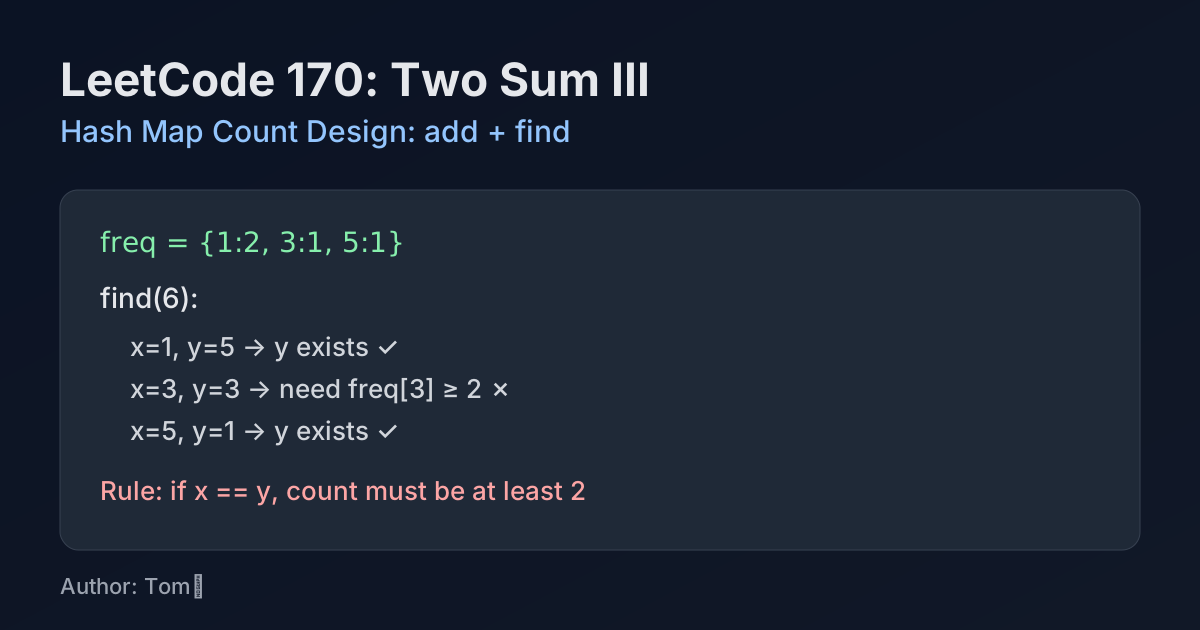
Maintain a frequency map count[num]. During find(value), iterate all seen numbers x, compute y = value - x, and check:
- If y != x, we only need both keys to exist.
- If y == x, we need frequency at least 2.
Algorithm
add(number): increment count[number].
find(value):
1) For every key x in map, set y = value - x.
2) If y != x and count[y] exists, return true.
3) If y == x and count[x] >= 2, return true.
4) Otherwise continue; if loop ends return false.
Complexity Analysis
add: O(1) average.find: O(n) where n is number of distinct values.
Space: O(n).
Common Pitfalls
- Forgetting the x == y case requires at least two copies.
- Iterating raw list each query leads to unnecessary overhead and harder duplicate handling.
- Accidentally deleting counts or mutating map during query.
Reference Implementations (Java / Go / C++ / Python / JavaScript)
import java.util.HashMap;
import java.util.Map;

class TwoSum {
    private final Map<Integer, Integer> freq = new HashMap<>();

    public TwoSum() {}

    public void add(int number) {
        freq.put(number, freq.getOrDefault(number, 0) + 1);
    }

    public boolean find(int value) {
        for (Map.Entry<Integer, Integer> entry : freq.entrySet()) {
            int x = entry.getKey();
            int y = value - x;
            if (y != x) {
                if (freq.containsKey(y)) return true;
            } else {
                if (entry.getValue() >= 2) return true;
            }
        }
        return false;
    }
}
type TwoSum struct {
freq map[int]int
}
func Constructor() TwoSum {
return TwoSum{freq: make(map[int]int)}
}
func (t *TwoSum) Add(number int) {
t.freq[number]++
}
func (t *TwoSum) Find(value int) bool {
for x, cx := range t.freq {
y := value - x
if y != x {
if _, ok := t.freq[y]; ok {
return true
}
} else {
if cx >= 2 {
return true
}
}
}
return false
}class TwoSum {
private:
unordered_map<int, int> freq;
public:
TwoSum() {}
void add(int number) {
++freq[number];
}
bool find(int value) {
for (const auto& [x, cx] : freq) {
int y = value - x;
if (y != x) {
if (freq.count(y)) return true;
} else {
if (cx >= 2) return true;
}
}
return false;
}
};class TwoSum:
def __init__(self):
self.freq = {}
def add(self, number: int) -> None:
self.freq[number] = self.freq.get(number, 0) + 1
def find(self, value: int) -> bool:
for x, cx in self.freq.items():
y = value - x
if y != x:
if y in self.freq:
return True
else:
if cx >= 2:
return True
return Falsevar TwoSum = function() {
this.freq = new Map();
};
TwoSum.prototype.add = function(number) {
this.freq.set(number, (this.freq.get(number) || 0) + 1);
};
TwoSum.prototype.find = function(value) {
for (const [x, cx] of this.freq.entries()) {
const y = value - x;
if (y !== x) {
if (this.freq.has(y)) return true;
} else {
if (cx >= 2) return true;
}
}
return false;
};中文
题目概述
设计一个数据结构,支持两个操作:
- add(number):加入一个数字。
- find(value):判断是否存在一对数字,其和等于 value。
注意数字可能重复,因此要正确处理频次。
核心思路
使用哈希表维护每个数字出现次数 freq[num]。查询时遍历每个数字 x,令 y = value - x:
- 若 y != x,只要 y 也存在即可。
- 若 y == x,则该数字至少要出现两次。
算法步骤
add(number):freq[number]++。
find(value):
1)遍历哈希表中每个键 x,计算 y = value - x。
2)若 y != x 且 freq 中有 y,返回 true。
3)若 y == x 且 freq[x] >= 2,返回 true。
4)遍历结束仍未命中,返回 false。
复杂度分析
add 平均 O(1)。find 为 O(n)(n 为不同数字个数)。
空间复杂度 O(n)。
常见陷阱
- 忽略 x == y 时需要“至少两个相同数字”。
- 直接用数组暴力两层循环会导致查询开销过大。
- 在查询过程中误修改频次表,造成后续结果错误。
多语言参考实现(Java / Go / C++ / Python / JavaScript)
import java.util.HashMap;
import java.util.Map;

class TwoSum {
    private final Map<Integer, Integer> freq = new HashMap<>();

    public TwoSum() {}

    public void add(int number) {
        freq.put(number, freq.getOrDefault(number, 0) + 1);
    }

    public boolean find(int value) {
        for (Map.Entry<Integer, Integer> entry : freq.entrySet()) {
            int x = entry.getKey();
            int y = value - x;
            if (y != x) {
                if (freq.containsKey(y)) return true;
            } else {
                if (entry.getValue() >= 2) return true;
            }
        }
        return false;
    }
}
type TwoSum struct {
freq map[int]int
}
func Constructor() TwoSum {
return TwoSum{freq: make(map[int]int)}
}
func (t *TwoSum) Add(number int) {
t.freq[number]++
}
func (t *TwoSum) Find(value int) bool {
for x, cx := range t.freq {
y := value - x
if y != x {
if _, ok := t.freq[y]; ok {
return true
}
} else {
if cx >= 2 {
return true
}
}
}
return false
}class TwoSum {
private:
unordered_map<int, int> freq;
public:
TwoSum() {}
void add(int number) {
++freq[number];
}
bool find(int value) {
for (const auto& [x, cx] : freq) {
int y = value - x;
if (y != x) {
if (freq.count(y)) return true;
} else {
if (cx >= 2) return true;
}
}
return false;
}
};class TwoSum:
def __init__(self):
self.freq = {}
def add(self, number: int) -> None:
self.freq[number] = self.freq.get(number, 0) + 1
def find(self, value: int) -> bool:
for x, cx in self.freq.items():
y = value - x
if y != x:
if y in self.freq:
return True
else:
if cx >= 2:
return True
return Falsevar TwoSum = function() {
this.freq = new Map();
};
TwoSum.prototype.add = function(number) {
this.freq.set(number, (this.freq.get(number) || 0) + 1);
};
TwoSum.prototype.find = function(value) {
for (const [x, cx] of this.freq.entries()) {
const y = value - x;
if (y !== x) {
if (this.freq.has(y)) return true;
} else {
if (cx >= 2) return true;
}
}
return false;
};
Comments