LeetCode 169: Majority Element (Boyer-Moore Voting)
LeetCode 169ArrayVoting AlgorithmGreedyToday we solve LeetCode 169 - Majority Element, a classic interview question that introduces the elegant Boyer-Moore voting algorithm.
Source: https://leetcode.com/problems/majority-element/
English
Problem Summary
Given an integer array nums of size n, return the majority element. The majority element appears more than ⌊n/2⌋ times, and it is guaranteed to exist.
Key Insight
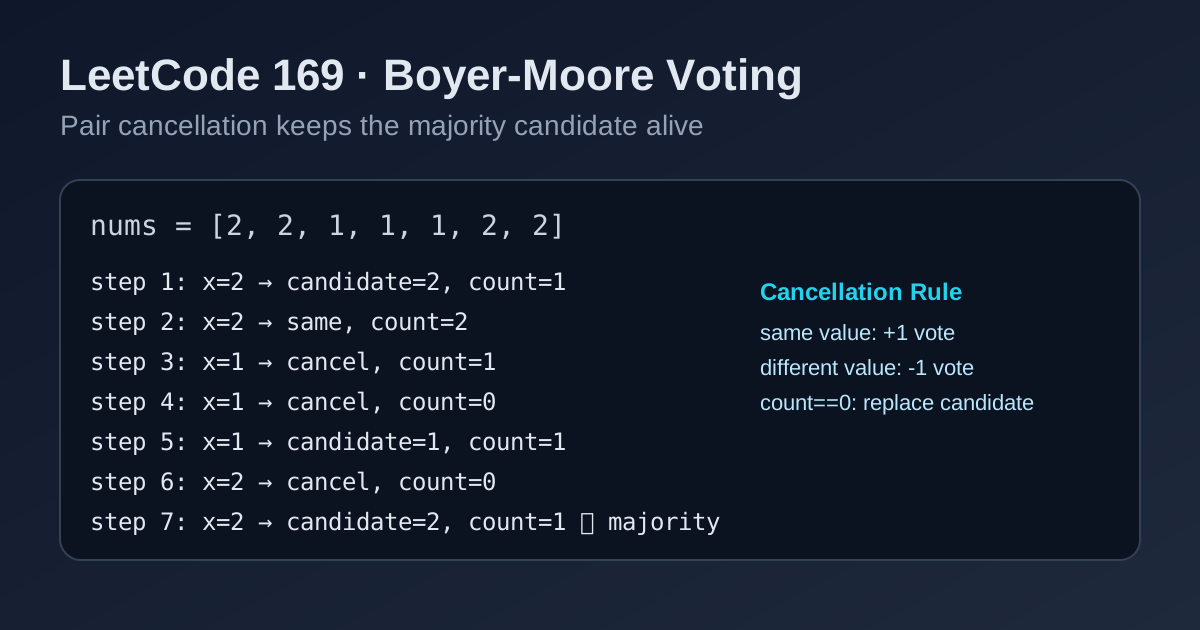
If we pair one occurrence of the majority value with one occurrence of a non-majority value, those pairs cancel each other. Because majority count is strictly greater than all others combined, it survives all cancellations.
Boyer-Moore keeps one candidate and a count:
- If count == 0, choose current number as new candidate.
- If current number equals candidate, count++.
- Otherwise, count--.
Baseline Approaches
- Hash map counting: O(n) time, O(n) space.
- Sorting and taking middle: O(n log n) time, O(1) extra space (in-place sort).
Boyer-Moore is optimal here: O(n) time and O(1) space.
Optimal Algorithm (Boyer-Moore Voting)
1) Initialize candidate = 0, count = 0.
2) Scan each x in nums:
a) If count == 0, set candidate = x.
b) If x == candidate, increment count; else decrement it.
3) Return candidate.
In this problem, no second validation pass is needed because majority is guaranteed.
Complexity Analysis
Time: O(n).
Space: O(1).
Common Pitfalls
- Forgetting to reset candidate when count becomes zero.
- Assuming this works without guarantee; for generic “possible majority” tasks, add a second count verification pass.
- Mixing candidate assignment and count update in wrong order.
Reference Implementations (Java / Go / C++ / Python / JavaScript)
class Solution {
    public int majorityElement(int[] nums) {
        int candidate = 0;
        int count = 0;

        for (int x : nums) {
            if (count == 0) {
                candidate = x;
            }
            if (x == candidate) {
                count++;
            } else {
                count--;
            }
        }

        return candidate;
    }
}
func majorityElement(nums []int) int {
candidate := 0
count := 0
for _, x := range nums {
if count == 0 {
candidate = x
}
if x == candidate {
count++
} else {
count--
}
}
return candidate
}class Solution {
public:
int majorityElement(vector<int>& nums) {
int candidate = 0;
int count = 0;
for (int x : nums) {
if (count == 0) {
candidate = x;
}
if (x == candidate) {
count++;
} else {
count--;
}
}
return candidate;
}
};class Solution:
def majorityElement(self, nums: List[int]) -> int:
candidate = 0
count = 0
for x in nums:
if count == 0:
candidate = x
if x == candidate:
count += 1
else:
count -= 1
return candidate/**
* @param {number[]} nums
* @return {number}
*/
var majorityElement = function(nums) {
let candidate = 0;
let count = 0;
for (const x of nums) {
if (count === 0) {
candidate = x;
}
if (x === candidate) {
count++;
} else {
count--;
}
}
return candidate;
};中文
题目概述
给定长度为 n 的整数数组 nums,返回其中的“多数元素”。多数元素指的是出现次数严格大于 ⌊n/2⌋ 的元素,并且题目保证它一定存在。
核心思路
可以把“多数元素”和“非多数元素”两两配对抵消。因为多数元素数量大于其余元素总和,所以抵消到最后,剩下的一定是它。
Boyer-Moore 投票算法只维护两个变量:
- candidate:当前候选值。
- count:当前候选值相对“净票数”。
常见基线解法
- 哈希表统计频次:时间 O(n),空间 O(n)。
- 排序后取中位:时间 O(n log n),额外空间可到 O(1)(原地排序)。
本题最优是 Boyer-Moore:时间 O(n),空间 O(1)。
最优算法(Boyer-Moore)
1)初始化 candidate = 0,count = 0。
2)遍历每个元素 x:
a)若 count == 0,把 x 设为新候选;
b)若 x == candidate,count++,否则 count--。
3)遍历结束返回 candidate。
由于本题保证多数元素存在,不需要额外二次验证。
复杂度分析
时间复杂度:O(n)。
空间复杂度:O(1)。
常见陷阱
- count 归零时忘记切换候选值。
- 在“不保证存在多数元素”的变体里忘记做二次校验。
- 候选切换和计数更新顺序写错,导致结果偏差。
多语言参考实现(Java / Go / C++ / Python / JavaScript)
class Solution {
    public int majorityElement(int[] nums) {
        int candidate = 0;
        int count = 0;

        for (int x : nums) {
            if (count == 0) {
                candidate = x;
            }
            if (x == candidate) {
                count++;
            } else {
                count--;
            }
        }

        return candidate;
    }
}
func majorityElement(nums []int) int {
candidate := 0
count := 0
for _, x := range nums {
if count == 0 {
candidate = x
}
if x == candidate {
count++
} else {
count--
}
}
return candidate
}class Solution {
public:
int majorityElement(vector<int>& nums) {
int candidate = 0;
int count = 0;
for (int x : nums) {
if (count == 0) {
candidate = x;
}
if (x == candidate) {
count++;
} else {
count--;
}
}
return candidate;
}
};class Solution:
def majorityElement(self, nums: List[int]) -> int:
candidate = 0
count = 0
for x in nums:
if count == 0:
candidate = x
if x == candidate:
count += 1
else:
count -= 1
return candidate/**
* @param {number[]} nums
* @return {number}
*/
var majorityElement = function(nums) {
let candidate = 0;
let count = 0;
for (const x of nums) {
if (count === 0) {
candidate = x;
}
if (x === candidate) {
count++;
} else {
count--;
}
}
return candidate;
};
Comments