LeetCode 1431: Kids With the Greatest Number of Candies (Global Max + Threshold Check)
LeetCode 1431ArraySimulationGreedy CheckToday we solve LeetCode 1431 - Kids With the Greatest Number of Candies.
Source: https://leetcode.com/problems/kids-with-the-greatest-number-of-candies/
English
Problem Summary
Given an integer array candies where candies[i] is the number of candies the i-th kid has, and an integer extraCandies, return a boolean array where each element indicates whether that kid can have the greatest number of candies after receiving all extra candies.
Key Insight
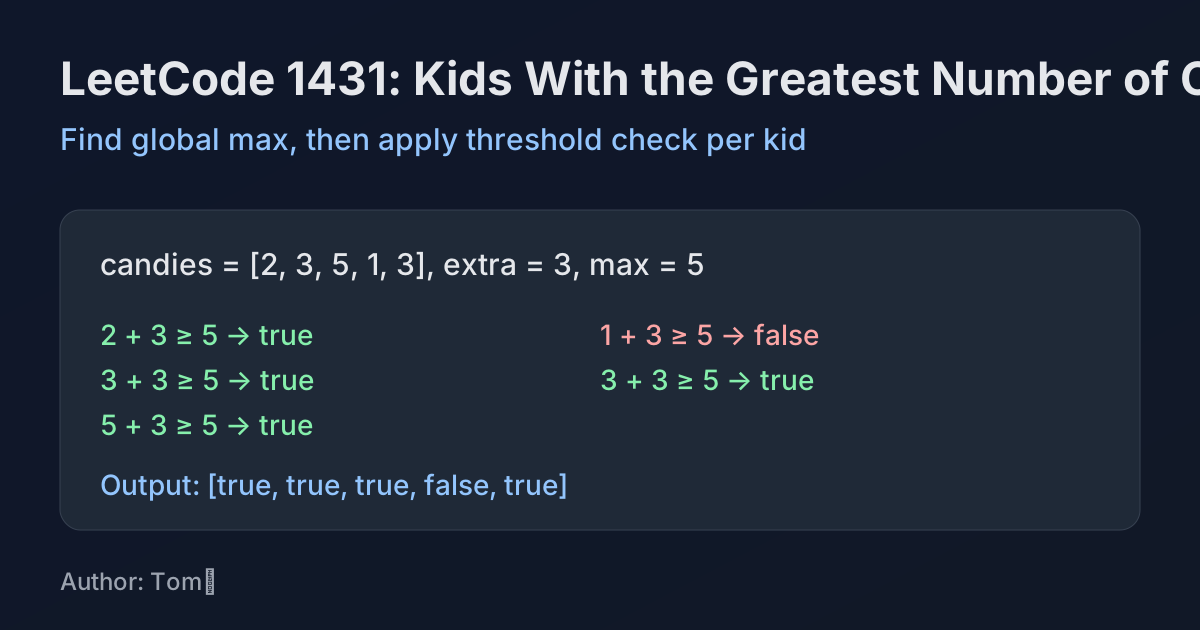
We only need one global value: the current maximum candies among all kids. Then for each kid, test whether candies[i] + extraCandies >= maxCandy.
Brute Force and Limitations
A brute-force method recomputes the maximum for every kid after virtual addition, which costs O(n^2). This is unnecessary because the same maximum can be reused.
Optimal Algorithm Steps
1) Scan once to find maxCandy.
2) Scan again and evaluate candies[i] + extraCandies >= maxCandy.
3) Append the boolean result for each kid.
4) Return the result array.
Complexity Analysis
Time: O(n).
Space: O(1) extra (excluding output array).
Common Pitfalls
- Recomputing max inside the loop (wastes time).
- Using > instead of >= (ties should be true).
- Forgetting output order must match original kids order.
Reference Implementations (Java / Go / C++ / Python / JavaScript)
class Solution {
    public List<Boolean> kidsWithCandies(int[] candies, int extraCandies) {
        int maxCandy = 0;
        for (int candy : candies) {
            maxCandy = Math.max(maxCandy, candy);
        }

        List<Boolean> ans = new ArrayList<>(candies.length);
        for (int candy : candies) {
            ans.add(candy + extraCandies >= maxCandy);
        }
        return ans;
    }
}
func kidsWithCandies(candies []int, extraCandies int) []bool {
maxCandy := 0
for _, candy := range candies {
if candy > maxCandy {
maxCandy = candy
}
}
ans := make([]bool, len(candies))
for i, candy := range candies {
ans[i] = candy+extraCandies >= maxCandy
}
return ans
}class Solution {
public:
vector<bool> kidsWithCandies(vector<int>& candies, int extraCandies) {
int maxCandy = *max_element(candies.begin(), candies.end());
vector<bool> ans;
ans.reserve(candies.size());
for (int candy : candies) {
ans.push_back(candy + extraCandies >= maxCandy);
}
return ans;
}
};class Solution:
def kidsWithCandies(self, candies: List[int], extraCandies: int) -> List[bool]:
max_candy = max(candies)
return [candy + extraCandies >= max_candy for candy in candies]var kidsWithCandies = function(candies, extraCandies) {
let maxCandy = 0;
for (const candy of candies) {
if (candy > maxCandy) maxCandy = candy;
}
const ans = new Array(candies.length);
for (let i = 0; i < candies.length; i++) {
ans[i] = candies[i] + extraCandies >= maxCandy;
}
return ans;
};中文
题目概述
给定整数数组 candies,其中 candies[i] 表示第 i 个小孩当前糖果数;再给定 extraCandies,表示可额外给某个小孩的糖果数。请返回布尔数组,判断每个小孩在拿到额外糖果后,是否能达到“最多糖果数”。
核心思路
先找出全局最大糖果数 maxCandy。然后逐个判断 candies[i] + extraCandies >= maxCandy 是否成立即可。
暴力解法与不足
暴力做法会对每个小孩都“模拟加糖后再重新求最大值”,复杂度变成 O(n^2),明显冗余。
最优算法步骤
1)第一遍遍历,求出 maxCandy。
2)第二遍遍历,判断每个小孩是否满足 candies[i] + extraCandies >= maxCandy。
3)按原顺序写入布尔结果。
4)返回结果数组。
复杂度分析
时间复杂度:O(n)。
额外空间复杂度:O(1)(不计输出数组)。
常见陷阱
- 在循环里反复求最大值,导致性能下降。
- 把条件写成 >,导致“并列最大”被误判为 false。
- 返回结果顺序和原数组下标不一致。
多语言参考实现(Java / Go / C++ / Python / JavaScript)
class Solution {
    public List<Boolean> kidsWithCandies(int[] candies, int extraCandies) {
        int maxCandy = 0;
        for (int candy : candies) {
            maxCandy = Math.max(maxCandy, candy);
        }

        List<Boolean> ans = new ArrayList<>(candies.length);
        for (int candy : candies) {
            ans.add(candy + extraCandies >= maxCandy);
        }
        return ans;
    }
}
func kidsWithCandies(candies []int, extraCandies int) []bool {
maxCandy := 0
for _, candy := range candies {
if candy > maxCandy {
maxCandy = candy
}
}
ans := make([]bool, len(candies))
for i, candy := range candies {
ans[i] = candy+extraCandies >= maxCandy
}
return ans
}class Solution {
public:
vector<bool> kidsWithCandies(vector<int>& candies, int extraCandies) {
int maxCandy = *max_element(candies.begin(), candies.end());
vector<bool> ans;
ans.reserve(candies.size());
for (int candy : candies) {
ans.push_back(candy + extraCandies >= maxCandy);
}
return ans;
}
};class Solution:
def kidsWithCandies(self, candies: List[int], extraCandies: int) -> List[bool]:
max_candy = max(candies)
return [candy + extraCandies >= max_candy for candy in candies]var kidsWithCandies = function(candies, extraCandies) {
let maxCandy = 0;
for (const candy of candies) {
if (candy > maxCandy) maxCandy = candy;
}
const ans = new Array(candies.length);
for (let i = 0; i < candies.length; i++) {
ans[i] = candies[i] + extraCandies >= maxCandy;
}
return ans;
};
Comments