LeetCode 1343: Number of Sub-arrays of Size K and Average >= Threshold (Fixed-Size Sliding Window)
LeetCode 1343Sliding WindowArrayToday we solve LeetCode 1343 - Number of Sub-arrays of Size K and Average Greater than or Equal to Threshold.
English
Problem Summary
Given an integer array arr, and integers k and threshold, count how many contiguous subarrays of length k have average value at least threshold.
Key Insight
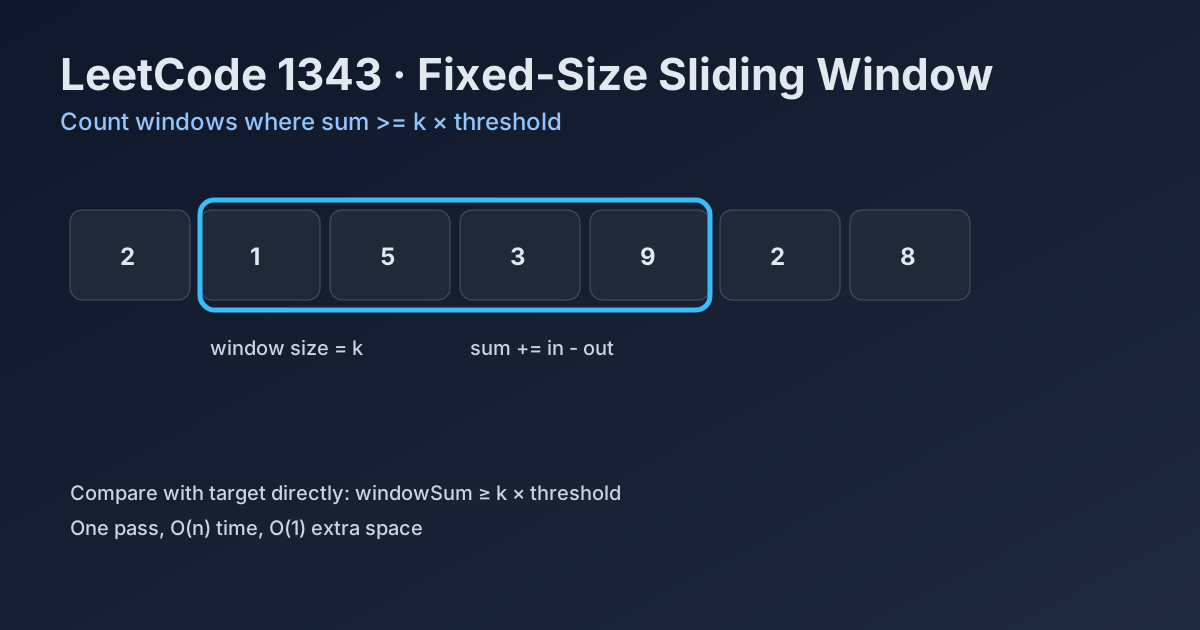
Because the window size is fixed at k, each move only removes one number and adds one number. So we maintain a running window sum in O(1) per step. Compare the sum with k * threshold to avoid floating-point division.
Brute Force and Limitations
Brute force recomputes each length-k subarray sum from scratch, taking O(nk). This is too slow for large inputs.
Optimal Algorithm Steps
1) Compute the first window sum for indices [0, k-1].
2) Let target = k * threshold; if first sum >= target, answer++.
3) Slide right from index k to n-1: add incoming value, subtract outgoing value.
4) After each slide, if window sum >= target, answer++.
5) Return answer.
Complexity Analysis
Time: O(n).
Space: O(1).
Common Pitfalls
- Using average division each time (unnecessary and can introduce precision issues).
- Off-by-one on outgoing element index (i - k).
- Not handling n == k correctly (only one window).
Reference Implementations (Java / Go / C++ / Python / JavaScript)
class Solution {
    public int numOfSubarrays(int[] arr, int k, int threshold) {
        int n = arr.length;
        int target = k * threshold;

        int sum = 0;
        for (int i = 0; i < k; i++) sum += arr[i];

        int ans = (sum >= target) ? 1 : 0;

        for (int i = k; i < n; i++) {
            sum += arr[i] - arr[i - k];
            if (sum >= target) ans++;
        }

        return ans;
    }
}
func numOfSubarrays(arr []int, k int, threshold int) int {
n := len(arr)
target := k * threshold
sum := 0
for i := 0; i < k; i++ {
sum += arr[i]
}
ans := 0
if sum >= target {
ans = 1
}
for i := k; i < n; i++ {
sum += arr[i] - arr[i-k]
if sum >= target {
ans++
}
}
return ans
}class Solution {
public:
int numOfSubarrays(vector& arr, int k, int threshold) {
int n = (int)arr.size();
int target = k * threshold;
int sum = 0;
for (int i = 0; i < k; ++i) sum += arr[i];
int ans = (sum >= target) ? 1 : 0;
for (int i = k; i < n; ++i) {
sum += arr[i] - arr[i - k];
if (sum >= target) ++ans;
}
return ans;
}
}; class Solution:
def numOfSubarrays(self, arr: list[int], k: int, threshold: int) -> int:
target = k * threshold
window_sum = sum(arr[:k])
ans = 1 if window_sum >= target else 0
for i in range(k, len(arr)):
window_sum += arr[i] - arr[i - k]
if window_sum >= target:
ans += 1
return ansfunction numOfSubarrays(arr, k, threshold) {
const target = k * threshold;
let sum = 0;
for (let i = 0; i < k; i++) sum += arr[i];
let ans = sum >= target ? 1 : 0;
for (let i = k; i < arr.length; i++) {
sum += arr[i] - arr[i - k];
if (sum >= target) ans++;
}
return ans;
}中文
题目概述
给定整数数组 arr,以及整数 k 和 threshold,统计长度为 k 的连续子数组中,平均值大于等于 threshold 的数量。
核心思路
这是固定窗口大小的滑动窗口。窗口每次右移一格,只会“减去一个旧元素 + 加上一个新元素”,因此每次更新是 O(1)。并且用 sum >= k * threshold 代替除法判断,避免浮点误差。
暴力解法与不足
暴力法对每个窗口都重新求和,时间复杂度 O(nk)。当 n 大时会明显超时。
最优算法步骤
1)先计算第一个长度为 k 的窗口和。
2)设 target = k * threshold,若当前和 >= target,答案加一。
3)从下标 k 开始滑动:加新元素、减旧元素。
4)每次滑动后判断窗口和是否 >= target。
5)遍历结束返回答案。
复杂度分析
时间复杂度:O(n)。
空间复杂度:O(1)。
常见陷阱
- 每次都做平均值除法,写法啰嗦且可能引入精度问题。
- 滑动时减错下标(应减 i-k)。
- 忽略 n == k 只有一个窗口的情况。
参考实现(Java / Go / C++ / Python / JavaScript)
class Solution {
    public int numOfSubarrays(int[] arr, int k, int threshold) {
        int n = arr.length;
        int target = k * threshold;

        int sum = 0;
        for (int i = 0; i < k; i++) sum += arr[i];

        int ans = (sum >= target) ? 1 : 0;

        for (int i = k; i < n; i++) {
            sum += arr[i] - arr[i - k];
            if (sum >= target) ans++;
        }

        return ans;
    }
}
func numOfSubarrays(arr []int, k int, threshold int) int {
n := len(arr)
target := k * threshold
sum := 0
for i := 0; i < k; i++ {
sum += arr[i]
}
ans := 0
if sum >= target {
ans = 1
}
for i := k; i < n; i++ {
sum += arr[i] - arr[i-k]
if sum >= target {
ans++
}
}
return ans
}class Solution {
public:
int numOfSubarrays(vector& arr, int k, int threshold) {
int n = (int)arr.size();
int target = k * threshold;
int sum = 0;
for (int i = 0; i < k; ++i) sum += arr[i];
int ans = (sum >= target) ? 1 : 0;
for (int i = k; i < n; ++i) {
sum += arr[i] - arr[i - k];
if (sum >= target) ++ans;
}
return ans;
}
}; class Solution:
def numOfSubarrays(self, arr: list[int], k: int, threshold: int) -> int:
target = k * threshold
window_sum = sum(arr[:k])
ans = 1 if window_sum >= target else 0
for i in range(k, len(arr)):
window_sum += arr[i] - arr[i - k]
if window_sum >= target:
ans += 1
return ansfunction numOfSubarrays(arr, k, threshold) {
const target = k * threshold;
let sum = 0;
for (let i = 0; i < k; i++) sum += arr[i];
let ans = sum >= target ? 1 : 0;
for (let i = k; i < arr.length; i++) {
sum += arr[i] - arr[i - k];
if (sum >= target) ans++;
}
return ans;
}
Comments