LeetCode 128: Longest Consecutive Sequence (Hash Set)
LeetCode 128ArrayHash TableToday we solve LeetCode 128 - Longest Consecutive Sequence.
Source: https://leetcode.com/problems/longest-consecutive-sequence/
English
Problem Summary
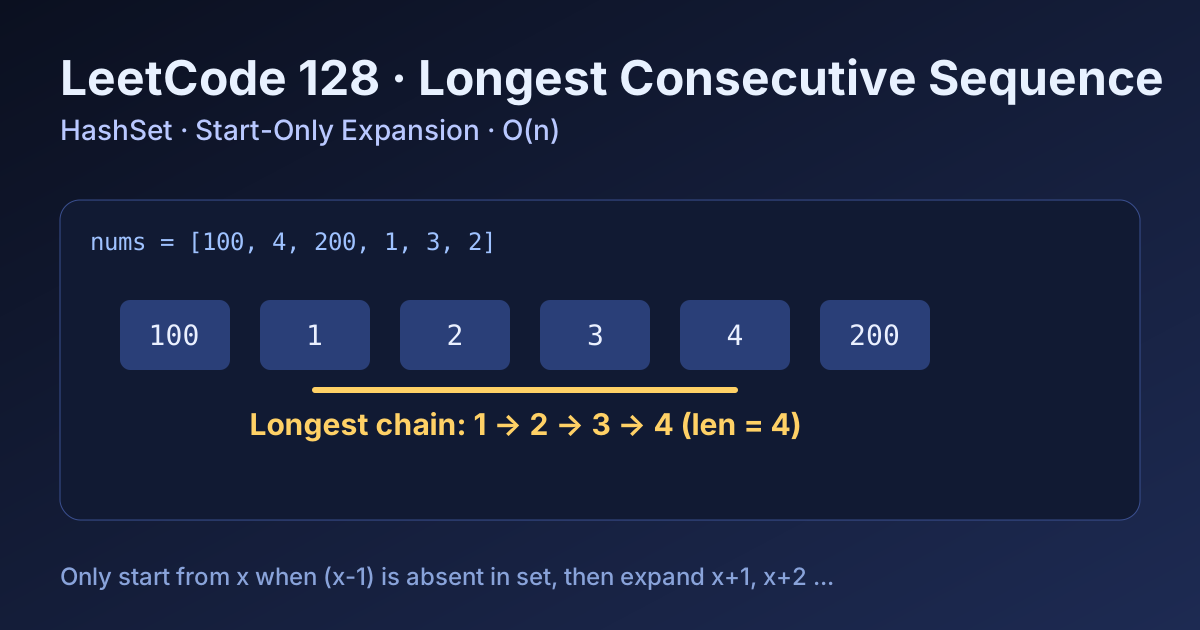
Given an unsorted integer array nums, return the length of the longest sequence of consecutive integers. The required target complexity is O(n).
Key Insight
Use a HashSet for O(1)-average membership checks. For each number x, only start expansion when x - 1 is absent. Then count upward (x+1, x+2...). This avoids repeated scans.
Baseline and Limitation
A sorting-based approach is easy: sort then count adjacent runs. But sorting costs O(n log n), which does not meet the linear-time requirement.
Optimal Algorithm Steps
1) Put all numbers into a set.
2) Iterate each x in the set.
3) If x - 1 exists, skip (not a start).
4) Otherwise, expand from x while x + len exists.
5) Update global max length.
Complexity Analysis
Time: O(n) average. Each number is visited as part of at most one expansion chain.
Space: O(n) for the set.
Common Pitfalls
- Expanding from every number (causes repeated work).
- Forgetting duplicates when using sorted approach.
- Edge case: empty array should return 0.
Reference Implementations (Java / Go / C++ / Python / JavaScript)
import java.util.*;

class Solution {
    public int longestConsecutive(int[] nums) {
        Set<Integer> set = new HashSet<>();
        for (int x : nums) set.add(x);

        int ans = 0;
        for (int x : set) {
            if (set.contains(x - 1)) continue;
            int y = x;
            while (set.contains(y)) y++;
            ans = Math.max(ans, y - x);
        }
        return ans;
    }
}
func longestConsecutive(nums []int) int {
set := make(map[int]bool, len(nums))
for _, x := range nums {
set[x] = true
}
ans := 0
for x := range set {
if set[x-1] {
continue
}
y := x
for set[y] {
y++
}
if y-x > ans {
ans = y - x
}
}
return ans
}class Solution {
public:
int longestConsecutive(vector<int>& nums) {
unordered_set<int> st(nums.begin(), nums.end());
int ans = 0;
for (int x : st) {
if (st.count(x - 1)) continue;
int y = x;
while (st.count(y)) y++;
ans = max(ans, y - x);
}
return ans;
}
};class Solution:
def longestConsecutive(self, nums: List[int]) -> int:
st = set(nums)
ans = 0
for x in st:
if x - 1 in st:
continue
y = x
while y in st:
y += 1
ans = max(ans, y - x)
return ansvar longestConsecutive = function(nums) {
const set = new Set(nums);
let ans = 0;
for (const x of set) {
if (set.has(x - 1)) continue;
let y = x;
while (set.has(y)) y++;
ans = Math.max(ans, y - x);
}
return ans;
};中文
题目概述
给定一个未排序整数数组 nums,返回最长连续整数序列的长度,并要求整体时间复杂度接近 O(n)。
核心思路
把所有数字放入哈希集合。只从“序列起点”开始扩展:如果 x-1 不在集合里,说明 x 才是起点,然后不断检查 x+1, x+2...。
基线方案与不足
排序后线性扫描也能做,但排序是 O(n log n),不满足题目强调的线性时间目标。
最优算法步骤
1)将数组元素全部放入集合。
2)遍历集合中的每个数 x。
3)若 x-1 存在,跳过(它不是起点)。
4)若不存在,从 x 开始向上扩展并计数。
5)更新全局最长长度。
复杂度分析
时间复杂度:平均 O(n)。每个元素最多被某条连续链扩展访问一次。
空间复杂度:O(n)(哈希集合)。
常见陷阱
- 对每个元素都盲目向上扩展,导致重复计算。
- 排序法中忘记处理重复值。
- 忘记空数组返回 0。
多语言参考实现(Java / Go / C++ / Python / JavaScript)
import java.util.*;

class Solution {
    public int longestConsecutive(int[] nums) {
        Set<Integer> set = new HashSet<>();
        for (int x : nums) set.add(x);

        int ans = 0;
        for (int x : set) {
            if (set.contains(x - 1)) continue;
            int y = x;
            while (set.contains(y)) y++;
            ans = Math.max(ans, y - x);
        }
        return ans;
    }
}
func longestConsecutive(nums []int) int {
set := make(map[int]bool, len(nums))
for _, x := range nums {
set[x] = true
}
ans := 0
for x := range set {
if set[x-1] {
continue
}
y := x
for set[y] {
y++
}
if y-x > ans {
ans = y - x
}
}
return ans
}class Solution {
public:
int longestConsecutive(vector<int>& nums) {
unordered_set<int> st(nums.begin(), nums.end());
int ans = 0;
for (int x : st) {
if (st.count(x - 1)) continue;
int y = x;
while (st.count(y)) y++;
ans = max(ans, y - x);
}
return ans;
}
};class Solution:
def longestConsecutive(self, nums: List[int]) -> int:
st = set(nums)
ans = 0
for x in st:
if x - 1 in st:
continue
y = x
while y in st:
y += 1
ans = max(ans, y - x)
return ansvar longestConsecutive = function(nums) {
const set = new Set(nums);
let ans = 0;
for (const x of set) {
if (set.has(x - 1)) continue;
let y = x;
while (set.has(y)) y++;
ans = Math.max(ans, y - x);
}
return ans;
};
Comments