LeetCode 123: Best Time to Buy and Sell Stock III (Two-Transaction State DP)
LeetCode 123Dynamic ProgrammingArrayState MachineToday we solve LeetCode 123 - Best Time to Buy and Sell Stock III.
Source: https://leetcode.com/problems/best-time-to-buy-and-sell-stock-iii/
English
Problem Summary
You are given an array prices[i], where prices[i] is the stock price on day i. You may complete at most two transactions (buy then sell). You cannot hold more than one share at a time. Return the maximum profit.
Key Insight
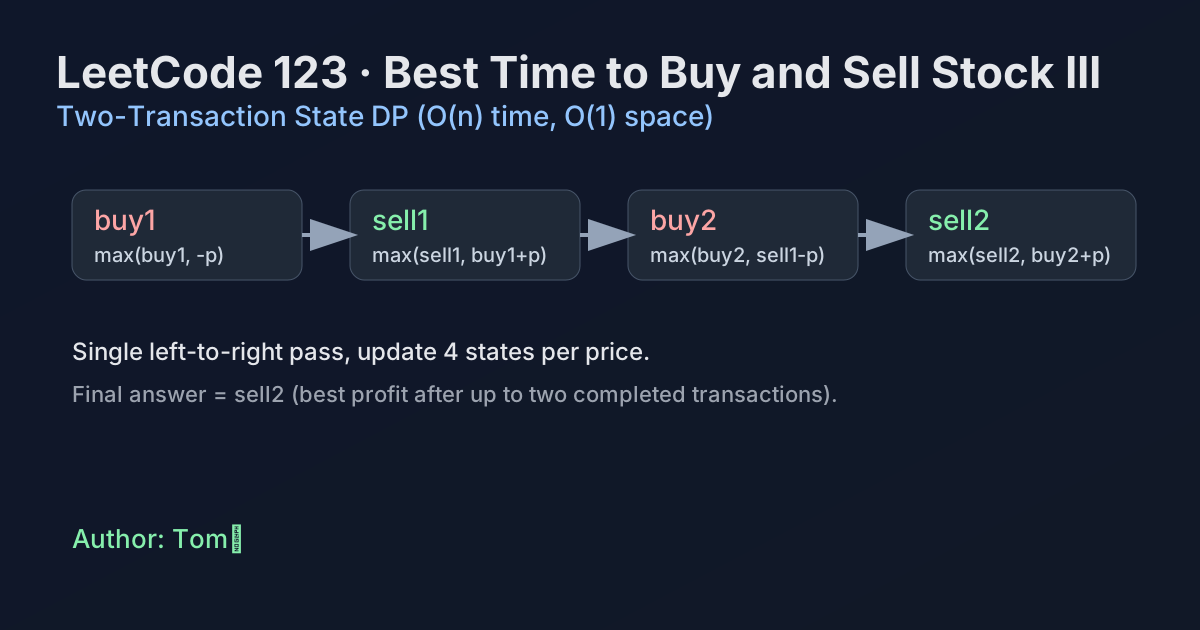
Track four rolling states while scanning prices once: first buy, first sell, second buy, second sell. Each state stores the best profit after that action.
Brute Force and Limitations
A brute-force split point + best single transaction on left/right can work in O(n) with extra arrays, but state DP is cleaner and uses O(1) space.
Optimal Algorithm Steps
1) Initialize:
buy1 = -∞, sell1 = 0, buy2 = -∞, sell2 = 0.
2) For each price p:
buy1 = max(buy1, -p)
sell1 = max(sell1, buy1 + p)
buy2 = max(buy2, sell1 - p)
sell2 = max(sell2, buy2 + p).
3) Answer is sell2.
Complexity Analysis
Time: O(n).
Space: O(1).
Common Pitfalls
- Forgetting that the second buy depends on sell1 (not raw price).
- Using wrong update order and mixing “same-day” transitions incorrectly.
- Returning sell1 instead of sell2 for two-transaction cap.
Reference Implementations (Java / Go / C++ / Python / JavaScript)
class Solution {
    public int maxProfit(int[] prices) {
        int buy1 = Integer.MIN_VALUE / 2;
        int sell1 = 0;
        int buy2 = Integer.MIN_VALUE / 2;
        int sell2 = 0;

        for (int p : prices) {
            buy1 = Math.max(buy1, -p);
            sell1 = Math.max(sell1, buy1 + p);
            buy2 = Math.max(buy2, sell1 - p);
            sell2 = Math.max(sell2, buy2 + p);
        }
        return sell2;
    }
}
func maxProfit(prices []int) int {
negInf := -1 << 60
buy1, sell1 := negInf, 0
buy2, sell2 := negInf, 0
for _, p := range prices {
if -p > buy1 {
buy1 = -p
}
if buy1+p > sell1 {
sell1 = buy1 + p
}
if sell1-p > buy2 {
buy2 = sell1 - p
}
if buy2+p > sell2 {
sell2 = buy2 + p
}
}
return sell2
}class Solution {
public:
int maxProfit(vector<int>& prices) {
int buy1 = INT_MIN / 2, sell1 = 0;
int buy2 = INT_MIN / 2, sell2 = 0;
for (int p : prices) {
buy1 = max(buy1, -p);
sell1 = max(sell1, buy1 + p);
buy2 = max(buy2, sell1 - p);
sell2 = max(sell2, buy2 + p);
}
return sell2;
}
};class Solution:
def maxProfit(self, prices: list[int]) -> int:
neg_inf = -10**18
buy1, sell1 = neg_inf, 0
buy2, sell2 = neg_inf, 0
for p in prices:
buy1 = max(buy1, -p)
sell1 = max(sell1, buy1 + p)
buy2 = max(buy2, sell1 - p)
sell2 = max(sell2, buy2 + p)
return sell2var maxProfit = function(prices) {
let buy1 = Number.NEGATIVE_INFINITY;
let sell1 = 0;
let buy2 = Number.NEGATIVE_INFINITY;
let sell2 = 0;
for (const p of prices) {
buy1 = Math.max(buy1, -p);
sell1 = Math.max(sell1, buy1 + p);
buy2 = Math.max(buy2, sell1 - p);
sell2 = Math.max(sell2, buy2 + p);
}
return sell2;
};中文
题目概述
给定数组 prices[i] 表示第 i 天股价。最多完成两笔交易(每笔先买后卖),且同一时间只能持有一股。求最大利润。
核心思路
用四个状态滚动维护一次扫描中的最优值:第一次买入、第一次卖出、第二次买入、第二次卖出。每个状态都表示“执行到这个动作后的最大收益”。
暴力解法与不足
可以枚举分割点,分别算左右区间的一次交易最优并相加(通常要前后缀数组)。虽然也能做到 O(n),但实现更冗长,状态 DP 更紧凑直观。
最优算法步骤
1)初始化:buy1=-∞, sell1=0, buy2=-∞, sell2=0。
2)遍历每个价格 p,按顺序更新:
buy1 = max(buy1, -p)
sell1 = max(sell1, buy1 + p)
buy2 = max(buy2, sell1 - p)
sell2 = max(sell2, buy2 + p)。
3)最终答案是 sell2。
复杂度分析
时间复杂度:O(n)。
空间复杂度:O(1)。
常见陷阱
- 第二次买入要基于 sell1,不是直接基于原始价格。
- 更新顺序写错会破坏状态语义。
- 最后返回值应是 sell2(最多两笔交易)。
多语言参考实现(Java / Go / C++ / Python / JavaScript)
class Solution {
    public int maxProfit(int[] prices) {
        int buy1 = Integer.MIN_VALUE / 2;
        int sell1 = 0;
        int buy2 = Integer.MIN_VALUE / 2;
        int sell2 = 0;

        for (int p : prices) {
            buy1 = Math.max(buy1, -p);
            sell1 = Math.max(sell1, buy1 + p);
            buy2 = Math.max(buy2, sell1 - p);
            sell2 = Math.max(sell2, buy2 + p);
        }
        return sell2;
    }
}
func maxProfit(prices []int) int {
negInf := -1 << 60
buy1, sell1 := negInf, 0
buy2, sell2 := negInf, 0
for _, p := range prices {
if -p > buy1 {
buy1 = -p
}
if buy1+p > sell1 {
sell1 = buy1 + p
}
if sell1-p > buy2 {
buy2 = sell1 - p
}
if buy2+p > sell2 {
sell2 = buy2 + p
}
}
return sell2
}class Solution {
public:
int maxProfit(vector<int>& prices) {
int buy1 = INT_MIN / 2, sell1 = 0;
int buy2 = INT_MIN / 2, sell2 = 0;
for (int p : prices) {
buy1 = max(buy1, -p);
sell1 = max(sell1, buy1 + p);
buy2 = max(buy2, sell1 - p);
sell2 = max(sell2, buy2 + p);
}
return sell2;
}
};class Solution:
def maxProfit(self, prices: list[int]) -> int:
neg_inf = -10**18
buy1, sell1 = neg_inf, 0
buy2, sell2 = neg_inf, 0
for p in prices:
buy1 = max(buy1, -p)
sell1 = max(sell1, buy1 + p)
buy2 = max(buy2, sell1 - p)
sell2 = max(sell2, buy2 + p)
return sell2var maxProfit = function(prices) {
let buy1 = Number.NEGATIVE_INFINITY;
let sell1 = 0;
let buy2 = Number.NEGATIVE_INFINITY;
let sell2 = 0;
for (const p of prices) {
buy1 = Math.max(buy1, -p);
sell1 = Math.max(sell1, buy1 + p);
buy2 = Math.max(buy2, sell1 - p);
sell2 = Math.max(sell2, buy2 + p);
}
return sell2;
};
Comments