LeetCode 122: Best Time to Buy and Sell Stock II (Greedy Daily Delta Sum)
LeetCode 122GreedyArrayStockToday we solve LeetCode 122 - Best Time to Buy and Sell Stock II.
Source: https://leetcode.com/problems/best-time-to-buy-and-sell-stock-ii/
English
Problem Summary
You are given an array prices where prices[i] is the stock price on day i. You may complete as many transactions as you want (buy then sell), but you can hold at most one stock at a time. Return the maximum total profit.
Key Insight
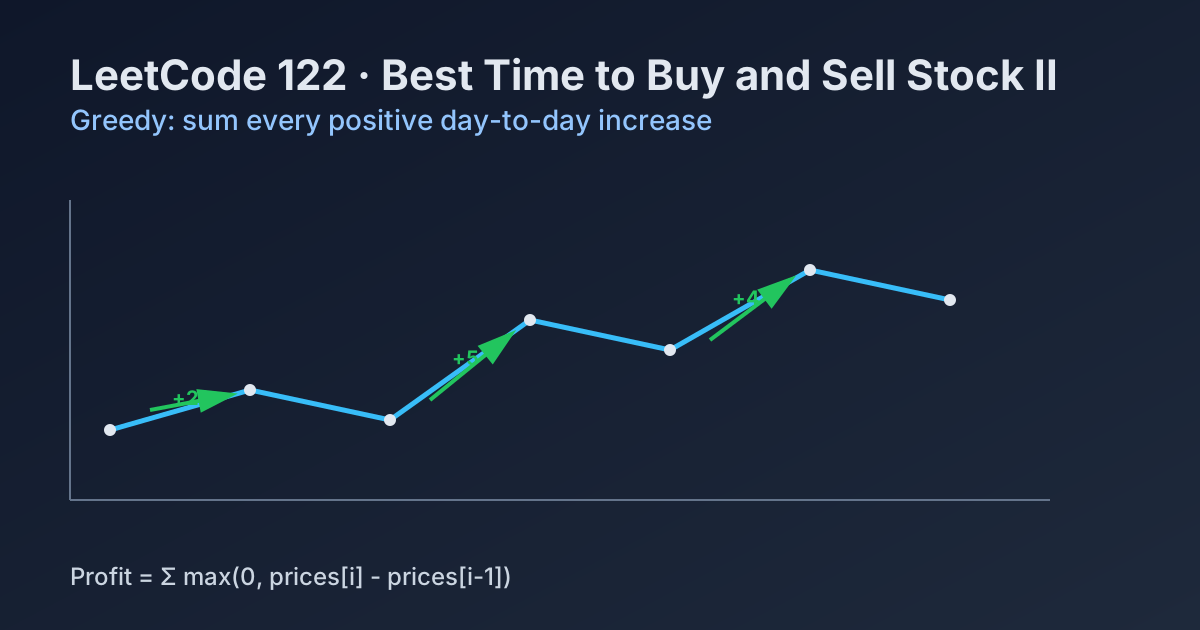
Any increasing segment can be split into day-by-day gains without changing total profit. So the optimal strategy is: whenever prices[i] > prices[i-1], add that positive difference.
Why This Greedy Is Correct
Suppose prices rise from a to b through intermediate days. One long trade earns b-a. Summing daily increases yields the same: (p1-a) + (p2-p1) + ... + (b-pk) = b-a. Also, on non-increasing days, buying/selling adds no benefit. Therefore summing positive deltas is optimal.
Algorithm
1) Initialize profit = 0.
2) For each day i from 1 to n-1:
- If prices[i] > prices[i-1], add prices[i] - prices[i-1] to profit.
3) Return profit.
Complexity Analysis
Time: O(n) (single pass).
Space: O(1).
Reference Implementations (Java / Go / C++ / Python / JavaScript)
class Solution {
    public int maxProfit(int[] prices) {
        int profit = 0;
        for (int i = 1; i < prices.length; i++) {
            if (prices[i] > prices[i - 1]) {
                profit += prices[i] - prices[i - 1];
            }
        }
        return profit;
    }
}
func maxProfit(prices []int) int {
profit := 0
for i := 1; i < len(prices); i++ {
if prices[i] > prices[i-1] {
profit += prices[i] - prices[i-1]
}
}
return profit
}class Solution {
public:
int maxProfit(vector<int>& prices) {
int profit = 0;
for (int i = 1; i < (int)prices.size(); i++) {
if (prices[i] > prices[i - 1]) {
profit += prices[i] - prices[i - 1];
}
}
return profit;
}
};class Solution:
def maxProfit(self, prices: List[int]) -> int:
profit = 0
for i in range(1, len(prices)):
if prices[i] > prices[i - 1]:
profit += prices[i] - prices[i - 1]
return profitvar maxProfit = function(prices) {
let profit = 0;
for (let i = 1; i < prices.length; i++) {
if (prices[i] > prices[i - 1]) {
profit += prices[i] - prices[i - 1];
}
}
return profit;
};中文
题目概述
给定数组 prices,prices[i] 表示第 i 天股价。你可以进行任意次交易(先买后卖),但同一时间最多持有一股。求最大总利润。
核心思路
只要今天比昨天贵,就把这段上涨的“日增量”直接计入利润。把一整段上涨拆成多天卖出,利润总和与“低买高卖一次”完全相同。
正确性直觉
对于单调上升区间,从 a 涨到 b:
一次交易利润是 b-a;
按天累加是 (p1-a)+(p2-p1)+...+(b-pk)=b-a。
两者相等。因此只加所有正差值就不会漏掉最优解。
算法步骤
1)初始化 profit = 0。
2)从第 2 天开始遍历:若 prices[i] > prices[i-1],就加上差值。
3)遍历结束返回 profit。
复杂度分析
时间复杂度:O(n)。
空间复杂度:O(1)。
多语言参考实现(Java / Go / C++ / Python / JavaScript)
class Solution {
    public int maxProfit(int[] prices) {
        int profit = 0;
        for (int i = 1; i < prices.length; i++) {
            if (prices[i] > prices[i - 1]) {
                profit += prices[i] - prices[i - 1];
            }
        }
        return profit;
    }
}
func maxProfit(prices []int) int {
profit := 0
for i := 1; i < len(prices); i++ {
if prices[i] > prices[i-1] {
profit += prices[i] - prices[i-1]
}
}
return profit
}class Solution {
public:
int maxProfit(vector<int>& prices) {
int profit = 0;
for (int i = 1; i < (int)prices.size(); i++) {
if (prices[i] > prices[i - 1]) {
profit += prices[i] - prices[i - 1];
}
}
return profit;
}
};class Solution:
def maxProfit(self, prices: List[int]) -> int:
profit = 0
for i in range(1, len(prices)):
if prices[i] > prices[i - 1]:
profit += prices[i] - prices[i - 1]
return profitvar maxProfit = function(prices) {
let profit = 0;
for (let i = 1; i < prices.length; i++) {
if (prices[i] > prices[i - 1]) {
profit += prices[i] - prices[i - 1];
}
}
return profit;
};
Comments