LeetCode 1143: Longest Common Subsequence (2D Dynamic Programming)
LeetCode 1143DPStringToday we solve LeetCode 1143 - Longest Common Subsequence.
Source: https://leetcode.com/problems/longest-common-subsequence/
English
Problem Summary
Given two strings text1 and text2, return the length of their longest common subsequence.
Key Insight
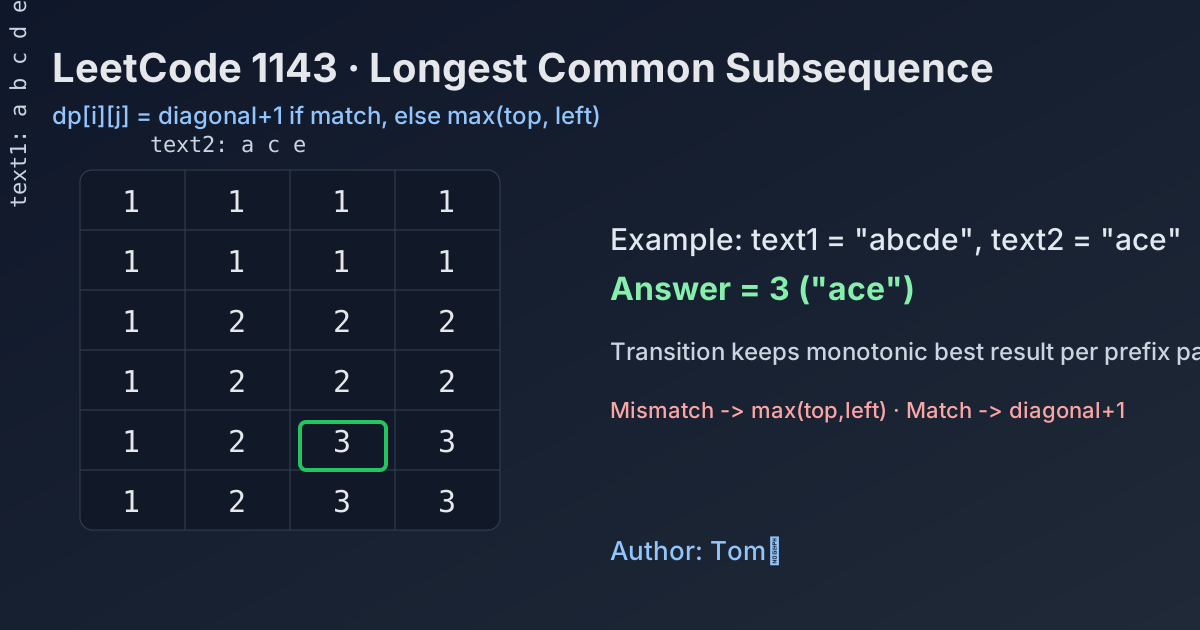
Define dp[i][j] as the LCS length between text1[0..i-1] and text2[0..j-1]. If current chars match, extend diagonal; otherwise keep the better value from top/left.
Optimal Algorithm (Step-by-Step)
1) Create a (m+1) x (n+1) DP table initialized to 0.
2) Iterate i=1..m and j=1..n.
3) If text1[i-1] == text2[j-1], set dp[i][j] = dp[i-1][j-1] + 1.
4) Else set dp[i][j] = max(dp[i-1][j], dp[i][j-1]).
5) Answer is dp[m][n].
Complexity Analysis
Time: O(mn).
Space: O(mn).
Common Pitfalls
- Mixing 0-based string index with 1-based DP index.
- Forgetting base row/column as 0.
- Using diagonal update when chars do not match.
Reference Implementations (Java / Go / C++ / Python / JavaScript)
class Solution {
    public int longestCommonSubsequence(String text1, String text2) {
        int m = text1.length(), n = text2.length();
        int[][] dp = new int[m + 1][n + 1];

        for (int i = 1; i <= m; i++) {
            for (int j = 1; j <= n; j++) {
                if (text1.charAt(i - 1) == text2.charAt(j - 1)) {
                    dp[i][j] = dp[i - 1][j - 1] + 1;
                } else {
                    dp[i][j] = Math.max(dp[i - 1][j], dp[i][j - 1]);
                }
            }
        }
        return dp[m][n];
    }
}
func longestCommonSubsequence(text1 string, text2 string) int {
m, n := len(text1), len(text2)
dp := make([][]int, m+1)
for i := range dp {
dp[i] = make([]int, n+1)
}
for i := 1; i <= m; i++ {
for j := 1; j <= n; j++ {
if text1[i-1] == text2[j-1] {
dp[i][j] = dp[i-1][j-1] + 1
} else if dp[i-1][j] > dp[i][j-1] {
dp[i][j] = dp[i-1][j]
} else {
dp[i][j] = dp[i][j-1]
}
}
}
return dp[m][n]
}class Solution {
public:
int longestCommonSubsequence(string text1, string text2) {
int m = (int)text1.size(), n = (int)text2.size();
vector<vector<int>> dp(m + 1, vector<int>(n + 1, 0));
for (int i = 1; i <= m; ++i) {
for (int j = 1; j <= n; ++j) {
if (text1[i - 1] == text2[j - 1]) {
dp[i][j] = dp[i - 1][j - 1] + 1;
} else {
dp[i][j] = max(dp[i - 1][j], dp[i][j - 1]);
}
}
}
return dp[m][n];
}
};class Solution:
def longestCommonSubsequence(self, text1: str, text2: str) -> int:
m, n = len(text1), len(text2)
dp = [[0] * (n + 1) for _ in range(m + 1)]
for i in range(1, m + 1):
for j in range(1, n + 1):
if text1[i - 1] == text2[j - 1]:
dp[i][j] = dp[i - 1][j - 1] + 1
else:
dp[i][j] = max(dp[i - 1][j], dp[i][j - 1])
return dp[m][n]var longestCommonSubsequence = function(text1, text2) {
const m = text1.length, n = text2.length;
const dp = Array.from({ length: m + 1 }, () => Array(n + 1).fill(0));
for (let i = 1; i <= m; i++) {
for (let j = 1; j <= n; j++) {
if (text1[i - 1] === text2[j - 1]) {
dp[i][j] = dp[i - 1][j - 1] + 1;
} else {
dp[i][j] = Math.max(dp[i - 1][j], dp[i][j - 1]);
}
}
}
return dp[m][n];
};中文
题目概述
给定两个字符串 text1 和 text2,返回它们最长公共子序列(LCS)的长度。
核心思路
定义 dp[i][j] 表示 text1 前 i 个字符与 text2 前 j 个字符的 LCS 长度。若当前字符相等,取左上角 +1;否则取上方和左方的较大值。
最优算法(步骤)
1)创建 (m+1) x (n+1) 的 DP 表,初始为 0。
2)双层循环遍历 i=1..m、j=1..n。
3)若 text1[i-1] == text2[j-1],则 dp[i][j] = dp[i-1][j-1] + 1。
4)否则 dp[i][j] = max(dp[i-1][j], dp[i][j-1])。
5)最终答案是 dp[m][n]。
复杂度分析
时间复杂度:O(mn)。
空间复杂度:O(mn)。
常见陷阱
- 字符串下标与 DP 下标错位(0-based vs 1-based)。
- 忘记初始化第 0 行和第 0 列为 0。
- 字符不相等时错误使用左上角转移。
多语言参考实现(Java / Go / C++ / Python / JavaScript)
class Solution {
    public int longestCommonSubsequence(String text1, String text2) {
        int m = text1.length(), n = text2.length();
        int[][] dp = new int[m + 1][n + 1];

        for (int i = 1; i <= m; i++) {
            for (int j = 1; j <= n; j++) {
                if (text1.charAt(i - 1) == text2.charAt(j - 1)) {
                    dp[i][j] = dp[i - 1][j - 1] + 1;
                } else {
                    dp[i][j] = Math.max(dp[i - 1][j], dp[i][j - 1]);
                }
            }
        }
        return dp[m][n];
    }
}
func longestCommonSubsequence(text1 string, text2 string) int {
m, n := len(text1), len(text2)
dp := make([][]int, m+1)
for i := range dp {
dp[i] = make([]int, n+1)
}
for i := 1; i <= m; i++ {
for j := 1; j <= n; j++ {
if text1[i-1] == text2[j-1] {
dp[i][j] = dp[i-1][j-1] + 1
} else if dp[i-1][j] > dp[i][j-1] {
dp[i][j] = dp[i-1][j]
} else {
dp[i][j] = dp[i][j-1]
}
}
}
return dp[m][n]
}class Solution {
public:
int longestCommonSubsequence(string text1, string text2) {
int m = (int)text1.size(), n = (int)text2.size();
vector<vector<int>> dp(m + 1, vector<int>(n + 1, 0));
for (int i = 1; i <= m; ++i) {
for (int j = 1; j <= n; ++j) {
if (text1[i - 1] == text2[j - 1]) {
dp[i][j] = dp[i - 1][j - 1] + 1;
} else {
dp[i][j] = max(dp[i - 1][j], dp[i][j - 1]);
}
}
}
return dp[m][n];
}
};class Solution:
def longestCommonSubsequence(self, text1: str, text2: str) -> int:
m, n = len(text1), len(text2)
dp = [[0] * (n + 1) for _ in range(m + 1)]
for i in range(1, m + 1):
for j in range(1, n + 1):
if text1[i - 1] == text2[j - 1]:
dp[i][j] = dp[i - 1][j - 1] + 1
else:
dp[i][j] = max(dp[i - 1][j], dp[i][j - 1])
return dp[m][n]var longestCommonSubsequence = function(text1, text2) {
const m = text1.length, n = text2.length;
const dp = Array.from({ length: m + 1 }, () => Array(n + 1).fill(0));
for (let i = 1; i <= m; i++) {
for (let j = 1; j <= n; j++) {
if (text1[i - 1] === text2[j - 1]) {
dp[i][j] = dp[i - 1][j - 1] + 1;
} else {
dp[i][j] = Math.max(dp[i - 1][j], dp[i][j - 1]);
}
}
}
return dp[m][n];
};
Comments