LeetCode 1021: Remove Outermost Parentheses (Primitive Decomposition + Nesting Depth)
LeetCode 1021StringStackToday we solve LeetCode 1021 - Remove Outermost Parentheses.
Source: https://leetcode.com/problems/remove-outermost-parentheses/
English
Problem Summary
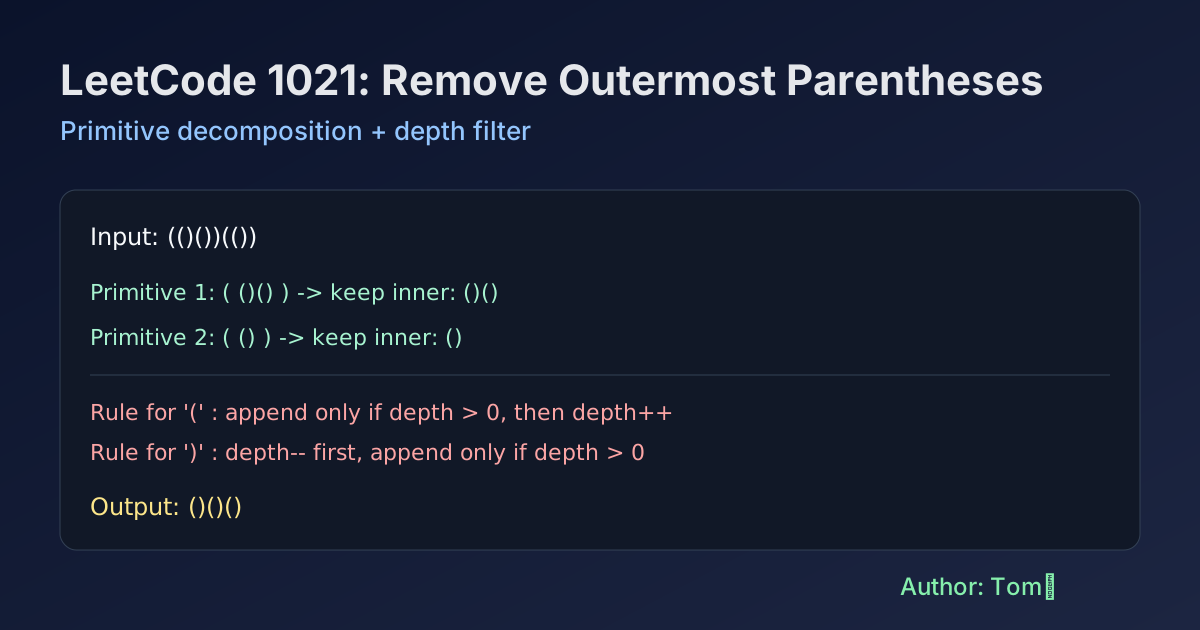
A valid parentheses string can be split into primitive valid groups. For each primitive group, remove its outermost pair, then concatenate results.
Key Insight
Track current nesting depth. Keep a '(' only if depth is already > 0 before adding it; keep a ')' only if depth stays > 0 after removing it. This precisely discards each primitive's outer shell.
Brute Force and Limitations
One brute-force approach is to explicitly parse primitives and slice each substring's first/last character. It works but needs extra substring bookkeeping and repeated boundary handling.
Optimal Algorithm Steps
1) Initialize depth = 0 and empty builder.
2) For each char c:
• If c == '(': if depth > 0, append it; then depth++.
• If c == ')': depth--; if depth > 0, append it.
3) Return builder string.
Complexity Analysis
Let n be string length.
Time: O(n).
Space: O(n) for output (auxiliary O(1)).
Common Pitfalls
- Updating depth in wrong order causes keeping/removing wrong brackets.
- Using stack unnecessarily when an integer depth is enough.
- Forgetting that input is guaranteed valid, overcomplicating error cases.
Reference Implementations (Java / Go / C++ / Python / JavaScript)
class Solution {
    public String removeOuterParentheses(String s) {
        StringBuilder sb = new StringBuilder();
        int depth = 0;

        for (char c : s.toCharArray()) {
            if (c == '(') {
                if (depth > 0) sb.append(c);
                depth++;
            } else {
                depth--;
                if (depth > 0) sb.append(c);
            }
        }
        return sb.toString();
    }
}
func removeOuterParentheses(s string) string {
depth := 0
out := make([]rune, 0, len(s))
for _, ch := range s {
if ch == '(' {
if depth > 0 {
out = append(out, ch)
}
depth++
} else {
depth--
if depth > 0 {
out = append(out, ch)
}
}
}
return string(out)
}class Solution {
public:
string removeOuterParentheses(string s) {
string ans;
ans.reserve(s.size());
int depth = 0;
for (char c : s) {
if (c == '(') {
if (depth > 0) ans.push_back(c);
depth++;
} else {
depth--;
if (depth > 0) ans.push_back(c);
}
}
return ans;
}
};class Solution:
def removeOuterParentheses(self, s: str) -> str:
depth = 0
out = []
for ch in s:
if ch == '(':
if depth > 0:
out.append(ch)
depth += 1
else:
depth -= 1
if depth > 0:
out.append(ch)
return ''.join(out)var removeOuterParentheses = function(s) {
let depth = 0;
const out = [];
for (const ch of s) {
if (ch === '(') {
if (depth > 0) out.push(ch);
depth++;
} else {
depth--;
if (depth > 0) out.push(ch);
}
}
return out.join('');
};中文
题目概述
一个合法括号串可以拆成若干个 primitive(原语)合法串。对每个 primitive 去掉最外层括号后,再把结果拼接起来。
核心思路
用 depth 记录当前嵌套层数:
遇到 '(' 时,只有在进入前 depth > 0 才保留;
遇到 ')' 时,先 depth--,只有在减少后 depth > 0 才保留。
这样恰好过滤掉每个 primitive 的外层括号。
暴力解法与不足
也可以先显式切分每个 primitive,再对子串做 substring(1, len-1)。但实现会引入额外边界处理与子串管理,写起来更重。
最优算法步骤
1)初始化 depth = 0 与结果构造器。
2)遍历字符:
• 若是 '(':若 depth > 0 先加入结果,再 depth++。
• 若是 ')':先 depth--,若 depth > 0 再加入结果。
3)返回结果字符串。
复杂度分析
设字符串长度为 n。
时间复杂度:O(n)。
空间复杂度:O(n)(输出所需,额外辅助 O(1))。
常见陷阱
- depth 的增减顺序写反,导致多删或少删。
- 过度使用栈,实际只需整数计数器。
- 忘记题目保证输入合法,写了不必要的异常分支。
多语言参考实现(Java / Go / C++ / Python / JavaScript)
class Solution {
    public String removeOuterParentheses(String s) {
        StringBuilder sb = new StringBuilder();
        int depth = 0;

        for (char c : s.toCharArray()) {
            if (c == '(') {
                if (depth > 0) sb.append(c);
                depth++;
            } else {
                depth--;
                if (depth > 0) sb.append(c);
            }
        }
        return sb.toString();
    }
}
func removeOuterParentheses(s string) string {
depth := 0
out := make([]rune, 0, len(s))
for _, ch := range s {
if ch == '(' {
if depth > 0 {
out = append(out, ch)
}
depth++
} else {
depth--
if depth > 0 {
out = append(out, ch)
}
}
}
return string(out)
}class Solution {
public:
string removeOuterParentheses(string s) {
string ans;
ans.reserve(s.size());
int depth = 0;
for (char c : s) {
if (c == '(') {
if (depth > 0) ans.push_back(c);
depth++;
} else {
depth--;
if (depth > 0) ans.push_back(c);
}
}
return ans;
}
};class Solution:
def removeOuterParentheses(self, s: str) -> str:
depth = 0
out = []
for ch in s:
if ch == '(':
if depth > 0:
out.append(ch)
depth += 1
else:
depth -= 1
if depth > 0:
out.append(ch)
return ''.join(out)var removeOuterParentheses = function(s) {
let depth = 0;
const out = [];
for (const ch of s) {
if (ch === '(') {
if (depth > 0) out.push(ch);
depth++;
} else {
depth--;
if (depth > 0) out.push(ch);
}
}
return out.join('');
};
Comments